
Your website is often the first place a potential client decides whether to call you or move on. For Arizona attorneys and accountants, that decision happens fast, and weak website copy accelerates it in the wrong direction. Legal content writing for websites is not just about sounding professional. It is about earning trust, satisfying search engines, and staying compliant with state advertising rules, all at the same time. This guide walks you through exactly how to do that, from ethical requirements to execution to performance.
Table of Contents
- Understand the legal and ethical requirements for your website content
- Prepare your content strategy centered around client questions and buying stages
- Execute legal content writing with precision, clarity, and SEO best practices
- Verify accuracy and compliance, including procedures when using AI-generated content
- Optimize user experience and performance to boost discoverability and client engagement
- Why compliance and client empathy must drive your legal content strategy
- Enhance your legal website with expert design and hosting solutions
- Frequently asked questions
Key Takeaways
| Point | Details |
|---|---|
| Compliance is mandatory | Legal website content must follow Arizona attorney advertising rules to avoid misleading clients and sanctions. |
| Client-focused strategy | Use a client-centric content strategy that addresses real questions at every stage of the client journey. |
| Structured, clear writing | Write in clear language with structured formatting for readability, trust, and SEO performance. |
| Review AI content carefully | All AI-generated legal marketing content requires licensed attorney review before publication. |
| Optimize technical performance | Fast, stable websites that load key content first boost user trust and search rankings effectively. |
Understand the legal and ethical requirements for your website content
Before you write a single sentence, you need to know what you are and are not allowed to say. Arizona follows the American Bar Association's Model Rules of Professional Conduct, and those rules extend to every page of your website. Your homepage, your bio, your blog posts, your landing pages. All of it counts as attorney advertising.
Legal content on law-firm websites must comply with lawyer advertising ethics rules and include jurisdiction-specific disclaimers. That means if you feature a case result, you need a disclaimer clarifying that past results do not guarantee future outcomes. If you display awards or peer recognitions, you need to explain the criteria used to grant them.
Here is what compliance requires at a minimum:
- Results disclaimers on any page referencing settlements, verdicts, or outcomes
- Testimonial disclosures noting that client experiences may vary
- Jurisdictional notices stating where you are licensed to practice
- Accurate credentials with no implied specialization unless you are board-certified in Arizona
- Clear identification that the content is attorney advertising where required
Accountants and CPAs face similar standards. Misrepresenting your credentials or implying guaranteed financial outcomes can trigger disciplinary action from the Arizona State Board of Accountancy.
Pro Tip: Build a simple compliance checklist and run every new page through it before publishing. Include items like "results disclaimer present," "credentials accurate," and "no misleading outcome language." It takes five minutes and protects your license.
One area many professionals overlook is the website add-ons they install over time. Chat widgets, review aggregators, and third-party testimonial plugins can pull in content you did not write and did not approve. That content still falls under your advertising obligations.
Prepare your content strategy centered around client questions and buying stages
Most legal and accounting websites fail not because the writing is bad, but because the strategy behind it is missing. Visitors arrive at different stages of their decision process, and content that only speaks to one stage loses everyone else.
Build pillar pages and supportive blog content mapped to awareness, consideration, and decision stages to capture clients early and convert effectively. This is called the hub-and-spoke model, and it works well for professional service websites because clients tend to research extensively before picking up the phone.
Here is how the three stages break down in practice:
| Buying stage | Client mindset | Content type | Example topic |
|---|---|---|---|
| Awareness | "I have a problem, what is it?" | Educational blog posts | "What happens if you miss an IRS deadline?" |
| Consideration | "What are my options?" | Comparison guides, FAQs | "Chapter 7 vs. Chapter 13 bankruptcy in Arizona" |
| Decision | "Which firm should I hire?" | Attorney bios, case studies, testimonials | "Why Phoenix families choose our estate planning team" |
To build this structure effectively, follow these steps:
- List the 10 most common questions your clients ask during consultations.
- Sort each question into one of the three buying stages above.
- Write a pillar page that covers a broad topic thoroughly (for example, "Arizona DUI defense").
- Create individual blog posts that address specific sub-questions and link back to the pillar page.
- Add FAQs at the bottom of key pages to capture voice search and AI-driven search features.
Websites are vital precisely because this content infrastructure does not exist anywhere else you control. Social media algorithms change. Directory listings limit your message. Your website is the one place where you own the full client journey.
Pro Tip: When writing FAQs, phrase the question exactly how a client would say it out loud. "How much does a divorce cost in Arizona?" converts better than "Divorce fee structure in Maricopa County." Google's AI Overviews pull directly from naturally phrased Q&A content.
For guidance on building effective legal blogs that serve this strategy, the investment in professional content pays for itself in qualified leads.
Execute legal content writing with precision, clarity, and SEO best practices
Now you have a strategy. Here is how to actually write the content well.

High-quality legal content combines legal expertise with simple language, structured formatting, and proof of experience to engage clients and rank on search engines. The biggest mistake attorneys and accountants make is writing for other professionals instead of writing for clients. Your website visitor does not know what "tortious interference" means. They know they have a business dispute and they need help.
Follow this process for every page you write:
- Start with the client's problem, not your credentials. "If you are facing a wage garnishment in Arizona, here is what you need to know" outperforms "Our firm has 20 years of experience in debt collection defense."
- Use plain language throughout. Replace "pursuant to" with "under." Replace "hereinafter" with "from here on." Replace "indemnification" with "protection from liability."
- Break content into scannable sections. Use H2 and H3 headings, short paragraphs of two to three sentences, and bullet points for lists of three or more items.
- Include one concrete example or case insight per major section. You do not need to name clients. "In a recent Arizona estate dispute, our team helped a family avoid probate by..." builds credibility without violating confidentiality.
- Place your target keyword in the page title, first paragraph, one subheading, and the meta description. That is enough. Forcing it into every paragraph hurts readability and search rankings.
| Content element | Best practice | Common mistake |
|---|---|---|
| Page title | Include primary keyword naturally | Keyword stuffing or vague titles |
| Introduction | Lead with client's problem | Starting with firm history |
| Body headings | Use client-language questions | Using legal jargon as headings |
| Calls to action | Specific and low-friction ("Schedule a free call") | Generic ("Contact us") |
| Disclaimers | Visible and plain-language | Buried in footers in small text |
The website features that support this content matter just as much as the writing itself. A well-structured page template makes it easier to apply these formatting rules consistently across every practice area or service page.
Pro Tip: For SEO for legal content, Google's local algorithm heavily weights geographic relevance. Mention Arizona cities, counties, and courts naturally in your content where accurate. "Maricopa County Superior Court," "Arizona Revised Statutes," and "Phoenix metro area" all signal local relevance without feeling forced.
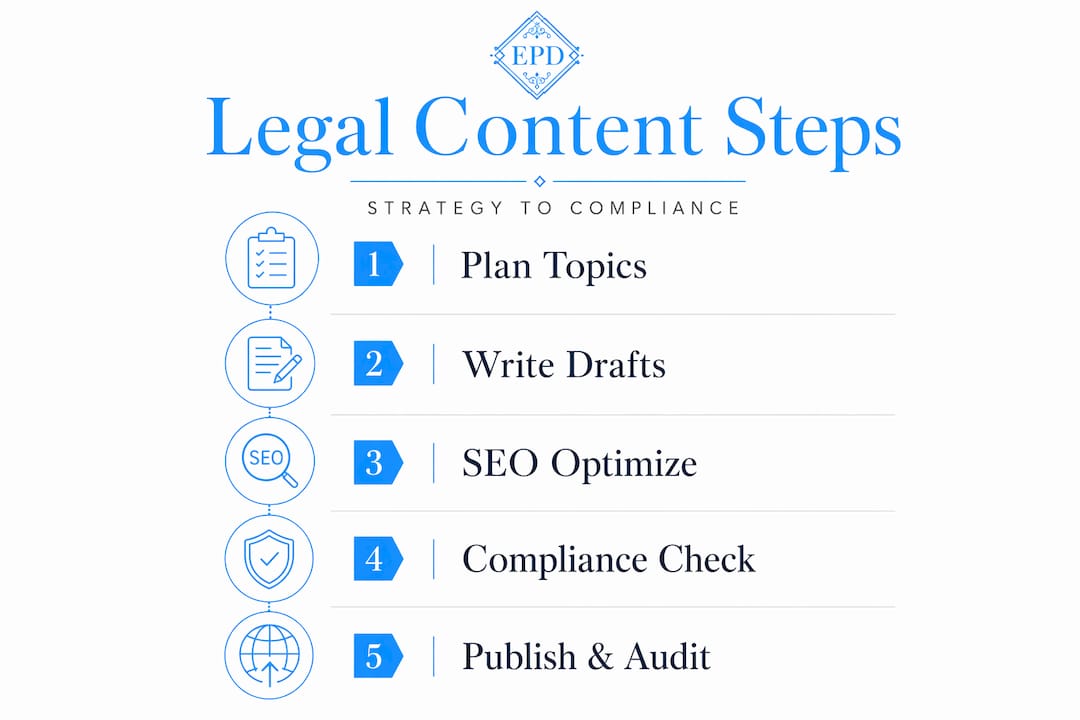
Verify accuracy and compliance, including procedures when using AI-generated content
AI writing tools can speed up content production significantly. Many Arizona attorneys and accountants are already using them. But speed without oversight is a liability.
Lawyers remain responsible for all website content accuracy and compliance. AI-generated material must be reviewed and verified by licensed attorneys before publishing. This is not optional, and it is not just about ethics. Inaccurate legal information published on your website can mislead prospective clients and expose you to malpractice concerns before they even become clients.
Build a documented review process that includes:
- Attorney sign-off on every page before it goes live, whether written by staff, a vendor, or an AI tool
- Statute verification by checking every legal claim against current Arizona statutes and recent case law
- Quarterly audits of existing content to catch outdated information, especially after legislative sessions or significant court rulings
- Version logs that record who approved what content and when, in case of a bar complaint or client dispute
"The ethical obligation to supervise applies to content just as it does to junior associates. If your name is on the website, you are responsible for what it says."
This is especially relevant for accountants publishing tax guidance. Tax law changes annually. Content that was accurate in 2024 may be misleading in 2026. A page that still references old contribution limits or expired deductions is not just unhelpful. It is a trust problem.
The website compliance FAQ covers common questions about keeping your site current and accurate.
Pro Tip: Create a content calendar that ties your audit schedule to known regulatory events. For Arizona attorneys, schedule a review after each Arizona Supreme Court rules update. For CPAs, schedule one after each tax season ends.
Optimize user experience and performance to boost discoverability and client engagement
You can write the best legal content in Arizona and still lose clients if your site loads slowly or looks broken on a phone. Technical performance is not separate from content strategy. It is part of it.
Improving Core Web Vitals like loading speed and visual stability is a win-win for law firm websites, improving both user experience and SEO. Google uses these signals as ranking factors, and users make trust judgments based on them. A slow or visually unstable site signals disorganization, which is the last impression a law firm or accounting practice wants to make.
Practical steps to improve performance and engagement:
- Prioritize above-the-fold content so the most important information loads first, even on slower connections
- Place your primary call to action (phone number, contact form, or scheduling link) within the first screen view on every key page
- Ensure mobile responsiveness because more than half of legal searches now happen on mobile devices
- Check accessibility by using sufficient color contrast, alt text on images, and keyboard-navigable menus to comply with ADA guidelines and reach more users
- Compress images without sacrificing quality to reduce page load time without affecting the visual presentation of your firm
Web design that integrates these performance factors from the start is far more effective than retrofitting them onto a site built without them in mind.
Pro Tip: Use Google's free PageSpeed Insights tool to test your site. Focus first on fixing "Largest Contentful Paint" issues, which measure how quickly your main content loads. A score above 90 on mobile is achievable for most professional service sites with the right hosting and image optimization.
Why compliance and client empathy must drive your legal content strategy
Here is something most content guides will not tell you: the firms that produce the best-performing legal websites are not the ones obsessing over keyword density. They are the ones that write like they actually care about the person reading.
Legal content writing is often a prospective client's first impression, and success depends on balancing authority with approachability and trust. We have seen this play out repeatedly with professional service websites. The attorney who writes a plain-language explanation of what to expect at a first consultation gets more calls than the one who lists credentials. The CPA who publishes a straightforward guide to Arizona small business tax deadlines builds more trust than the one with a polished homepage that says nothing specific.
Compliance is non-negotiable. But compliance alone produces sterile, defensive content that no one wants to read. The attorneys and accountants who win online are the ones who treat their website as a client service tool, not a legal liability shield.
The importance of professional content writing is not just about quality. It is about recognizing that your website is doing sales work 24 hours a day. Every page either builds confidence or erodes it. Empathy, specificity, and genuine usefulness are what separate the sites that convert from the ones that just exist.
Write for the person at 11pm who just got served with divorce papers and does not know what to do next. Write for the small business owner who got an IRS notice and is panicking. That is your audience. Compliance keeps you out of trouble. Empathy gets you hired.
Enhance your legal website with expert design and hosting solutions
If this guide has made one thing clear, it is that great law website content requires more than good writing. It requires a site built to support it.

At EPD Websites, we have been building professional websites for Arizona attorneys, CPAs, and other white-collar service providers since 2009. Our website features are designed with compliance, performance, and client engagement in mind from day one. We handle the technical side so you can focus on the legal side. From fast, secure hosting to content update support through our website updates service, we keep your site accurate, current, and performing at its best. Have questions before you start? Our web design FAQ covers the most common concerns from professional service providers just like you.
Frequently asked questions
Do Arizona legal websites need disclaimers to comply with advertising rules?
Yes, Arizona legal websites must include disclaimers such as results disclaimers and jurisdictional notices to comply with attorney advertising rules. Jurisdiction-specific disclaimers are required to avoid misleading prospective clients about outcomes or the scope of your practice.
Can I use AI to write legal content for my website?
Yes, but AI-generated content must go through thorough attorney review before publishing. Lawyers remain responsible for all website content accuracy and compliance regardless of how it was produced.
What type of legal content best attracts clients at different stages of their decision process?
Content should match where the client is in their journey. Effective content targets awareness, consideration, and decision stages with educational posts, comparison guides, and conversion-focused pages respectively.
How can I improve my legal website's search engine ranking and user trust?
Focus on site speed, mobile responsiveness, and clear content structure. Improving Core Web Vitals directly improves both search rankings and the trust users place in your site when they land on it.