
If you're starting from zero, BrightLocal is the best all-around pick for most local businesses, since it packs rank tracking, GBP audits, citation management, and review monitoring into one dashboard. For specialized needs, add from a short list: Local Falcon for geo-grid rank tracking, Whitespark for citation cleanup, Moz Local for hands-off listing sync, and Semrush if you already use it for broader SEO and want AI-assisted Google Business Profile management.
Before buying anything, claim and verify your Google Business Profile and connect it to GA4. Run a free GBP audit first; it usually surfaces missing categories, outdated hours, or duplicate listings you didn't know existed. Industry roundups consistently pair native Google products with a specialist platform as the baseline local SEO toolkit, and that combination costs nothing to start.
Budget expectations vary widely:
- Free tier: Google Business Profile, GA4, and basic citation checks
- Entry-level paid: $29 to $50 per month for single-location rank tracking and review management
- Mid-tier platforms: $99 to $400 per month for multi-location dashboards and white-label reporting
- Enterprise/agency: custom pricing tied to location count and API access
Key Takeaways
The most effective local SEO stack pairs one all-in-one platform with a purpose-built geo-grid tracker, all resting on a technically sound, professionally built website.
| Point | Details |
|---|---|
| Start with BrightLocal or the free tier | Use BrightLocal for a consolidated dashboard, or Google Business Profile plus GA4 if you're not ready to pay. |
| Add geo-grid tracking for spread-out service areas | Local Falcon reveals rank differences across a metro area that a single average rank hides. |
| Fix citations before chasing rankings | Clean, consistent listings through Whitespark or Moz Local prevent wasted effort on rank tracking later. |
| Tie rank data to real conversions | Pair rank reports with GA4 or call tracking so you're not optimizing for movement that doesn't produce leads. |
| Consider a managed build for compliance-heavy practices | Epdwebsites pairs professional web design and hosting with the schema and speed foundations local SEO tools depend on. |
Table of Contents
- 1. BrightLocal
- 2. Semrush Local
- 3. Moz Local
- 4. Whitespark
- 5. Local Falcon
- 6. Google Business Profile
- 7. Ahrefs
- How to Choose the Right Local SEO Tools for Your Business
- Understanding the Categories Behind Local SEO Software
- What Professional-Service Websites Need From Their SEO Stack
- Tracking and Optimizing Local Backlinks
- What the Data Actually Says About Tool Stacks
- A Managed Alternative for Busy Professionals
- Sources
1. BrightLocal
BrightLocal earns its spot at the top because it does not force you to stitch together five separate subscriptions. The platform bundles rank tracking, citation building, GBP auditing, and review monitoring, and it has built a reputation specifically around local search workflows rather than general SEO.
- Standout feature: AI-generated insights that flag GBP inconsistencies and site audit issues without manual digging
- Best for: Solo practitioners and small firms who want one login instead of five
- Pricing shape: Entry plans start in the affordable range, with tiers scaling by location count
- Next step: Run BrightLocal's free local SEO audit tool before committing to a paid plan
Reviewers on TrustRadius consistently point to time savings as the real payoff. Consolidating listings, reviews, and reporting into one place cuts the hours a business owner or office manager would otherwise spend logging into four different systems every week.
2. Semrush Local
Semrush's local features exist inside a much bigger SEO suite, which makes it the natural pick if you already use Semrush for keyword research or competitor tracking. The local module includes listing management, a geo heatmap rank tracker, review management, and an AI-powered GBP agent that automates posts and review replies.
- Standout feature: The AI agent that drafts and schedules GBP posts and review responses on your behalf
- Best for: Marketing teams already invested in Semrush for content and competitive research
- Pricing shape: Local add-ons layer onto existing Semrush subscription tiers
- Next step: Test the map rank tracker heatmap against your current GBP insights data
Semrush also matters for a reason most local SEO checklists skip: AI visibility. How ChatGPT, Google's AI Overviews, or Perplexity describe your business when someone asks "best dentist near me" is becoming its own optimization target, and platforms that help shape that narrative offer value that didn't exist three years ago.
3. Moz Local
Moz Local solves one problem extremely well: keeping your business information identical across dozens of directories without you touching each one individually. It auto-syncs listings and flags missing fields or inconsistencies the moment they appear.
- Standout feature: Automated listing distribution paired with ongoing monitoring for data drift
- Best for: Businesses that have moved, changed phone numbers, or rebranded and need to clean up scattered NAP data
- Pricing shape: Straightforward per-location monthly pricing, competitive with other listings-only tools
- Next step: Search your business name and check how many directories show outdated information
Moz Local isn't the tool you reach for when you want granular rank data. It's the tool you set up once and let run quietly in the background, catching the citation drift that erodes local rankings over months, not days.
4. Whitespark
Whitespark built its reputation on citations before "local SEO tool" was even a common phrase, and it still positions itself as the listings and citation specialist rather than an all-in-one platform. That focus shows in the depth of its citation database and its manual citation-building service.
- Standout feature: Human-assisted citation building, not just automated syncing
- Best for: Businesses in competitive niches where citation quality and niche-specific directories matter more than volume
- Pricing shape: Affordable rank tracker tier, with citation services priced separately per project
- Next step: Run a free citation audit to see where your listings are missing or inconsistent
Whitespark's rank tracker also includes visual grid reporting, which puts it in direct competition with Local Falcon for businesses that want to see how rankings shift block by block across a service area.
5. Local Falcon
Local Falcon pioneered geo-grid rank tracking, and nothing else on this list visualizes map ranking quite the way it does. It generates heatmaps and Share of Local Voice metrics that show exactly where you rank on Google Maps at dozens or hundreds of points across your service area, not just at your business address.
- Standout feature: Share of Local Voice, a metric that quantifies your map visibility relative to competitors across an entire grid
- Best for: Restaurants, clinics, and any business whose customers are spread across a metro area rather than clustered at one address
- Pricing shape: Pay-per-scan or subscription options, generally affordable for single-location testing
- Next step: Run a single geo-grid scan on your business name to see how rank varies just two miles from your storefront
Geo-grid tracking matters because a single "average rank" number hides enormous variation. A law firm might rank third citywide but drop to twelfth just across a highway, and that's exactly the kind of gap Local Falcon's API and MCP integrations let agencies monitor programmatically across dozens of client locations.
6. Google Business Profile
Google Business Profile isn't a paid tool, and that's precisely why it belongs on this list. It's the foundation every other platform on this page reads from and writes to, and no third-party tool can substitute for keeping it accurate.
- Standout feature: Direct control over the exact data Google displays in Maps and local search results
- Best for: Every local business, with no exception
- Pricing shape: Free
- Next step: Log in this week and check your categories, hours, and Q&A section for anything outdated
Treat GBP maintenance as ongoing work, not a setup task you finish once. Seasonal hours changes, new service areas, and review responses all need regular attention, and businesses that let their profile go stale for months tend to see the slowest recovery when they finally return to it.
7. Ahrefs
Ahrefs isn't built specifically for local search, but it earns a place in a local SEO stack because local keyword research and competitor backlink analysis still require general SEO horsepower. Industry roundups recommend it for keyword research, backlink analysis, and competitor insight that feed directly into local content strategy.
- Standout feature: Backlink and keyword gap analysis you can filter by geography and competitor domain
- Best for: Agencies and in-house marketers who need local content ideas grounded in real search volume, not guesswork
- Pricing shape: Mid-tier to premium monthly pricing, positioned above most local-only specialist tools
- Next step: Run a competitor gap analysis against the top three local competitors in your city
Ahrefs won't audit your GBP or generate a geo-grid heatmap. Pair it with a specialist tool from this list rather than expecting it to replace one.
How to Choose the Right Local SEO Tools for Your Business
The right stack depends less on which tool has the most features and more on matching capability to how you actually operate. A solo attorney and a five-location dental group need almost nothing in common.
Selection criteria that matter most:
- Scale: Single-location businesses need lighter reporting; multi-location chains need bulk management and API access
- Feature depth: Decide whether you need rank tracking, citation management, review monitoring, or all three before comparing price
- Reporting: Check whether the tool exports client-ready PDFs or dashboards if you're an agency reporting to clients
- Integrations: Confirm GBP sync, GA4 connection, and CRM or email platform compatibility before signing up
- Support: Look for documented response times, not just a contact form
Prioritize by business type:
A single-location owner should start with the free tier: Google Business Profile plus GA4, then add one paid rank tracker once traffic patterns are established. A small marketing team managing three to ten clients benefits most from an all-in-one platform like BrightLocal, since consolidated reporting saves hours every week, or you can get professional support from a trusted local marketing agency to handle it all. An agency managing dozens of locations needs API access and white-label reporting, which narrows the field to Semrush, BrightLocal's higher tiers, or Local Falcon's programmatic scanning.
During any 14 to 30 day trial, test these specifically:
- Whether GBP sync updates in real time or lags by days
- Whether exported reports are genuinely client-ready or need manual reformatting
- Whether the rank data matches what you see manually searching from your own location
- Whether API or Zapier-style integrations actually connect to your existing CRM
Pro Tip: Ask any vendor directly whether their GBP integration is read-only or two-way. A read-only sync means you're still logging into Google separately to make changes, which defeats half the point of paying for the platform.
Red flags to walk away from: no native GBP integration, rank reports that don't specify the exact location they were scanned from, and support teams that only respond within multi-day windows during a trial period.
Understanding the Categories Behind Local SEO Software
Every tool on the list above falls into one of five categories, and understanding the category matters more than memorizing product names, because most businesses eventually need at least three of them working together.
Rank and geo-grid tracking shows where you appear in search results and on the map, scanned from multiple points across a service area rather than one central address. This is mission-critical for any business competing across a spread-out metro area, and optional for a single-storefront business with no real competition nearby.
Listings and citation management keeps your name, address, and phone number consistent across directories. This is mission-critical for any business that has moved, rebranded, or expanded locations, since inconsistent data actively suppresses rankings.
Review and reputation management monitors and responds to reviews across Google, Yelp, and industry-specific platforms. Mission-critical for service businesses where trust drives the click.
Local SEO auditing identifies technical and on-page issues specific to local search, from missing schema markup to slow-loading location pages.
Analytics integration ties ranking movement to actual outcomes: calls, form submissions, and direction requests.
A practical workflow looks like this:
- Audit your GBP and site for gaps
- Clean up citations to fix inconsistent NAP data
- Set up review monitoring so new feedback doesn't go unanswered
- Layer in geo-grid tracking to measure whether the first three steps actually moved rankings
Skipping straight to rank tracking without fixing citations first is one of the more common mistakes we see; the tool will faithfully report a problem that citation cleanup could have prevented in the first place.
What Professional-Service Websites Need From Their SEO Stack
Law firms, CPA offices, and medical practices get the fastest lift from just two categories: GBP optimization and review management. Clients hiring a professional care more about trust signals than flashy content, and a steady stream of recent, positive reviews does more for conversion than almost anything else on this list.
Site architecture matters more here than most tool vendors admit. A geo-grid tracker can show you're ranking well, but if your site lacks LocalBusiness schema markup or your hosting causes slow load times, that ranking rarely converts into a booked consultation. Structured data and page speed are the mechanical layer that lets Google, and increasingly AI assistants, correctly parse who you are and where you practice.
Three practical stacks:
- Solo practitioner: Google Business Profile, GA4, one geo-grid scan monthly
- Small firm: BrightLocal or Whitespark for citations, plus review monitoring
- Multi-location or agency: Semrush or Local Falcon's API for programmatic tracking across offices
A well-built site with proper schema and reliable hosting is what lets these tools' data actually translate into new clients, a topic covered in more depth in this hiring guide for law firms and CPAs.
Tracking and Optimizing Local Backlinks
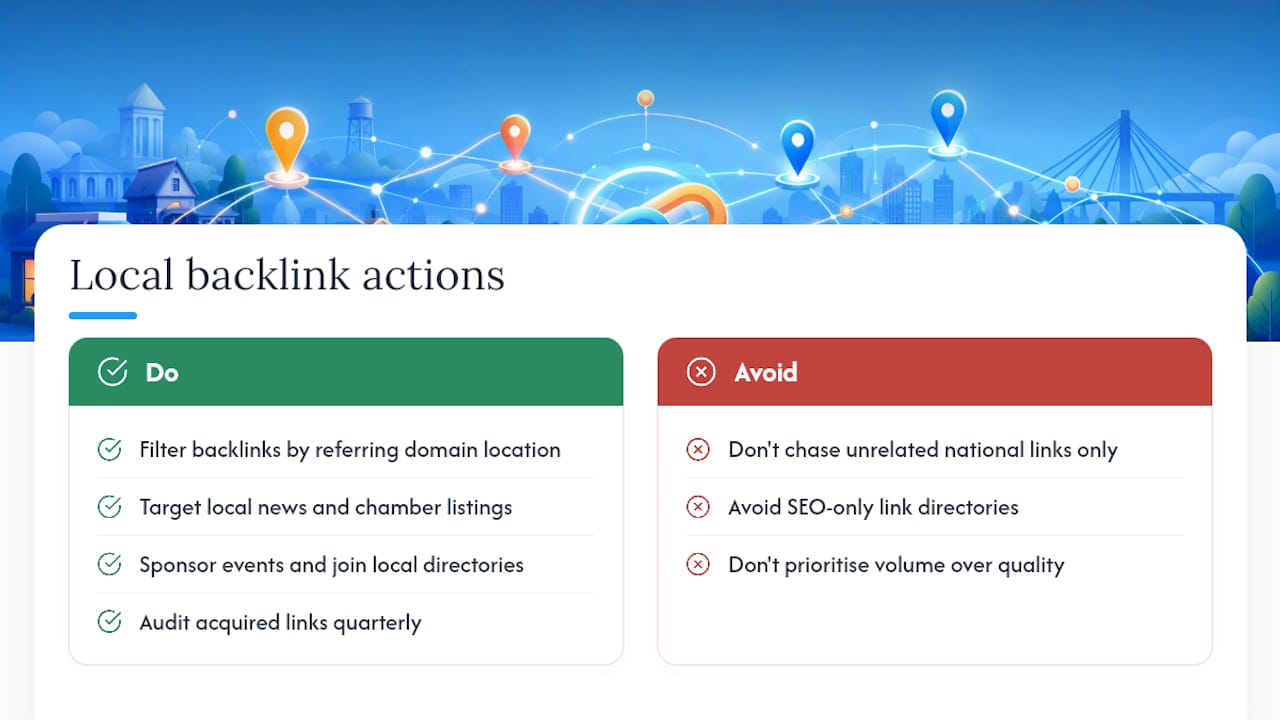
Local backlinks work differently than general SEO backlinks. A single link from your city's chamber of commerce or a local bar association directory often carries more local ranking weight than a generic high-authority link from an unrelated national site, because it signals geographic relevance Google can verify.
Tracking these links requires filtering backlink reports by geography, something Ahrefs handles well when you segment by referring domain location rather than raw domain authority. Look specifically for links from local news sites, chamber of commerce listings, industry associations with regional chapters, and sponsorship or event pages tied to your city.
Building them is slower than citation work but compounds over time. Sponsor a local event, get listed on a bar association or medical board directory, or contribute a quote to a local news story covering your industry. Each one adds a geographic signal that a purely national competitor can't easily replicate.
Avoid link directories that exist purely for SEO with no real audience; Google has gotten better at discounting these, and they rarely move rankings the way an editorial mention on a regional outlet does. Prioritize quality over volume, and check quarterly whether any acquired links have gone dead or been removed, since a disappeared local link is easy to miss without periodic auditing.
What the Data Actually Says About Tool Stacks
Conventional advice tells business owners to grab the tool with the most features and call it done. That's backwards. The research points somewhere else: the businesses getting the most value are the ones matching a lean stack to their actual size and workflow, not the ones buying the biggest platform available.
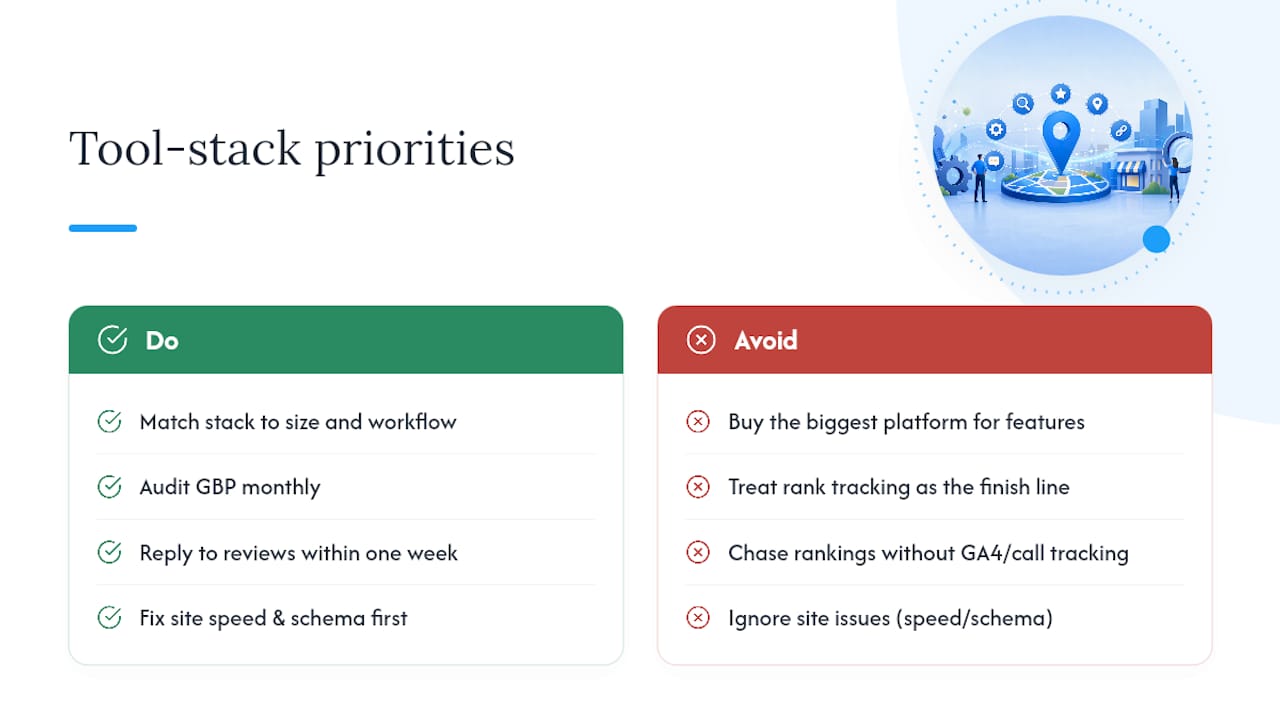
The overrated move is treating rank tracking as the finish line. A geo-grid heatmap showing improved visibility means nothing if it's not tied back to GA4 conversion data or call tracking. We've seen plenty of businesses chase rank position for months while ignoring whether those rankings produced a single phone call.
What actually deserves priority, especially for law firms, CPAs, and medical practices: a GBP that's audited monthly, a review response cadence that never lets feedback sit unanswered for a week, and a website architecture that doesn't undercut everything the tools report. No rank tracker fixes a site that loads slowly or lacks proper schema. Get the foundation right first, then let the tools measure whether it's working.
— Kate
A Managed Alternative for Busy Professionals
Buying tools works if you have the time to configure dashboards, interpret geo-grid data, and keep citations clean every month. Epdwebsites is the alternative for professionals who don't. Instead of stitching together three subscriptions and learning each one, you get a website built with the structured data, speed, and review integration these tools actually measure, managed for you from the start.

This matters most for compliance-heavy fields and multi-location practices where nobody has a spare afternoon to audit citations. Epdwebsites pairs premium web design and hosting with the technical groundwork, LocalBusiness schema, fast load times, and review widgets, that local SEO tools depend on to report results that mean something. If you'd rather have a partner handle the build than manage another dashboard, request a consult and see what a professionally built site changes about your local visibility.
Sources
- Local SEO tools for rankings, listings, & reviews | Semrush features
- 11 local SEO tools you should be using - Search Engine Land