
Chiropractors who lack an optimized local web presence are losing patients to nearby practices right now, often before those patients ever hear the clinic's name. Over 60% of local healthcare searches happen on mobile devices, driven by people in immediate pain looking for the closest available help. A Google Business Profile alone no longer covers it. In 2026, AI tools like ChatGPT and Google AI Overviews are fielding patient questions before a map result even loads, and they pull answers from practices with rich, credentialed, consistently maintained digital footprints.
Here is what a strong local web presence actually requires:
- A fully verified and regularly updated Google Business Profile
- Consistent name, address, and phone number across every online directory
- Condition-specific website pages that answer real patient questions
- A steady flow of detailed, recent patient reviews
- Local content that references your community, not just your services
- A mobile-friendly site that loads fast and makes booking frictionless
- Ongoing attention, because this is infrastructure, not a one-time project
Why chiropractors need local SEO to stay visible
Local SEO is the practice of shaping your digital presence so that patients searching for care near your clinic find you first. For chiropractors, this is not optional. Chiropractic care is inherently physical. A patient with acute lower back pain is not browsing nationally; they need someone within a short drive, and they need an appointment today.
The search results page reflects that urgency. Google's Map Pack, the three local listings that appear above organic results, captures nearly 70% of all local clicks. If your practice is not in those top three spots, the vast majority of searchers never see you. That is not a visibility problem you can solve with a better waiting room.
Local SEO also differs from general SEO in a specific, practical way. You are not competing for "back pain relief" globally. You are competing for "chiropractor in [your city]" or "sciatica treatment near me," and proximity is the dominant ranking signal. Localized keywords tied to your specific neighborhood and the conditions you treat are what move the needle.
"Local search is not a marketing project that gets done once. It is infrastructure that either works for your practice every day or quietly fails it." — RepuClinic, DCRank 2026
Key ranking factors that actually move your local search position
Getting into the Map Pack and staying there depends on a specific set of signals. These are not abstract best practices; they are the concrete inputs Google and AI search tools use to decide which practices to surface.
- Google Business Profile accuracy: Your name, address, phone number, business category, and hours must be exact and current. Profiles updated consistently outperform stagnant ones in both traditional and AI-driven search.
- NAP consistency across directories: Conflicting contact information across Yelp, Healthgrades, Apple Maps, and other directories signals unreliability to both Google and AI indexing tools. One mismatched phone number can quietly suppress your rankings.
- Specific, recent patient reviews: A review that mentions "Dr. Smith helped me recover after a car accident" carries more weight than "great office." AI tools treat review content as a signal, and treatment-specific mentions influence rankings more than generic praise.
- Condition-focused website content: Pages dedicated to sciatica, sports injuries, or whiplash give search engines and AI tools something concrete to cite. A homepage that says only "we offer chiropractic care" gives them nothing.
- Local authority signals: Mentions in local news, links from community organizations, and participation in neighborhood events tell search engines your practice is genuinely embedded in the area it serves.
Pro Tip: Send a review request via SMS within 24 hours of a patient's visit. Patients are most likely to leave detailed, specific feedback while the experience is still fresh, and that specificity is exactly what boosts your local search credibility.
How to improve your local search visibility step by step
Knowing the ranking factors is one thing. Putting them into practice is where most chiropractors either gain ground or fall behind. The good news: the operational ask is not enormous. It is consistent.
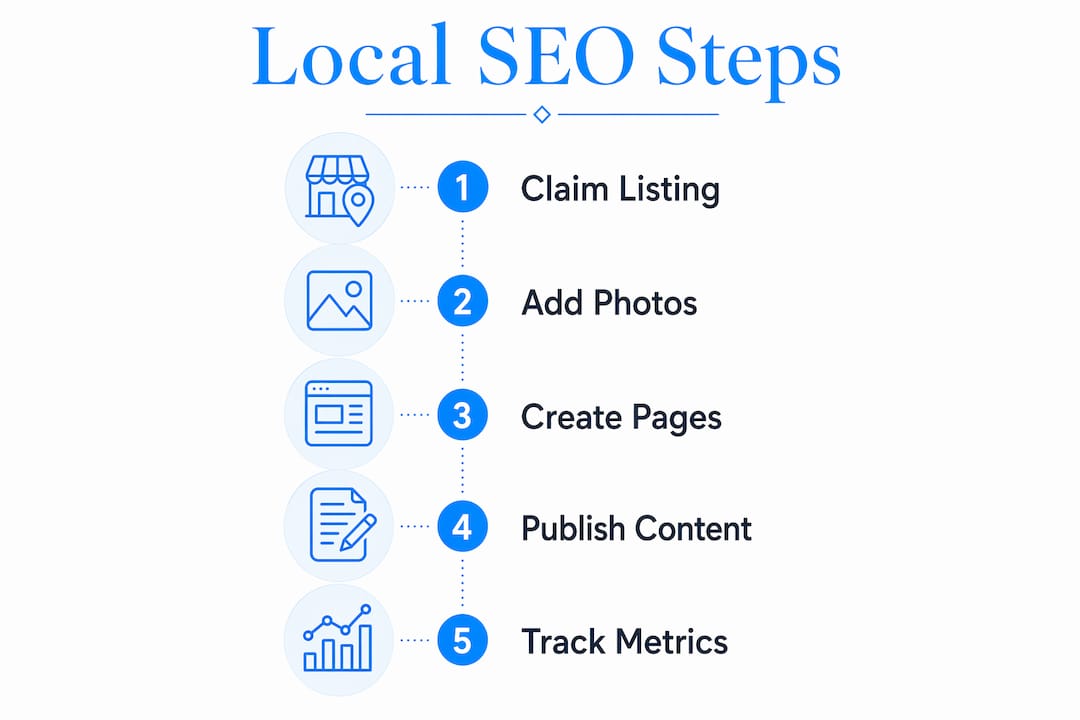
Claim and maintain your Google Business Profile. Verify your listing, fill in every field, add photos, and post updates regularly. Google rewards active profiles. Think of it as your clinic's digital front door; if it looks neglected, patients move on.
Build localized website pages. Create dedicated pages for the conditions you treat most, written in plain language that answers the questions patients actually type. Reference local landmarks and neighborhood names naturally. A page that mentions your clinic is "two blocks from Glendale Community College" does more for geographic relevance than a generic services list. Community references in web copy build both search trust and immediate patient rapport.

Publish credentialed, educational content. Blog posts explaining what causes sciatica, when to see a chiropractor for headaches, or how spinal adjustments work give AI-powered search platforms something to quote when patients ask conversational questions. Thin content gets ignored; detailed, accurate content gets cited.
Track what is working. Monitor your Google Business Profile insights, website traffic sources, and the search queries bringing patients to your site. If a condition-specific page starts driving appointment requests, that tells you exactly where to invest more content effort.
Pro Tip: Add online booking directly to your website and make sure the site loads quickly on mobile. A patient in pain who hits a slow, hard-to-navigate site will close the tab and call the next clinic on the list.
How a strong local presence helps you attract more patients
The direct line between local search visibility and new patient bookings is shorter than most chiropractors realize. When your practice appears in the Map Pack for "chiropractor near me," you are reaching someone who has already decided they need care. That is a fundamentally different kind of lead than someone who sees a billboard.

Visibility at that moment of intent converts. Patients searching for immediate relief are not comparison shopping the way someone buying a laptop might. They want proximity, availability, and enough trust signals to feel confident picking up the phone. Consistent reviews, accurate information, and a professional website deliver all three simultaneously.
Beyond first appointments, a strong local presence supports retention. Patients who find you through a well-maintained digital presence, read your educational content, and see you responding to reviews are more likely to return and refer others. Practices combining digital visibility with strong patient experience, including easy scheduling and clear communication, consistently outperform peers on both patient retention and financial metrics.
The practices that rely only on word-of-mouth or a basic directory listing are competing with one hand tied behind their back. Symptom-based searches like "sharp pain between shoulder blades" or "numbness in fingers after car accident" represent patients who do not yet know they need a chiropractor. A practice with condition-specific content captures those patients before competitors do.
What experts and emerging trends say about local SEO in 2026
The most significant shift in local patient discovery right now is the rise of AI-powered search. Patients are increasingly asking tools like ChatGPT and Perplexity questions such as "which chiropractor near me treats sports injuries" rather than typing keywords into Google. These tools pull from structured, credentialed digital content to generate answers, and a practice with thin website content or inconsistent directory information is largely invisible to that layer of discovery.
Understanding how AI platforms affect visibility for professional service providers is now a practical concern, not a future-proofing exercise. Practices that specifically prepare for AI-powered search are capturing patient inquiries that traditional SEO-only practices miss entirely.
"Practices that are building content around specific conditions, publishing credentialed information, and earning consistent patient reviews are the ones that AI search engines quote and recommend." — RepuClinic, DCRank 2026
Traditional map rankings are now the floor, not the ceiling. The chiropractors seeing the most durable new-patient growth are building genuine community connection through digital channels: educational content, active review management, and local partnerships that generate authentic mentions and backlinks. According to DCRank 2026, these practices are also seeing stronger patient growth with lower ad spend compared to those relying on paid traffic alone.
Mobile search dominates local healthcare queries, and that reality shapes every design and content decision. A site that is slow, hard to read on a phone, or missing a clear call to action is failing the majority of patients who find it. Speed and accessibility are not technical niceties; they are patient acquisition factors. Chiropractors who treat their web presence as ongoing infrastructure rather than a one-time setup are the ones consistently filling their schedules.
Key Takeaways
Chiropractors who combine accurate local listings, specific patient reviews, and condition-focused content are the practices that AI search tools cite and patients choose in 2026.
| Point | Details |
|---|---|
| Mobile search drives urgency | Over 60% of local healthcare searches happen on mobile, often from patients in immediate pain. |
| Map Pack dominance | The top three local listings earn nearly 70% of all clicks; falling outside them means most patients never see you. |
| Specific reviews outperform generic ones | Reviews mentioning treatments or outcomes carry more weight with both Google and AI search tools. |
| AI discovery requires rich content | AI tools like ChatGPT surface practices with structured, condition-specific, credentialed website content. |
| Epdwebsites builds the foundation | Epdwebsites designs professional, mobile-ready websites for chiropractors that support local SEO, fast loading, and patient trust from day one. |
Your practice deserves a website that works as hard as you do
Most chiropractors spend years building clinical expertise and then lose new patients to a competitor with a faster website and more Google reviews. That gap is a web presence problem, and it is fixable.

Epdwebsites has been building professional websites for medical practices, attorneys, and consultants since 2009. For chiropractors specifically, that means a site designed to load fast on mobile, present your credentials clearly, support local SEO from the ground up, and make booking as simple as possible for a patient who is already in pain. No generic templates, no long-term contracts, and no technical jargon to wade through. You get a site that looks like it belongs to a practice patients can trust, because it does.
See the web design features built for professional practices, or browse the completed portfolio to see what a practice-ready website actually looks like. When you are ready to stop losing patients to a weaker digital presence, Epdwebsites is the straightforward next step.