
Real estate agent SEO starts with owning your Google Business Profile and publishing targeted neighborhood pages. Fix those two things before touching anything else. Google Business Profile is the single most important local SEO asset an agent has, and a complete, active profile drives outsized visibility in the map pack. Neighborhood pages matter just as much because portals like Zillow and Realtor.com own the broad "homes for sale" searches, but they leave the hyperlocal, long-tail queries wide open for independent agents to win.
Do this now:
- Audit your Google Business Profile: category, service area, hours, photos, and posting activity.
- Publish or rewrite one neighborhood page with a market snapshot, not just a description.
- Set a baseline in Google Search Console so you can measure what changes.
Chasing keywords like "homes for sale in [city]" wastes months you don't have. Local content converts faster and ranks sooner.
Key Takeaways
Real estate agent SEO succeeds when agents prioritize Google Business Profile completeness, hyperlocal neighborhood content, and a disciplined IDX canonical strategy over chasing broad, portal-dominated keywords.
| Point | Details |
|---|---|
| Start with Google Business Profile | Complete every field, post weekly, and respond to reviews within days, not weeks. |
| Publish neighborhood pages first | One detailed guide with market data outperforms dozens of generic blog posts. |
| Noindex most IDX listings | Keep marketing surfaces like neighborhood pages and your agent profile as the primary indexed content. |
| Set a 3 to 12 month timeline | Technical fixes show results in weeks; content and authority-building take months to mature. |
| Hire out the technical build | Epdwebsites configures IDX, schema, and hosting together so the site launches ready to generate leads. |
Table of Contents
- What Should Real Estate Agents Prioritize in the First 90 Days?
- How Do You Optimize a Google Business Profile for Real Estate?
- What Content Actually Ranks for Real Estate Agents?
- How Should IDX Listings Be Indexed for SEO?
- Which Schema Markup Helps Real Estate Agent Websites Rank?
- What Should You Track to Know if Your SEO Is Working?
- How Long Does Real Estate SEO Take to Show Results?
- How Epdwebsites Handles Real Estate Agent SEO Implementation
- Build the Agent Website That Handles This for You
- Sources
What Should Real Estate Agents Prioritize in the First 90 Days?
Sequencing matters more than effort here. Doing five things in the wrong order stalls results; doing three things in the right order compounds them.
Days 0 to 30: Foundation.
- Claim and fully complete your Google Business Profile, then start requesting reviews from your last 10 closed clients.
- Fix technical basics: confirm SSL is active, add descriptive alt text to listing photos, and run a speed test on your homepage.
- Set up Google Search Console and Google Analytics 4 if you haven't already. You can't fix what you don't measure.
Days 30 to 90: Content that compounds. 4. Write one detailed neighborhood guide for your top target area. 5. Publish a first market report covering median price, inventory, and days on market. 6. Build internal links between your homepage, the neighborhood page, and the market report.
Day 90 and beyond: repeat the neighborhood/market-report cycle for your next two or three target areas, and start tracking which pages generate actual inquiries, not just traffic.
Pro Tip: Ask closed clients for reviews within 48 hours of closing, while the relief and gratitude are still fresh. Response rates drop fast after that window.
How Do You Optimize a Google Business Profile for Real Estate?
Your Google Business Profile is often the first thing a prospective client sees, before they ever land on your website. Treat it like a landing page, not a directory listing.
Start with your primary category. "Real Estate Agent" is usually correct, but check whether "Real Estate Agency" fits better if you operate under a team name. Add every relevant service (buyer representation, listing services, relocation, investment properties) so Google has more to match against search queries. Set your service area precisely. If you work three zip codes intensely rather than a whole metro thinly, say so. A tightly defined service area tends to outperform a sprawling one in local rankings.
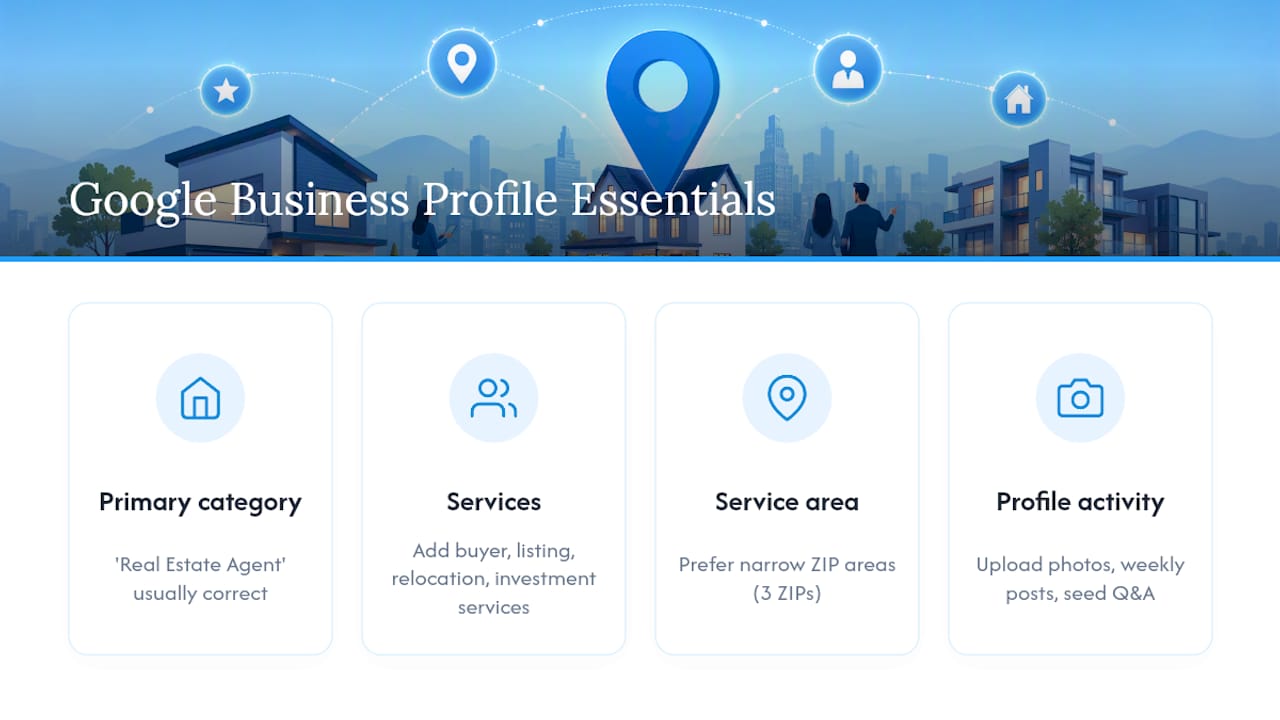
Photos and posts keep the profile active, which Google rewards. Upload new listing photos, headshots, and community shots regularly, and publish a weekly post, even something as simple as a new listing or a market update. Monitor the Q&A section too. If nobody's asked a question yet, seed it with the two or three questions clients actually ask you (commission structure, timeline, service area) and answer them yourself.
Reviews carry real weight in local rankings and in buyer decisions. Ask for them consistently, but never offer anything in exchange, that violates Google's policies and most state real estate advertising rules. Respond to every review, positive or negative, within a few days. A thoughtful response to a critical review often does more for credibility than five generic five-star ratings.
Consistency across citation sites matters too. Keep your name, address, and phone number identical across your GBP, your website footer, and major directories like Zillow, Realtor.com, Yelp, and the Better Business Bureau. A mismatched suite number or an old phone number on one directory can quietly undercut the trust signals you're building everywhere else.
Pro Tip: Screenshot your NAP details (name, address, phone) once, in one document, and use it as the copy-paste source every time you claim a new directory listing. Manual retyping is where inconsistencies creep in.
What Content Actually Ranks for Real Estate Agents?
Neighborhood pages and market reports are the highest-leverage content type available to agents, and they capture dozens of long-tail keyword variations that a generic "About Us" page never will, according to Fokal's real estate SEO guide. The reason is simple: nobody else is writing genuinely useful, locally specific content at the neighborhood level, so the competition is thin even in dense markets.
A strong neighborhood guide template includes:
- A short overview of the area's character and who tends to buy there.
- A market snapshot: median price, average days on market, current inventory.
- School information (with names, not just district scores).
- Commute times to major employment centers.
- Amenities: parks, walkability, dining, transit access.
Market reports work as a companion piece, published periodically, and serve as outreach material. Market reports containing original data tend to attract more backlinks and local press pickup than standard blog posts, as journalists and local sites cite original numbers.
FAQ sections on these pages should answer-first: state the answer in the first sentence, then explain. This format is what AI tools and featured snippets pull from, and it also respects a reader who's scanning on their phone between showings.
| Content Type | Update Cadence | Primary Ranking Value |
|---|---|---|
| Neighborhood guide | Refresh every 6 months | Long-tail, hyperlocal keyword capture |
| Market report | Monthly or quarterly | Backlinks, local press pickup |
| FAQ / answer-first sections | Refresh as questions evolve | Featured snippets, AI citations |
Link these pieces together deliberately. Your homepage should link to your top neighborhood pages, each neighborhood page should link to the relevant market report, and both should link back to your agent profile. That internal structure tells search engines which pages you consider most important.
How Should IDX Listings Be Indexed for SEO?
IDX and MLS feeds create a duplicate-content problem that trips up most agent websites, because hundreds of other sites are displaying the exact same listing data pulled from the same feed. ThatDevPro's real estate SEO framework recommends treating IDX listings as a noindex-by-default surface, with your neighborhood pages and agent profile as the primary indexable content instead.
The practical rules:
- Noindex the bulk of your IDX listing pages. They're useful for visitors, not for rankings.
- Selectively index a small number of showcase listings, ones with unique photography and original descriptions you've written yourself, rather than syndicated MLS copy.
- Use canonical tags correctly so search engines know which version of a page (if duplicated across feed and site) is the authoritative one.
- Submit a clean XML sitemap that excludes noindexed pages, so crawl budget goes toward pages that can actually rank.
On the performance side, follow this sequence:
- Run your IDX search pages through PageSpeed Insights and check Core Web Vitals scores specifically, slow IDX widgets are a common culprit behind poor mobile performance.
- Confirm your site renders cleanly on mobile first, since most buyers browse listings from a phone.
- Avoid generating hundreds of programmatic city or zip-code pages with thin, templated content. These read as doorway pages to Google and rarely rank, even when the intent behind building them was reasonable.
A disciplined canonical strategy protects your indexed pages from being diluted by thousands of near-identical listing URLs elsewhere on the web.
Which Schema Markup Helps Real Estate Agent Websites Rank?
Two schema types matter most: RealEstateAgent and RealEstateListing. Both come from the standard vocabulary at Schema, and implementing them correctly gives search engines and AI tools a structured way to understand who you are and what you're selling, rather than guessing from unstructured page text.
For your agent profile, include your name, license number, service area, and contact details within the RealEstateAgent schema. For individual listings you choose to index, RealEstateListing should include price, square footage, and GeoCoordinates so map-based search results can place the listing accurately. If you hold MLS credentials or professional designations, add the MLS ID and use sameAs properties to link out to your verified portal profiles, like your Zillow agent page or your state licensing board listing.
Once implemented, test everything with Google's Rich Results Test before publishing. A single missing required property can invalidate the whole markup silently.
- Add
RealEstateAgentschema to your homepage and about page. - Add
RealEstateListingschema only to indexed showcase listings. - Include
GeoCoordinatesand MLS identifiers wherever available. - Validate with Google's testing tool after every template change.
Pro Tip: Schema doesn't move rankings directly, but it improves click-through rates on the results you already earn, and it's increasingly how AI search tools extract facts to cite. Skipping it means AI engines are more likely to summarize a competitor's listing instead of yours.
What Should You Track to Know if Your SEO Is Working?
Three numbers matter more than any vanity metric: organic leads generated, Google Business Profile actions (calls, direction requests, website clicks), and traffic to your neighborhood and market report pages specifically, not just site-wide sessions.
Your toolset doesn't need to be expensive. Google Search Console shows which queries bring people to your site and how your pages perform in search results. GA4 tracks what visitors actually do once they arrive. GBP Insights, built into your profile dashboard, shows how people are finding and interacting with your listing. Add a basic keyword rank tracker to watch movement on your target neighborhood terms over time.
Report monthly, and keep the dashboard simple:
- Organic sessions to your top five landing pages.
- GBP calls, direction requests, and website clicks.
- Keyword rank changes for your five priority terms.
- New reviews received and average response time.
One more check worth running: search a handful of your own target questions ("best neighborhoods in [your area] for families," for example) in ChatGPT or Perplexity, and see whether your content gets cited. If it doesn't, that's a signal your pages aren't structured in the answer-first format AI tools favor.
How Long Does Real Estate SEO Take to Show Results?
Set expectations correctly from the start, or you'll abandon tactics right before they start working. Quick technical wins (SSL, alt text, GBP completion) can show measurable movement within days to a few weeks. Content and authority-building, the neighborhood pages and market reports that actually generate leads, typically take three to twelve months to mature, since they depend on accumulated backlinks, indexing time, and search engines building confidence in your site.
- Weeks 1 to 4: GBP optimization and technical fixes. Expect early movement in map-pack visibility.
- Months 2 to 6: Neighborhood pages and market reports start indexing and climbing for long-tail terms.
- Months 6 to 12: Compounding link equity and content depth start producing consistent organic leads.
Some tasks are worth doing yourself: review responses, GBP posts, and photo updates take minutes and need a personal touch. Other tasks, schema implementation, IDX canonical configuration, and Core Web Vitals fixes, are worth handing to a developer or agency, since mistakes there can suppress your whole site's indexing.
- Solo agents: budget two to three focused hours weekly on content and GBP activity.
- Teams: assign one person to content, one to technical maintenance and reporting.
- Evaluate ROI by lead source, not by traffic volume alone. A page with modest traffic that generates two closings beats a page with high traffic and zero inquiries.
How Epdwebsites Handles Real Estate Agent SEO Implementation
Most of the checklist above is straightforward to describe and slower to execute correctly, especially the technical pieces. Epdwebsites has built agent sites since 2009, and the implementation work maps directly onto the priorities in this guide.
- Custom site design paired with hosting configured for the speed and mobile performance IDX pages demand.
- IDX integration set up with a canonical, noindex-by-default strategy from day one, not retrofitted after duplicate-content issues appear.
RealEstateAgentandRealEstateListingschema implemented and validated as part of the build, not left as a follow-up task.- Add-ons like Google Reviews integration to support the review-solicitation workflow covered above, viewable on the website add-ons page.
A typical agent project moves through design, IDX configuration, schema implementation, and a technical QA pass before launch, backed by hosting built for ongoing maintenance rather than a one-time handoff.
Agents who try to piece together IDX plugins, schema, and hosting separately often lose weeks to configuration conflicts that a single coordinated build avoids entirely.
Handing this to a specialist doesn't just save hours. It usually shortens the gap between launch and your first real lead.
An editorial take on the 90-day plan
Kate has reviewed enough agent websites to notice a pattern: agents overinvest in blog volume and underinvest in the two assets that actually convert, their Google Business Profile and two or three genuinely detailed neighborhood pages. Chasing "content calendars" full of generic posts is often just busywork dressed up as strategy.
The uncomfortable truth is that most agent SEO fails from scope, not effort. Writing forty thin pages spreads authority thin; writing four excellent ones concentrates it. Measure what each page produces, not how many you've published, and let that data decide what gets a rewrite and what gets abandoned.
— Kate
Build the Agent Website That Handles This for You
Everything in this guide, the GBP optimization, the neighborhood pages, the schema, the IDX canonical strategy, takes real hours to implement correctly, and most agents are already stretched between showings and closings. Epdwebsites builds this into the site itself, so you're not stitching together plugins, a developer, and a separate SEO consultant to get one working system.

A typical build for an agent includes custom design, hosting configured for speed and mobile performance, IDX integration with a proper canonical strategy already in place, and RealEstateAgent and RealEstateListing schema validated before launch. Add-ons like Google Reviews integration and AI chat support are available if you want the review-solicitation and lead-capture pieces automated from day one, detailed on the website features page. If you're evaluating whether a professional build fits your budget, the pricing and plan FAQ answers most of the common questions upfront. Reach out to get a quote on a site built around the priorities in this guide, not a generic template retrofitted after the fact.