
CPA website hosting selection is the process of evaluating and choosing a hosting provider built specifically for accounting professionals, with security, compliance, and performance as the core criteria. The wrong choice costs more than money. It costs client trust, regulatory standing, and firm credibility. This guide covers every factor a CPA or financial professional needs to evaluate, from SOC 2 Type II certification and uptime guarantees to pricing tiers and provider specialization. Whether you run a solo practice or a mid-sized firm, the right hosting decision shapes your professional website's ability to attract clients and stay compliant.
What key features and compliance requirements must CPA hosting providers offer?
The non-negotiable starting point for any CPA website hosting selection guide is compliance. Accounting firms handle sensitive financial data, and the hosting environment must reflect that responsibility.
SOC 2 Type II certification audits a provider's security controls over time, not just at a single point. That distinction matters. A provider with SOC 2 Type II has demonstrated sustained, audited security practices, not just a one-time checklist pass. For firms hosting tax software or client portals, this certification is the baseline standard in 2026.

The FTC Safeguards Rule adds another layer. It requires firms that handle consumer financial data to maintain written security programs, conduct risk assessments, and document incident response plans. Here is the part most CPAs miss: hosting providers secure the infrastructure, but firms remain responsible for their own internal policies. A compliant host does not make a firm compliant. Both sides of the equation must be covered.
Key security features to require from any provider:
- Encryption at rest and in transit for all client data
- Multi-factor authentication (MFA) for admin and client portal access
- Audited data centers with physical access controls
- Automated backups with documented recovery procedures
- Written incident response plans shared with the firm
Pro Tip: Ask every hosting candidate for their SOC 2 Type II audit report before signing. A provider unwilling to share it is a provider you should not trust with client tax data.
One critical distinction: website hosting and tax software hosting are different products. Your marketing website needs reliability and security. Your tax software environment, hosting applications like Lacerte or UltraTax, needs far more intensive controls. Do not conflate the two when evaluating providers.
How does hosting performance affect CPA firms during tax season?
Performance is not a luxury for accounting firms. It is a business continuity requirement. Tax season concentrates client activity into a narrow window, and any downtime during that period directly damages client relationships and firm revenue.
The recommended uptime SLA for hosting tax applications is a minimum of 99.9%, with 99.99% as the preferred standard during peak periods. To put that in concrete terms: 99.9% uptime allows roughly 8.7 hours of downtime per year. 99.99% allows less than one hour. For a firm fielding client calls in april, that difference is significant.
The server architecture choice also matters. Dedicated private servers provide better isolation and more predictable performance than shared cloud environments. On a shared server, a traffic spike from another tenant can slow your site. On a dedicated server, your resources are yours alone. For firms hosting client portals or running tax software in the cloud, dedicated infrastructure is the right call.
Evaluating a provider's business continuity and disaster recovery plan is equally critical. A strong plan covers:
- Defined recovery time objectives (RTO) stating how fast systems come back online
- Defined recovery point objectives (RPO) stating how much data can be lost in a worst-case scenario
- Geographically redundant data centers to prevent single-point failures
- Regular backup testing with documented results
- 24/7 support access with guaranteed response times during declared incidents
"Reliable support, including 24/7 access via multiple channels, is essential for hosting providers to ensure tax season continuity." — CPA Practice Advisor
Pro Tip: Request a provider's uptime scorecard for the previous 12 months, not just their advertised SLA. Real performance data tells you far more than a marketing promise.
What do CPA hosting packages cost, and what do you get?
Pricing for CPA site hosting options spans a wide range, and the gap between tiers reflects real differences in features and support. Entry-level shared hosting starts at $2–$5 per month. Specialized accounting platforms run from $76 to $500 or more per month. That is not a small gap, and it reflects what you actually receive.
Lower-cost shared hosting typically lacks accounting-specific features like secure client portals, pre-built service page templates, and automated compliance updates. Firms that start with budget hosting often face retrofit costs and delayed launches when they realize the platform cannot support their workflow.
| Hosting tier | Monthly cost | Key features included |
|---|---|---|
| Budget shared hosting | $2–$5 | Basic uptime, generic templates, limited support |
| Mid-tier managed hosting | $30–$75 | SSL, backups, some CMS tools, email hosting |
| Accounting-specific platforms | $76–$500+ | Client portals, SEO tools, compliance features, dedicated support |
| Full-service design and hosting | Custom pricing | Custom design, branding, ongoing maintenance, compliance-ready setup |
The pricing table above makes one thing clear: the cheapest option is rarely the right option for a CPA firm. A $3/month host that requires $2,000 in custom development to add a secure client portal is not actually affordable.
Specialized hosting providers with accounting ecosystem experience deliver better long-term value than generic hosts. Providers familiar with Lacerte, UltraTax, and QuickBooks understand the workflow demands of an accounting firm. That expertise shows up in faster support resolution, better integration options, and fewer compatibility surprises.
Pro Tip: Ask providers to itemize what is included in their monthly fee. Transparent pricing with no hidden fees for SSL renewal, backup storage, or support tickets is a sign of a trustworthy partner.
How do you evaluate and choose the right CPA hosting partner?
Choosing the best hosting for CPA firms requires a structured evaluation process. The right provider is not always the most expensive or the most advertised. It is the one whose capabilities match your firm's specific needs.
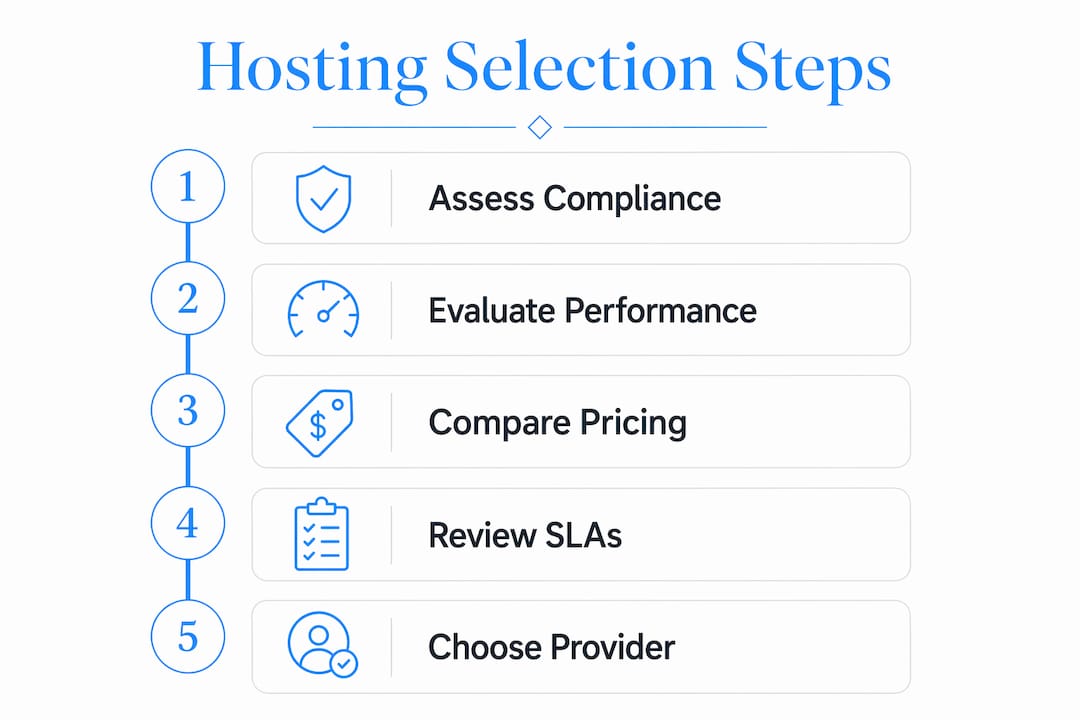
Follow these steps to shortlist and compare providers:
- Define your hosting scope. Separate your marketing website needs from any tax software or application hosting needs. They require different providers and different contracts.
- Verify compliance credentials. Confirm SOC 2 Type II certification, data center audit reports, and written incident response documentation before any other evaluation.
- Review SLA details. Check uptime guarantees, response time commitments, and what financial remedies the provider offers if they miss their SLA targets.
- Assess accounting ecosystem knowledge. Ask whether the provider has experience hosting Lacerte, QuickBooks, or UltraTax. Providers without that knowledge create support gaps when integration issues arise.
- Evaluate support responsiveness. Test their support before you sign. Submit a pre-sales question and measure response time and quality. Tax season support failures are not recoverable.
Beyond the checklist, look for these provider traits that separate accounting-focused hosts from generic alternatives:
- Written Information Security Program (WISP) templates or guidance for client firms
- Documented backup policies with tested recovery procedures
- Scalability options that grow with your firm without requiring a full platform migration
- Integration support for common accounting workflows and client communication tools
- References from other CPA firms of similar size and practice type
Evaluating SLA details, data center certifications, and backup policies is the most critical step in the selection process. Firms that skip this step often discover gaps only after a security incident or a tax season outage. The parallel holds true for attorneys and other professional service firms, where hosting reliability standards follow the same logic.
The long-term value of specialized providers consistently exceeds the cost savings from generic hosting. The math is straightforward: a provider that understands your industry resolves problems faster, supports your growth better, and keeps you compliant without requiring you to become a hosting expert yourself.
Key takeaways
Selecting the right CPA website hosting provider requires matching security certifications, uptime guarantees, and accounting-specific features to your firm's compliance obligations and growth stage.
| Point | Details |
|---|---|
| Compliance is non-negotiable | Require SOC 2 Type II certification and FTC Safeguards Rule alignment from every provider you evaluate. |
| Uptime standards matter most in april | Target a minimum 99.9% uptime SLA, with 99.99% preferred during peak tax season periods. |
| Dedicated servers outperform shared hosting | Private server environments provide better isolation and predictable performance for client-facing applications. |
| Pricing reflects real feature differences | Budget shared hosting at $2–$5/month lacks client portals and compliance tools that accounting-specific platforms include. |
| Specialized providers deliver better ROI | Providers with Lacerte, UltraTax, and QuickBooks experience resolve issues faster and support firm growth more effectively. |
Why I think most CPAs choose their hosting provider for the wrong reasons
Most CPA firms pick a hosting provider the same way they pick a printer: they search for the cheapest option that technically works. I have seen this pattern repeatedly, and it almost always leads to the same outcome. The firm outgrows the platform within 18 months, scrambles to migrate, and loses weeks of productivity in the process.
The more dangerous mistake is assuming that a compliant hosting provider makes the firm compliant. The FTC Safeguards Rule is explicit: internal policies, risk assessments, and incident response plans are the firm's responsibility, not the host's. I have watched firms invest heavily in premium hosting and then skip the WISP documentation entirely. That is the wrong order of priorities.
My honest recommendation is to treat hosting as a professional services decision, not a technology purchase. The same rigor you apply to selecting an audit software vendor should apply here. Ask for references. Read the SLA in full. Test the support team before you sign. A provider that cannot answer a pre-sales compliance question clearly will not perform better after you are locked into a contract.
Hosting needs also evolve. A solo practitioner's needs in year one look nothing like a 10-person firm's needs in year five. Build scalability into your evaluation criteria from the start, and revisit your hosting contract annually. The right provider grows with you. The wrong one becomes an obstacle.
— Kate
Professional CPA website hosting and design from Epdwebsites
Epdwebsites has served CPAs and financial professionals since 2009, building websites that meet the credibility and performance standards accounting clients expect.

Every hosting and design package from Epdwebsites includes SSL security, regular backups, SEO-ready structure, and support from a team that understands professional services. The focus is on websites that work for your firm from day one, without the retrofit costs that come with generic platforms. Explore the full range of CPA hosting and design features to see what a purpose-built accounting website looks like. If you are ready to move forward, review hosting options and pricing and connect with the Epdwebsites team directly.
FAQ
What is the minimum uptime SLA a CPA hosting provider should offer?
The minimum acceptable uptime SLA for CPA website hosting is 99.9%, with 99.99% preferred during tax season. Anything below 99.9% introduces unacceptable downtime risk for client-facing operations.
Is SOC 2 Type II certification required for CPA website hosting?
SOC 2 Type II certification is the standard for hosting environments that handle tax software or client financial data. It audits security controls over time, making it a stronger credential than basic compliance checklists.
What is the difference between website hosting and tax software hosting?
Website hosting supports your marketing site and client-facing pages. Tax software hosting runs applications like Lacerte or UltraTax and requires far stricter security controls, dedicated infrastructure, and compliance documentation.
How much should a CPA firm budget for website hosting?
Entry-level shared hosting starts at $2–$5 per month, but accounting-specific platforms with client portals and compliance features range from $76 to $500 or more monthly. The right budget depends on the features your firm actually needs.
Does a compliant hosting provider make my firm FTC-compliant?
No. Hosting providers secure the technical infrastructure, but firms remain responsible for internal policies, risk assessments, and incident response plans required under the FTC Safeguards Rule.