Most CPAs spend years building expertise and a reputation in their community, then let a generic template or outdated web page represent them online. Knowing what is a professional website for a CPA means understanding that it's not a digital business card. It's a trust-building, client-converting platform that works for you around the clock. The difference between a professional CPA website and a basic one shows up directly in whether prospects call you or the firm down the street.
Table of Contents
- Key takeaways
- What a professional CPA website actually is
- Your website as an ongoing engagement hub
- Security, compliance, and what CPAs must know
- How to create a CPA website: your three main options
- My honest take on CPA websites
- Ready to build a website that works as hard as you do?
- FAQ
Key takeaways
| Point | Details |
|---|---|
| More than a brochure | A CPA website should actively generate leads and build client trust, not just list services. |
| Design signals credibility | Clean layouts, verified domains, and clear service pages directly influence how prospects perceive your firm. |
| Security is non-negotiable | SSL, secure portals, and compliant content protect both your clients and your professional standing. |
| Mobile optimization matters | Over half of visitors arrive on mobile devices, making responsive design a baseline requirement. |
| Provider choice affects outcomes | Full-service web partners save time and deliver results that DIY builders rarely match for professional firms. |
What a professional CPA website actually is
A professional CPA website is a purpose-built digital presence that communicates your qualifications, serves your clients, and positions your firm for growth. It's not about having a pretty homepage. It's about creating a site where every element earns its place by building trust or moving a prospect closer to picking up the phone.
The design elements that signal trust
Clean design is not the same as minimal design. A professional site uses a controlled color palette that reflects financial stability, typically blues, whites, and grays with intentional accent colors. Navigation should be obvious without thought. A visitor should find your tax services page, your contact form, and your credentials within two clicks from the homepage.
Customized and professionally designed sites consistently produce higher engagement and perceived credibility than generic templates. That perception gap matters because your website is often the first impression a prospective client forms before they ever speak with you.
Service pages deserve particular attention. Each major offering, whether business tax preparation, bookkeeping, or financial consulting, should have its own dedicated page with a clear explanation. Bundling everything on one page is one of the most common mistakes CPAs make.
Domain, mobile design, and secure portals
The .cpa verified domain is a meaningful differentiator. It signals to clients and search engines alike that your firm has been vetted and is legitimate. That kind of trust signal goes well beyond what a generic .com can communicate.
Mobile-friendly design is no longer optional. More than half of CPA website traffic comes from mobile devices, and Google penalizes sites that don't perform well on smaller screens. Responsive design isn't a bonus feature. It's a baseline requirement.

Secure client portals let clients upload tax documents and exchange sensitive financial information without relying on email. This one feature alone can increase client satisfaction significantly. It shows you take data protection seriously and that you've built your firm for the way people actually work today.
Pro Tip: When reviewing your current site on mobile, pay close attention to form fields and contact buttons. If they're hard to tap or slow to load, you're losing prospects before they ever reach your phone number.
Your website as an ongoing engagement hub
The firms that grow consistently through their websites treat them as living platforms, not static pages. This is where the benefits of a professional CPA website really compound over time.
Here's how that engagement strategy breaks down in practice:
-
SEO-optimized content. Targeting local keywords and relevant search terms brings in prospects who are actively searching for a CPA in your area. Regular blog posts, tax deadline reminders, and explainer articles keep your site fresh and visible.
-
Webinars and educational resources. Continuous content engagement through recorded webinars, downloadable guides, and timely tax law updates positions your firm as the go-to authority. Clients don't just need a tax preparer. They want a trusted advisor who keeps them informed.
-
Newsletter and social media integration. Your website should function as the hub in a broader digital marketing approach. When you integrate email sign-up forms and link your active social profiles, you create multiple touch points with potential clients between tax seasons.
-
Internal staff resources. Many CPA firms use password-protected sections of their website to house onboarding documents, policy updates, and training materials. This keeps operations organized and reduces time spent on internal communication.
-
Lead generation through contact forms and scheduling tools. Online scheduling and detailed contact forms convert curious visitors into booked appointments. Without these tools, you're relying on prospects to take extra steps, and most won't.
Pro Tip: Post a brief tax tip or deadline reminder on your website at least once a month. This habit keeps your content current, signals to Google that your site is active, and gives you something worth sharing on social media.
A professional website built around content and engagement doesn't just attract one-time tax clients. It builds the kind of ongoing relationships that generate referrals and repeat business for years.
Security, compliance, and what CPAs must know
This is the section that separates a genuinely professional CPA website from one that merely looks professional. There are legal and regulatory considerations that apply specifically to CPAs, and ignoring them creates real risk.
- SSL certificates and secure hosting. Any site handling client inquiries about financial matters needs HTTPS as a minimum. Without it, browsers flag your site as insecure, which kills trust instantly.
- IRS Circular 230 compliance. IRS Circular 230 rules extend to your online presence. Content that resembles specific tax advice must include appropriate disclosures. Using certain designations or implying federal tax authority without proper standing is a direct compliance issue.
- Restrictions on professional titles. You cannot describe yourself with titles or credentials you don't hold. This applies to your website copy just as it does to your business cards and marketing materials.
- Data security beyond SSL. Hosting matters. Cheap shared hosting environments expose your site to security vulnerabilities that can compromise client data. Quality CPA website hosting uses isolated server environments, regular backups, and malware scanning.
The most overlooked compliance issue I see on CPA websites is unqualified tax commentary presented without Circular 230 disclosures. It reads like advice, Google indexes it as advice, and a regulator can treat it as advice. A sentence of disclosure costs nothing. Non-compliance can cost your license.
The .cpa domain adds another layer of protection by requiring credential verification before it's granted. That verification signals to both clients and regulators that your firm meets professional standards.
How to create a CPA website: your three main options
When you're ready to build or rebuild, you have three realistic paths. Each has trade-offs worth understanding before you commit.
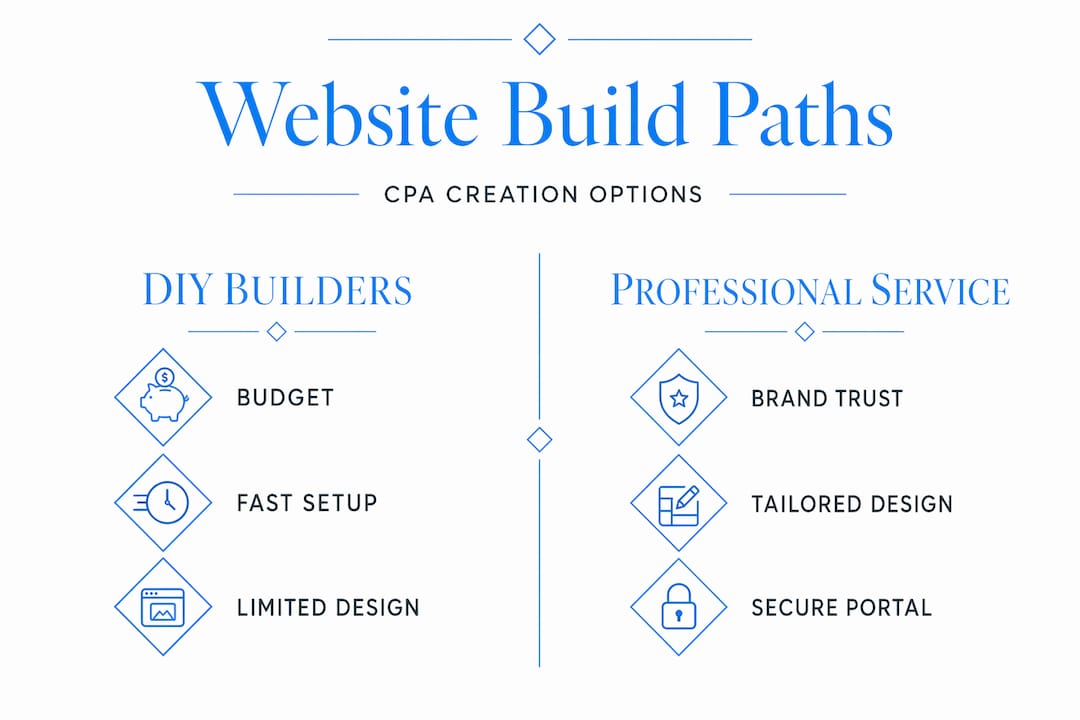
| Approach | Best for | Limitations |
|---|---|---|
| DIY website builders | Solo practitioners on a tight budget | Generic templates, limited SEO control, time-consuming |
| AI-powered website tools | Quick placeholder sites | Lack of nuance, compliance awareness, and custom branding |
| Full-service web providers | Firms prioritizing credibility and growth | Higher upfront investment |
Full-service providers combine design, hosting, SEO, and support into a single relationship. For CPAs who want to focus on client work rather than managing website issues, this is the approach that delivers the best return.
Here's how to evaluate which route fits your firm:
- Time budget. DIY builders take more hours than advertised, especially for a site that needs to look and perform at a professional level.
- Technical expectations. Compliance-aware copy, local SEO setup, and secure hosting require expertise that templates don't provide by default.
- Growth goals. A firm planning to scale, add staff, or expand services needs a site built with that growth in mind from the start.
- Client perception. Client testimonials and design quality directly influence conversion rates. A site that looks like every other accounting template sends the wrong message about your standards.
For CPAs building a brand around trust and expertise, the investment in a properly designed site pays back in client quality and volume. Resources like CPA website branding strategies can help you think through the positioning before you build.
My honest take on CPA websites
I've reviewed dozens of professional firm websites over the years, and one pattern keeps showing up. CPAs who are exceptional at their work settle for websites that communicate the opposite. The site is slow, the navigation is confusing, and the design looks like it was last updated when flip phones were relevant.
The mistake isn't laziness. It's misplaced confidence that clients will overlook a weak online presence because the CPA's work speaks for itself. The problem is that the website speaks first. Before your credentials, before your referrals, before your first conversation, that homepage is making a judgment call for every prospect who lands on it.
What I've found actually changes outcomes is treating the website as a professional tool on the same level as your office, your letterhead, and your staff. You wouldn't let your office reception area fall into disrepair. Your homepage deserves the same standard.
The firms that invest in proper digital marketing integration consistently outperform competitors who rely solely on referrals. Referrals are valuable, but they have a ceiling. A well-built, well-optimized website has no ceiling.
The uncomfortable truth is that most CPAs are leaving real money on the table by not taking their website seriously enough.
— Kate
Ready to build a website that works as hard as you do?
At Epdwebsites, we've spent over 15 years designing and hosting websites for CPAs, attorneys, consultants, and other professionals who can't afford to look anything less than exceptional online.

When you work with Epdwebsites, you get a site built with the specific credibility signals, security standards, and design quality that financial professionals need. That means mobile-optimized pages, secure hosting environments, and copy that reflects your expertise without triggering compliance concerns. You don't have to figure out navigation structures, SEO basics, or hosting specs on your own. Explore our professional website features or browse the client portfolio to see what a truly professional CPA website looks like in practice. When you're ready to stop settling for generic, we're ready to build something worth bookmarking.
FAQ
What makes a CPA website professional?
A professional CPA website combines clean, credibility-focused design with clear service pages, mobile optimization, secure hosting, and compliance-aware content. It functions as a client acquisition and trust-building tool, not just an information page.
Why is the .cpa domain better for CPA websites?
The .cpa domain requires credential verification, which signals to clients and search engines that your firm is legitimate and vetted. It provides a layer of trust that a generic .com domain cannot match.
What does IRS Circular 230 mean for my website?
IRS Circular 230 requires that any online content resembling tax advice include specific disclosures. Using restricted professional titles or implying federal tax authority without proper standing on your website can create compliance and licensing risks.
Should I hire a professional or use a website builder?
If client trust and firm growth are priorities, a full-service provider delivers significantly better results than DIY builders. Builders save money upfront but often lack the SEO capability, secure hosting, and professional design quality that CPA firms require.
How often should a CPA update their website?
Adding new content at least once a month, whether a tax tip, deadline reminder, or short article, keeps your site active in search rankings and gives clients a reason to return. Continuous content updates are directly linked to stronger client engagement over time.