
Law firm branding is the consistent set of promises, visuals, and client experiences that make a firm instantly recognizable and trustworthy to the people who need it. The next move isn't a new logo. Write one sentence describing who you serve and the outcome you deliver, then check whether your homepage says that same thing in the first five seconds. Everything else in this guide builds from that single sentence.
TL;DR:
- Consistent messaging and a clear value proposition are essential for effective branding, with the homepage reflecting the firm's target client and outcome within five seconds.
- Visual identity should be simple, versatile, and authentic, with colors, typography, and photography aligned across all physical and digital touchpoints.
- Tracking key metrics such as qualified inquiries, response time, and referral sources provides better insights into branding effectiveness than visual audits alone.
- Operational consistency, especially in intake and follow-up processes, is critical to maintaining trust and avoiding brand damage despite visual branding efforts.
- A disciplined focus on positioning, messaging, and operational execution, rather than just logos or website design, drives better firm recognition and client conversion.
Table of Contents
- The 8-Step Law Firm Branding Checklist
- Why Does Branding Matter for Small and Boutique Firms?
- Positioning and Messaging: A Framework You Can Fill In Today
- Visual Identity: What Actually Signals Credibility
- Building a Digital Presence That Actually Converts
- Where Brand Promises Get Broken: Intake and Follow-Up
- Personal Brand or Firm Brand? Choosing the Right Architecture
- Common Branding Mistakes and When a Rebrand Actually Makes Sense
- The 20-Point Brand Audit You Can Run This Week
- How Epdwebsites Executes Law Firm Branding in Practice
- Keeping Brand Consistency Across Multiple Offices or Attorneys
- Extending Your Brand Into Print and Physical Spaces
- What Successful Law Firm Branding Looks Like in Practice
- Three Priorities Worth Acting on This Week
- Get Your Website and Branding Built by a Team That Knows Legal Practices
- Sources
The 8-Step Law Firm Branding Checklist
Most branding for attorneys fails because firms start with a logo instead of a decision. Work through these steps in order, because each one depends on the last.
- Define positioning and your ideal client. Write a one-sentence value proposition: what you do, for whom, and what changes for them.
- Set a brand promise and tone of voice. Decide whether you sound formal and buttoned-up or approachable and plain-spoken, then write it down so every team member sounds consistent.
- Build a simple visual identity. Lock in a logo, two or three colors, and one font pairing, then apply them everywhere, especially the website.
- Standardize intake scripts. Write down exactly what the first caller or form-filler hears, so the brand promise survives the first human contact.
- Claim and clean up directory listings. Match your name, address, and phone number across Google Business Profile, Avvo, and state bar directories.
- Publish one pillar piece monthly. Write a solid article on a client question, then cut it into a LinkedIn post, an email, and a short video.
- Track qualified leads and speed-to-contact. Measure how many inquiries fit your ideal client profile and how fast someone responds.
- Run two quick wins this week. Rewrite your homepage headline to match your one-sentence value prop, and respond to every open Google review, good or bad.
None of this requires a rebrand budget. It requires someone in the firm to own the checklist and actually finish it, which is where most law practice branding efforts quietly die.
Why Does Branding Matter for Small and Boutique Firms?
Branding shortens the distance between "found you online" and "hired you." A prospective client comparing three attorneys in a five-minute search isn't reading case law. They're scanning for signals: does this firm look organized, does the site load fast, does the language sound like someone who understands their specific problem. Strong law firm branding removes friction at exactly that moment, and clear positioning often influences a client's choice before they ever pick up the phone.
Reviews and digital identity now do a lot of the persuading that word-of-mouth used to handle alone. Firms that claim their directory profiles and publish consistently build the digital identity that both prospects and AI-driven search tools rely on when surfacing recommendations. A dormant Google Business Profile or a stock-photo homepage sends the opposite signal, no matter how good the legal work actually is.
What to track: qualified inquiries per month, conversion rate from inquiry to signed client, speed-to-contact on new leads, and referral volume from past clients. These four numbers tell you more about branding for attorneys than any visual audit ever will.
Firms that treat these as recurring metrics, not one-time checks, tend to catch problems (a slow intake response, a confusing homepage) before they cost a signed retainer.
Positioning and Messaging: A Framework You Can Fill In Today
Positioning is the decision underneath everything else, and most firms skip it because it feels less urgent than a website redesign. It isn't. A confused message costs more leads than a mediocre logo ever will.
The value proposition formula: [what you do] + [for whom] + [what changes for them]. A workable example: "We handle contested custody cases for parents in [region] so they keep meaningful time with their kids without a courtroom battle that drains their savings." That sentence does more branding work than a new color palette.
From there, build three messaging pillars tied to what clients actually worry about, not what impresses other lawyers:
- Expertise pillar: what specific problem you solve better than a generalist would.
- Experience pillar: what working with your firm feels like, from first call to case close.
- Outcome pillar: the concrete result clients are trying to reach, stated in their language, not statute numbers.
Pair that with a brand promise, one sentence that sets a service expectation you're willing to be held to, like "We return every call within one business day." Storytelling and clear positioning are what make a firm the obvious choice for its ideal client rather than one option among many.
Use these as starting templates for your site:
- Homepage headline: "[Practice area] help for [client type] in [area], without the runaround."
- About page opener: "I started this firm because [specific reason tied to client pain], and every case since has been built around [core promise]."
Pro Tip: Read your homepage headline out loud to someone outside the legal field. If they can't repeat back who it's for and what problem it solves, rewrite it before touching anything else.
Visual Identity: What Actually Signals Credibility
Good visual identity for a law firm follows three rules: simplicity, distinctiveness, and versatility across a business card, a website header, and a courthouse sign. Skip anything that only works at one size or on one background.
Color carries more meaning than most attorneys assume. Navy and dark green signal stability and tradition. Burgundy and charcoal read as serious and slightly upscale. Bright colors can work for a boutique consumer-facing practice but risk looking unserious for litigation or estate work. Whatever you pick, applying it consistently across the site, business cards, and signage builds the recognition that generic, mismatched branding never achieves.
Typography needs only two choices: one for headlines, one for body text, both readable at a glance on mobile. Avoid anything with thin strokes that disappear on a phone screen in bright sunlight.
Photography is where firms cut corners and pay for it later. Authentic headshots and real office or team photography consistently outperform generic stock imagery for building trust, because prospects can tell the difference between a real person and a model. Budget for one solid photo session rather than years of borrowed stock images.
When you brief a designer, request:
- Logo files in vector format (SVG or EPS) plus PNG variants with transparent backgrounds.
- A one-page style guide covering colors (with hex codes), fonts, and logo spacing rules.
- Both horizontal and stacked logo versions for different placements.
Pro Tip: Ask your designer for a "one-color" version of your logo that still works printed in plain black. If it holds up on a fax cover sheet or a courthouse sign-in board, it's solid everywhere else.
For real examples of firms that got this right, browsing a curated list of strong law firm websites is faster than guessing at trends from memory.
Building a Digital Presence That Actually Converts
Your website carries more brand weight than any other single asset, because it's usually the first place a referral actually lands. The homepage needs to state who you help and what happens next within the first screen. The About page should support the positioning you wrote earlier, not repeat a generic bio template.
Trust elements matter more than polish. Testimonials, brief case snapshots (without confidential details), a visible phone number, and a clear call-to-action button all reduce the hesitation a prospect feels before reaching out. Site speed and mobile responsiveness aren't cosmetic. A slow or clunky site actively undermines the trust a well-designed page is trying to build, no matter how strong the messaging above it reads.
Directory hygiene is the unglamorous half of law firm reputation management, and it's the half most firms neglect:
- Match name, address, and phone number exactly across Google Business Profile, Avvo, Justia, and your state bar listing.
- Respond to every Google review within a few days, positive or negative.
- Keep practice area categories current as your work shifts.
Channel choice depends on who you serve. Consumer-facing practices (family, personal injury, criminal defense) tend to do well on Google and Facebook. B2B and corporate-facing attorneys get more mileage from LinkedIn-first content and targeted bylines that build the authority referral sources actually trust. Video is underused across the board. Firms that publish even occasional video or thought leadership content see stronger client confidence than text alone produces.
Basic SEO rounds it out: descriptive title tags on every page, local business schema markup, and a content cadence you can actually sustain, even if that's one solid post a month.
Where Brand Promises Get Broken: Intake and Follow-Up
A beautiful website with a slow intake process is a broken brand. Clients experience your firm through touchpoints, not through your logo, and the gap between the two is where trust quietly evaporates.
- First contact (call or form): answer or respond within hours, not days. A scripted, warm greeting matters more than a fast one if it's rude.
- Intake call: use a written script that mirrors your brand voice, so a new hire sounds as consistent as the founding partner.
- Confirmation email: send it within minutes, referencing what the client said, not a generic template.
- Case updates: set a cadence (weekly, biweekly) and stick to it, even when there's nothing new to report.
- Post-resolution follow-up: ask for a review while the relief of a resolved case is still fresh.
Automation helps here more than most attorneys expect. A templated but personalized email sequence preserves consistent voice even when the person sending it changes. What tanks a brand faster than almost anything else is inconsistency: a polished site paired with a disorganized intake process cancels out the credibility the site worked to build.
Pro Tip: Call your own firm's intake line from a different phone and time how long it takes to get a real answer. If it takes longer than you'd tolerate as a client, fix that before spending another dollar on design.
Personal Brand or Firm Brand? Choosing the Right Architecture
Solo attorneys and relationship-driven practices, especially in family law, estate planning, or criminal defense, generally do better leading with a personal brand. Clients are hiring a person they trust, and your name recognition travels with referrals in a way a generic firm name doesn't.
Firms planning to scale, add partners, or eventually merge or sell should build the firm brand first and keep individual attorneys visible but secondary. This protects continuity if a named partner leaves or retires.
A hybrid model works for firms in between: attorneys publish under their own byline for authority, but every piece links back to and reinforces the firm's core positioning and visual identity.
- Solo path: invest in your own headshots, bio, and a personal LinkedIn presence tied tightly to the firm site.
- Multi-partner path: invest in firm-level visual identity and a homepage that doesn't lean on any one name.
- Hybrid path: assign each attorney one content pillar to own, so bylines build authority without fragmenting the firm's overall message.
Common Branding Mistakes and When a Rebrand Actually Makes Sense
The most expensive mistake is treating branding as a visual-only project. A new logo layered over the same confusing positioning and slow intake process changes nothing that clients actually notice. The second most common failure is inconsistent execution: gorgeous website, mismatched business cards, an outdated directory listing still showing a dissolved partnership.
Legitimate reasons to rebrand exist, but they're narrower than most firms assume:
- The firm has genuinely changed practice areas or client focus since the current brand was built.
- A merger, partner departure, or ownership change makes the existing name or identity inaccurate.
- The current visual identity actively looks dated enough to raise doubts about competence.
- Client research shows consistent confusion about what the firm actually does.
A lean rebrand starts with a positioning workshop, not a font selection. Rewrite messaging and the homepage next, then redesign the visual system, then rebuild the site with proper testing before launch. Skipping straight to visuals is how firms end up rebranding twice in three years. A structured rebrand checklist keeps the sequence honest.
The 20-Point Brand Audit You Can Run This Week

Score each item 1 (missing) to 3 (strong), then total the section.
Critical (fix first):
- Phone number and contact form work and are visible on every page.
- Homepage states who you help and what to do next within one screen.
- New inquiries get a response within a few hours, not days.
- Practice areas are named in plain language, not statute citations.
Important: 5. Messaging matches across the website, LinkedIn, and printed materials. 6. Google Business Profile and directory listings show matching contact details. 7. Website loads quickly and displays cleanly on mobile. 8. At least one testimonial or case snapshot appears above the fold.
Nice to have: 9. Logo and colors apply consistently across business cards, signage, and email signatures. 10. Photography looks authentic rather than generic stock.
| Score range | What it means |
|---|---|
| — | Brand is solid; focus on measurement and content cadence. |
| — | Foundations exist but execution is inconsistent; fix critical items first. |
| — | Start with positioning and intake before touching visuals. |
Two quick wins to run today: rewrite your homepage headline, and reply to your three most recent Google reviews. A 90-day plan might allocate weeks 1 through 2 to positioning and intake, weeks 3 through 8 to website and directory fixes, and weeks 9 through 12 to content cadence and measurement.
How Epdwebsites Executes Law Firm Branding in Practice
A specialized vendor has built websites, branding, and hosting for professional service providers, including attorneys, since 2009. A common deliverable set for a law firm engagement covers logo and visual identity work, a custom-built website aligned to the firm's positioning, built-in SEO fundamentals, and ongoing hosting and maintenance so the site stays fast and current.
A typical workflow moves through discovery (positioning and messaging review), design (visual identity and homepage structure), build and QA, then launch with hosting and monthly maintenance to keep everything running. The portfolio of completed projects shows the range of professional service firms this approach has served, from solo practices to multi-partner offices needing a more established look.
Keeping Brand Consistency Across Multiple Offices or Attorneys
Firms with more than one office or more than a handful of attorneys face a different problem than solos: the same brand has to survive being interpreted by several different people at once. The fix isn't more rules. It's fewer, clearer ones that are actually enforced.
Start with a one-page brand guide, not a fifty-page manual nobody reads. Cover the logo files and spacing, the two or three approved colors with hex codes, the font pairing, and three or four approved messaging lines every attorney can use without rewriting from scratch. Distribute it to every office and require sign-off that it's been received and applied to local signage and stationery.
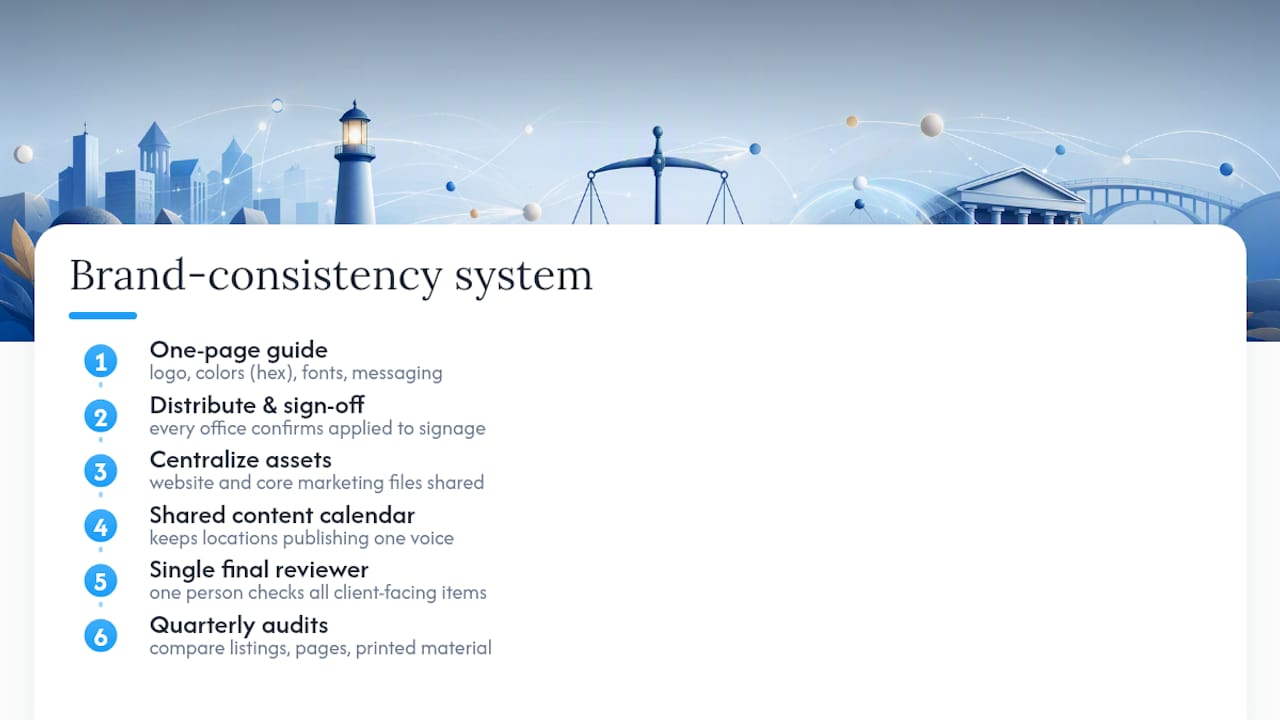
Centralize the website and core marketing assets even if individual offices handle local outreach. A shared content calendar keeps every location publishing under the same voice, even when different attorneys are writing. Assign one person, not a committee, as the final check on anything client-facing before it goes out, whether that's a new office's Google Business Profile or a partner's LinkedIn bio.
Audit quarterly. Pull up every office's Google listing, website page, and printed material side by side and look for drift: a logo that's been stretched, a tagline that's changed without approval, a color that's shifted because someone used the wrong file. Catching drift early costs an email. Catching it two years later costs a reprint of every business card in the firm.
Extending Your Brand Into Print and Physical Spaces
A firm's brand doesn't stop at the browser tab. Business cards, brochures, and office signage are often the first physical thing a client sees, and they need to match the website exactly, not approximately.
Business cards should carry the same logo file, same colors, and same font as the site, no substitutions because a printer suggested a "close enough" shade. Brochures work best when they mirror the website's messaging pillars rather than restating a generic firm history; a client picking up a brochure in the waiting room should read the same value proposition they saw online.
Office signage matters more than most attorneys credit. A reception area sign, a suite directory listing, or exterior signage in the same color and typeface as the website reassures a visiting client they're in the right place, and reinforces the brand promise before anyone says a word. Even small details, like a consistent email signature and letterhead, close the loop between digital and physical touchpoints.
The cheapest way to check this is a physical audit: lay a business card, a brochure, and a printed screenshot of the homepage side by side. If the colors, fonts, or logo don't match exactly, that's a fix worth making before ordering another print run.
What Successful Law Firm Branding Looks Like in Practice
The clearest branding wins share a pattern: they picked a narrow position and executed it everywhere, rather than trying to appeal to every possible client. Firms that choose a specific practice area or client type to own, instead of marketing as generalists, consistently outperform broader competitors on both recognition and referral volume.
A boutique immigration practice that leads every piece of content with client-language questions ("Can I bring my parents once I get my green card?") instead of statute references tends to convert better than a firm using formal legal terminology on its homepage. A family law solo who replaces stock photography with real headshots and an authentic office photo often sees a measurable lift in inquiry quality, because prospects can picture the actual person they'd be working with.
The common thread across strong examples isn't a bigger budget. It's discipline: one clear positioning statement, applied without variation across the website, directory listings, business cards, and the first phone call. Firms that skip that discipline and jump straight to a new logo tend to see the least return on their branding spend, no matter how much they invest.
Three Priorities Worth Acting on This Week
If a firm's brand feels muddled, the fix is rarely more marketing spend. It's usually one of three things: positioning that's too vague to differentiate, a website that buries the value proposition below the fold, or an intake process slow enough to lose a warm lead before the first call ends.
What surprises me most reviewing firms across practice areas is how often the visual identity is fine and the operational consistency is the actual problem. A firm can have a sharp logo and still lose clients because the confirmation email took three days to send. Pick one of the three priorities above, run the audit, and fix the lowest-scoring section before touching anything else. Momentum on one real fix beats a scattered rebrand every time.
— Kate
Get Your Website and Branding Built by a Team That Knows Legal Practices
Most of what's in this guide, you can execute yourself with a checklist and some discipline. Where it gets harder is the technical build: a custom site that actually reflects your positioning, loads fast, and gets maintained without you having to think about it. That's the gap Epdwebsites fills for attorneys who'd rather spend billable hours on cases than on website plugins.

The typical engagement is straightforward: a one-time design and build fee for a custom site, then a monthly hosting fee that includes maintenance so the site stays current without a separate IT headache. That structure fits solo attorneys and small partnerships best, since it avoids the ongoing retainer commitments many agencies require. If you're comparing a DIY template against a custom build, this breakdown of legal website design options lays out the tradeoffs plainly.
Ready to see what a properly branded site looks like for your practice? Review the website features built for professionals and start the conversation about your build.
Sources
- Law Firm Branding: A Comprehensive Guide to Elevate Your Legal Practice | Clio
- Law Firm Branding: Build Trust, Attract Clients, and Grow Your Practice - Smokeball
- Law Firm Branding: How Your Firm Can Stand Out | Rocket Matter
- Legal Examiner — Marketing coverage (digital identity and publishing priorities)
- Law Firm Marketing Strategies | Berbay