
Managed hosting for medical websites is a service where the hosting provider takes full responsibility for server maintenance, security patching, backups, and compliance infrastructure, so your practice can focus on patient care rather than server administration. The industry term is "managed hosting," and in the healthcare context it carries specific legal weight because your website may store or transmit electronic protected health information, known as ePHI. HIPAA requires that any vendor handling ePHI sign a Business Associate Agreement (BAA) before a single byte of patient data touches their servers. Providers like Liquid Web and InMotion Hosting have built dedicated HIPAA-compliant managed hosting tiers precisely because standard shared hosting cannot meet these requirements. Understanding managed hosting scope from the start saves medical organizations from costly compliance failures later.
What is managed hosting for medical websites?
Managed hosting means the provider runs and maintains the server environment, handling updates, patching, monitoring, backups, and incident response on behalf of the customer. For a medical website, that definition expands significantly. The provider is not just keeping your server online. They are operating infrastructure that may fall under federal health data law.
A standard web host rents you server space and walks away. A managed host for healthcare actively monitors your environment around the clock, applies OS and kernel patches before vulnerabilities are exploited, configures firewalls, and responds to security incidents. The difference is the same as hiring a building manager versus renting an empty warehouse. One comes with accountability; the other does not.

Medical practices, dental offices, and specialty clinics all benefit from this model because their internal teams rarely include dedicated server administrators. Outsourcing that function to a provider with HIPAA expertise transfers technical risk to a party equipped to handle it. The result is a website that stays online, stays secure, and stays auditable.
What services are included in managed healthcare hosting?
True managed hosting means proactive operational management rather than passive infrastructure rental. For medical websites, the service bundle typically includes the following:
- OS and kernel patching: The provider applies security updates on a scheduled or emergency basis, closing vulnerabilities before attackers exploit them.
- Firewall management: Rules are configured and updated to block unauthorized access while allowing legitimate patient and staff traffic.
- Security hardening: Server configurations are locked down beyond default settings, reducing the attack surface for malware and intrusion attempts.
- Performance monitoring: Uptime and response times are tracked continuously, with alerts triggered when thresholds are breached.
- Backup and disaster recovery: Encrypted backups are created on a defined schedule, with tested restoration procedures to minimize downtime after an incident.
- 24/7 human support: A technical team is reachable at any hour to address outages, security events, or configuration questions.
- Compliance documentation: Audit logs, access records, and incident reports are maintained to support HIPAA audits and risk assessments.
Pro Tip: Ask any prospective provider to show you a sample audit log and a sample BAA before signing. If they cannot produce both within 24 hours, their compliance program is likely underdeveloped.
What separates a strong managed hosting provider from a weak one is not the feature list. It is the response time and the depth of documentation. Providers like InMotion Hosting and Liquid Web publish their managed service scopes explicitly, which makes comparison straightforward.
How does managed hosting address HIPAA compliance?
HIPAA-compliant hosting satisfies infrastructure audit requirements, but clients remain responsible for configuring and using safeguards correctly. This is the shared responsibility model, and misunderstanding it is the most common compliance mistake medical organizations make.
Here is how a properly structured HIPAA-compliant managed hosting arrangement works:
- Sign a BAA first. Without a signed BAA, even a technically secure infrastructure is not HIPAA-compliant. The BAA establishes legal liability between your organization and the hosting provider.
- Verify encryption standards. Your provider should encrypt data at rest and in transit using current standards. Confirm this is active, not just listed as a feature.
- Confirm access controls and logging. HIPAA hosting safeguards include access logging, backup management, and continuous patching and monitoring. Every login and data access event should be recorded.
- Review audit trail capabilities. You need to demonstrate to auditors that access to ePHI was controlled and monitored. Your provider's logging infrastructure is your evidence.
- Understand your remaining duties. The HIPAA Shared Responsibility Model places application security, user access configuration, and data handling procedures squarely on your organization, not the host.
"HIPAA compliance in hosting depends on contractually defined responsibilities. The BAA is foundational but does not relieve the healthcare organization from operational controls."
This distinction matters in audits. A hosting provider can certify their infrastructure is compliant. They cannot certify that your staff configured user permissions correctly or that your application encrypts form submissions. Both sides of the model must be in order.
Shared vs. dedicated vs. isolated: which environment fits medical sites?
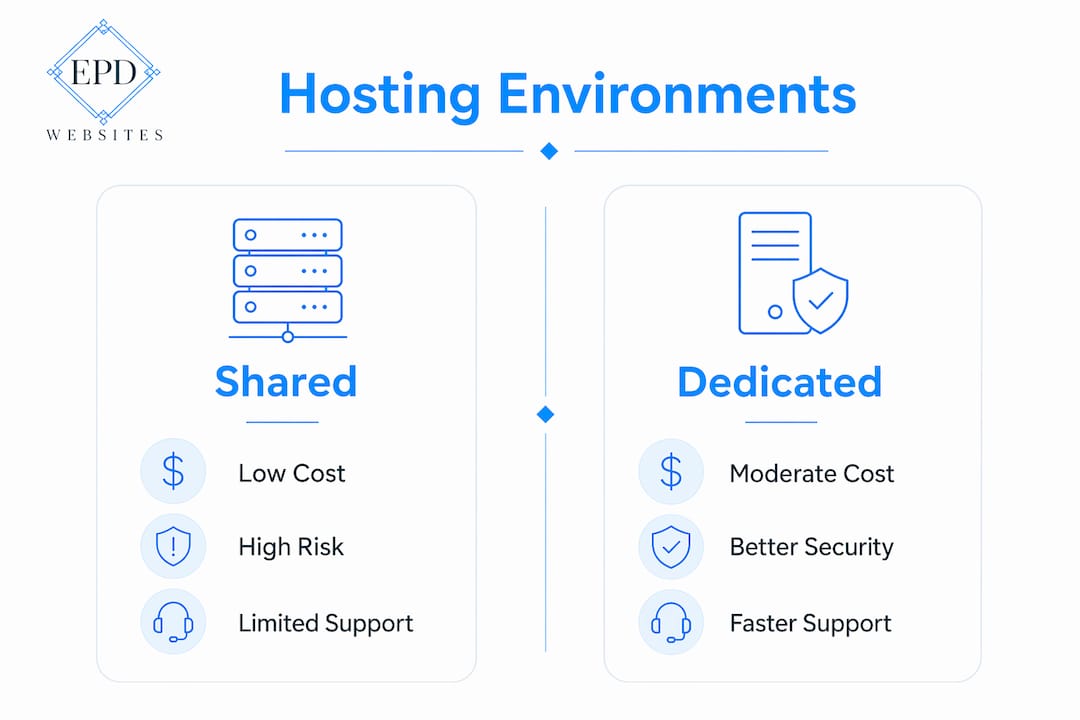
The hosting environment type determines your exposure to shared-tenant risk, your audit complexity, and your performance ceiling. The table below compares the three primary options for medical websites.
| Environment type | Security isolation | Audit readiness | Typical monthly cost | Best for |
|---|---|---|---|---|
| Shared hosting | Low | Poor | $10 to $50 | Non-PHI marketing pages only |
| Dedicated server | High | Strong | $200 to $800 | Mid-size practices with PHI workloads |
| Isolated/private cloud | Very high | Excellent | $500 to $2,500+ | Hospitals, patient portals, large clinics |
Dedicated cloud environments for medical data isolation improve audit compliance and reduce shared-tenant risk. When your server is shared with dozens of other websites, a security breach on any one of them can expose your environment. For a practice handling patient intake forms or appointment scheduling, that risk is unacceptable.
Isolated private cloud environments go further by placing your workloads on infrastructure that no other tenant touches. This simplifies audit defense considerably because your logs reflect only your activity. Providers like Nexcess offer healthcare-specific isolated environments built for exactly this purpose.
Pro Tip: Even if your medical website does not currently collect ePHI directly, choose a dedicated or isolated environment from the start. Retrofitting a shared hosting setup for HIPAA compliance mid-operation is far more disruptive than building on compliant infrastructure initially.
Performance is also a factor. Patient-facing portals and appointment booking systems require consistent response times. Shared environments are subject to the "noisy neighbor" problem, where another tenant's traffic spike degrades your site's speed. Dedicated resources eliminate that variable entirely.
What does managed hosting cost for medical organizations?
HIPAA-compliant managed hosting costs significantly more than standard hosting, often 5 to 20 times higher, with plans ranging between $300 and $2,500 or more per month depending on features and compliance needs. That premium reflects the added compliance work, documentation overhead, and specialized support required to meet healthcare standards.
Budget planning for managed healthcare hosting should account for several cost categories:
- Base hosting fee: Covers server resources, uptime guarantees, and basic managed services.
- Compliance add-ons: BAA execution, audit log retention, and compliance reporting often carry separate fees.
- Migration costs: Moving an existing site to a HIPAA-compliant environment requires careful data handling and may involve professional services fees.
- Ongoing management fees: Some providers charge separately for managed services layered on top of infrastructure costs.
When evaluating service agreements, review the Service Level Agreement (SLA) for uptime guarantees, incident response times, and escalation procedures. A 99.9% uptime guarantee sounds strong, but check whether it covers planned maintenance windows and how credits are calculated for downtime. For a medical practice, an hour of downtime during peak scheduling hours has real operational consequences.
The client organization retains responsibility for application-layer security, staff training, and internal access controls regardless of how much the hosting provider manages. Document those responsibilities in writing before going live. Auditors will ask for evidence of both sides of the shared responsibility model.
How to maximize the benefits of managed hosting for your practice
Getting full value from managed hosting for healthcare requires active collaboration between your internal team and your provider. The hosting provider secures the infrastructure. Your team secures the application and the people using it.
Practical steps that make a measurable difference include:
- Schedule quarterly compliance reviews with your provider to verify that patches are current, logs are intact, and the BAA reflects your current service scope.
- Implement multi-factor authentication for all administrative access to your website and hosting control panel. This single control blocks the majority of credential-based attacks.
- Run annual risk assessments that include your hosting environment as a component. HIPAA requires documented risk analysis, and your hosting setup is part of that scope.
- Monitor SLA performance monthly. Track actual uptime and support response times against your contract. If your provider consistently misses targets, you have grounds to renegotiate or switch.
- Plan for scalability before you need it. Patient volumes grow, and so does web traffic during flu season or public health events. Confirm your hosting plan can scale resources without a full migration.
The most common pitfall is assuming that because a provider calls their service "HIPAA-compliant," your organization is automatically covered. Compliance is a shared outcome, not a feature you purchase. Understanding healthcare website design best practices alongside your hosting decisions produces a more defensible compliance posture than treating them as separate concerns.
Key takeaways
Managed hosting for medical websites requires both a technically capable provider and an organizationally disciplined client to achieve genuine HIPAA compliance and reliable performance.
| Point | Details |
|---|---|
| Managed hosting defined | The provider handles server updates, security, backups, and monitoring so your team focuses on patient care. |
| BAA is non-negotiable | A signed Business Associate Agreement is legally required before any ePHI touches the provider's infrastructure. |
| Shared responsibility applies | Providers secure infrastructure; your organization must configure applications, manage user access, and train staff. |
| Environment type matters | Isolated or dedicated environments reduce shared-tenant risk and simplify HIPAA audit defense significantly. |
| Cost reflects compliance work | Expect to pay $300 to $2,500 or more per month for HIPAA-compliant managed hosting, depending on service scope. |
Why I think most medical practices underestimate what "managed" actually means
After years of working with professional service providers on their web presence, the pattern I see most often with medical clients is this: they select a hosting provider based on the word "managed" in the marketing copy, sign the contract, and assume the compliance work is done. It is not.
The BAA is the starting line, not the finish line. I have seen practices with technically sound hosting infrastructure fail internal audits because nobody documented who was responsible for rotating access credentials or reviewing login logs. The hosting provider did their job. The practice did not do theirs.
What I tell every medical client is to treat the hosting agreement like a partnership agreement. Read the scope of services with the same attention you would give a vendor contract. Ask specifically: what do you patch, and what do I patch? What logs do you retain, and for how long? What happens if there is a breach at 2 a.m. on a Sunday?
The providers worth working with answer those questions without hesitation. The ones who deflect or respond with vague reassurances are telling you something important about how they will perform when it actually matters. Prioritize documented accountability over polished sales decks every time. Your patients' data and your practice's reputation depend on it.
— Kate
Hosting built for medical professionals, handled by Epdwebsites
Medical practices deserve hosting that is built for their specific requirements, not adapted from a generic plan.

Epdwebsites has served professional service providers, including medical practices, since 2009. The hosting plans available through Epdwebsites' professional hosting services are designed with security, performance, and compliance documentation in mind. From initial setup and migration to ongoing site management, the team handles the technical side so you can focus on your practice. If you are ready to move your medical website onto infrastructure that takes compliance seriously, explore the hosting options and reach out for a consultation tailored to your organization's needs.
FAQ
What is managed hosting for medical websites?
Managed hosting for medical websites is a service where the provider handles server maintenance, security patching, backups, and compliance infrastructure on your behalf. It differs from standard hosting because it includes active management and HIPAA-specific safeguards for protecting patient data.
Is a BAA required for all medical website hosting?
Yes. A signed Business Associate Agreement is legally required before a hosting provider can store or process electronic protected health information. Without it, the arrangement is not HIPAA-compliant regardless of the technical security measures in place.
How much does HIPAA-compliant managed hosting cost?
HIPAA-compliant managed hosting typically ranges from $300 to $2,500 or more per month, which is 5 to 20 times the cost of standard hosting. The premium reflects compliance documentation, specialized support, and the infrastructure controls required by HIPAA.
Can a shared hosting plan work for a medical website?
Shared hosting is appropriate only for medical websites that collect no patient data whatsoever, such as a basic informational page with no forms. Any site that handles appointment requests, patient intake, or contact forms involving health information requires a dedicated or isolated environment.
What is the HIPAA Shared Responsibility Model?
The HIPAA Shared Responsibility Model defines which compliance duties belong to the hosting provider and which belong to the healthcare organization. Providers secure physical infrastructure and server-level controls; the healthcare organization is responsible for application security, user access management, and staff training.