
Physician website hosting security is the practice of applying technical, administrative, and physical safeguards to protect Protected Health Information (PHI) stored or transmitted through a medical practice's website. Every physician with an online presence faces real regulatory exposure. The 2026 HIPAA NPRM converts previously "addressable" controls like multi-factor authentication (MFA) and encryption into hard legal requirements. That shift means the stakes for getting your hosting environment wrong are higher than ever. This physician website hosting security guide covers what you need to know to stay compliant and protect your patients.
What are the essential safeguards in a physician website hosting security guide?
The baseline for any HIPAA-compliant physician website starts with a Business Associate Agreement. A signed BAA is mandatory before any hosting provider can legally handle PHI on your behalf. Without it, no amount of technical configuration makes your environment compliant. That is not a technicality. It is the legal foundation everything else rests on.
Beyond the BAA, the 2026 technical requirements for secure hosting for doctors include:
- Encryption in transit: TLS 1.2 or higher on all web traffic, enforced through HTTPS and HTTP Strict Transport Security (HSTS)
- Encryption at rest: AES-256 encryption for all stored data, including databases, backups, and log files
- Multi-factor authentication: MFA required for all admin accounts and any privileged access to your hosting environment
- Audit logging: Tamper-resistant logs that record every access, change, and login attempt
- Documented risk assessments: Formal, written assessments conducted at regular intervals and after any system change
- Incident response plan: A written procedure for detecting, reporting, and containing breaches
Administrative safeguards matter as much as technical ones. Access controls should follow the principle of least privilege. Only staff who need access to specific data should have it. Workforce training on phishing, password hygiene, and PHI handling is a formal HIPAA requirement, not optional guidance.
Pro Tip: Set a calendar reminder for monthly vulnerability scans. The 2026 NPRM guidance specifically recommends monthly scans, and skipping even one cycle creates a documentation gap that auditors will flag.
How do you evaluate HIPAA-compliant hosting providers for physicians?
Choosing the right hosting provider is one of the highest-leverage decisions a physician can make for their website security. The wrong provider creates liability that no internal policy can fix.

Start with willingness to sign a BAA. Any provider that hesitates or refuses is immediately disqualified. That single filter removes most consumer-grade hosting platforms from consideration. Consumer website builders and generic form tools almost never offer BAAs, which makes them non-compliant by definition for any site collecting or transmitting PHI.
After confirming the BAA, evaluate these technical capabilities:
- Web Application Firewall (WAF): Blocks common attack patterns before they reach your application
- Intrusion Detection and Prevention Systems (IDS/IPS): Monitors traffic for anomalies in real time
- Automated backups with tested recovery: Daily backups stored in encrypted, geographically separate locations
- Disaster recovery documentation: A written recovery time objective (RTO) and recovery point objective (RPO)
Third-party audits tell you whether a provider's claims hold up under scrutiny. SOC 2 and SOC 3 audits from providers with healthcare-specific certifications give you independent verification of their security controls. Ask for the audit report, not just a badge on their website.
Cost is a real factor. HIPAA-compliant hosting ranges from $30 to over $600 per month depending on environment size and managed services. Dedicated HIPAA-ready servers start at $229 per month for Linux configurations and $271 per month for Windows as of early 2026. Standard web hosting runs $5–$50 per month. The price gap reflects the actual cost of compliance infrastructure.
| Feature | Standard hosting | HIPAA-compliant hosting |
|---|---|---|
| BAA available | No | Yes (required) |
| Encryption at rest | Rarely | AES-256 standard |
| MFA for admin access | Optional | Required |
| Audit logging | Basic or none | Tamper-resistant logs |
| WAF and IDS/IPS | Add-on or absent | Included |
| SOC 2/SOC 3 audits | Uncommon | Expected |
| Monthly cost range | $5–$50 | $30–$600+ |
Managed hosting options are worth serious consideration for most medical practices. Managed hosting for medical websites shifts the operational burden of patching, monitoring, and configuration to specialists who do this work daily. For a solo practitioner or small group practice, that expertise is difficult to replicate in-house.
Pro Tip: Request a sample BAA before signing any hosting contract. Review it with a healthcare attorney to confirm it covers breach notification timelines and subcontractor obligations.
Step-by-step measures to secure your physician website hosting environment
Securing your hosting environment is not a one-time project. It is an ongoing operational discipline. The following sequence gives you a practical roadmap.
1. Prepare your baseline
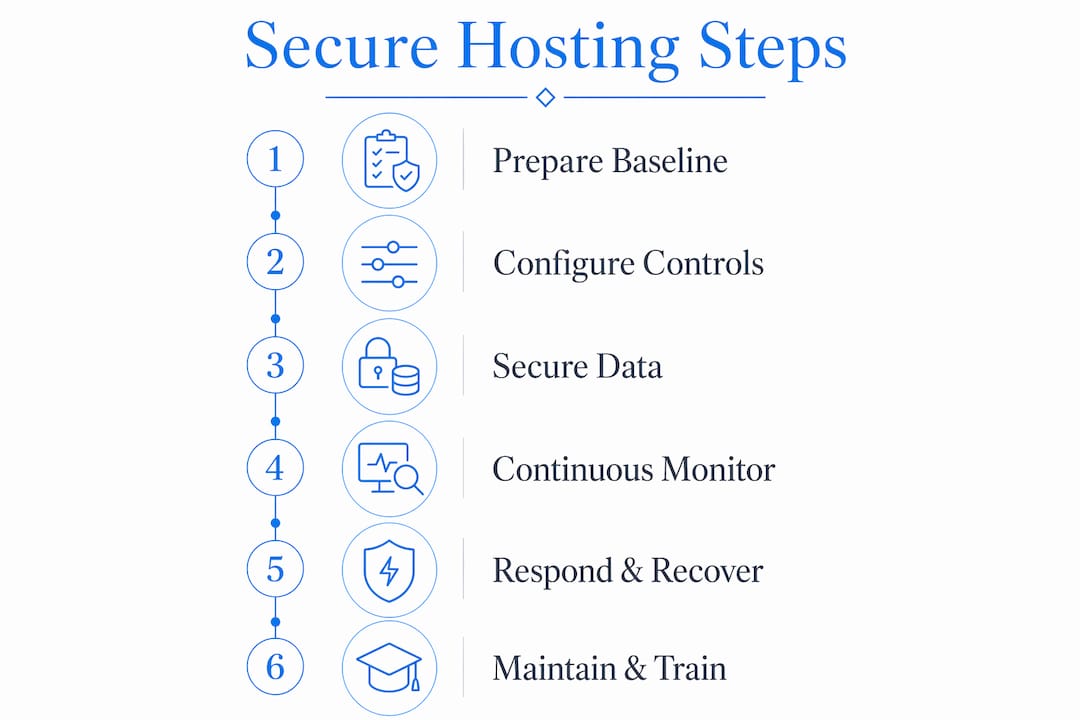
Inventory every system that touches PHI: your website platform, contact forms, appointment scheduling tools, email services, and any third-party plugins. Document where PHI enters, where it is stored, and where it exits. Confirm your BAA is signed and current before proceeding.
2. Configure your technical controls
Enforce HTTPS across your entire domain and enable HSTS to prevent protocol downgrade attacks. Set TLS to version 1.2 or higher and disable older protocols. Enable MFA on every admin account. Configure your firewall to block traffic from known malicious IP ranges and set your WAF rules to block SQL injection and cross-site scripting attempts.
3. Deploy secure data handling practices
Replace any standard HTML contact forms with HIPAA-compliant form tools that encrypt submissions end to end. Never send PHI through standard email. Isolate your production environment from any staging or development environment to prevent accidental data exposure.
4. Monitor continuously
Run and document monthly vulnerability scans. Review audit logs weekly for anomalies. Set automated alerts for failed login attempts, configuration changes, and unusual data access patterns. Log every review in writing.
5. Respond and recover
Your incident response plan should name a responsible person, define what constitutes a reportable breach under HIPAA, and specify notification timelines. Test the plan at least once per year with a tabletop exercise.
6. Maintain and train
Regular risk assessments are a formal HIPAA requirement. Conduct a documented assessment whenever you add a plugin, change vendors, or update your platform. Train all staff who touch the website or patient data at least annually.
Pro Tip: Treat your staging environment like your production environment in terms of access controls. Developers working in an unsecured staging environment with real patient data is a breach waiting to happen.
Common mistakes in physician website hosting security
The most dangerous assumption in medical website security is that signing a BAA is enough. A BAA alone does not guarantee compliance. The hosting provider manages infrastructure. You remain responsible for application-level security, including your forms, your access controls, and how your staff handles data.
Several patterns appear repeatedly in audit failures and breach investigations:
- Set-and-forget configuration: Physicians launch a compliant site and never revisit it. Software updates, new plugins, and vendor changes all create new risk surfaces that require fresh assessments.
- PHI in unencrypted email: Sending appointment confirmations or test results through standard email violates HIPAA. Encrypted messaging platforms or patient portals are required.
- Non-compliant third-party tools: Standard contact form services, generic chat widgets, and basic scheduling apps rarely offer BAAs. Using them on a physician website creates direct liability.
- No environment segregation: Running patient-facing forms on the same server partition as public marketing content without isolation increases breach risk.
- Missing documentation: Absent or outdated risk assessments are the most common cause of audit failure. Compliance is not a state you achieve. It is a process you document continuously.
"The most frequent compliance failure during audits is the absence of current, documented risk assessments and failure to review them after website changes. Continuous security management is not optional. It is the difference between passing an audit and facing a breach investigation."
Troubleshooting an unexpected audit finding starts with your documentation trail. If you cannot produce a dated risk assessment that covers the period in question, the auditor will assume the control was absent. Rebuild your documentation from the earliest available evidence and establish a forward-looking schedule immediately.
Review your medical website design checklist to catch security and compliance gaps before they become audit findings.
Key Takeaways
Physician website hosting security requires a signed BAA, layered encryption, MFA, continuous risk assessments, and a formal incident response plan working together as a system, not as isolated checkboxes.
| Point | Details |
|---|---|
| BAA is non-negotiable | No hosting environment is HIPAA-compliant without a signed Business Associate Agreement. |
| Encryption must be layered | Use TLS 1.2+ in transit and AES-256 at rest for all PHI-related data and backups. |
| MFA is now mandatory | The 2026 HIPAA NPRM makes MFA a hard requirement for all privileged access accounts. |
| Documentation prevents audit failure | Dated, continuous risk assessments are the most commonly missing element in failed audits. |
| Managed hosting reduces risk | Specialized providers with SOC 2 audits apply consistent safeguards that most practices cannot replicate in-house. |
What I've learned about physician website security after years in the field
Most physicians I work with are not ignoring security. They are genuinely unaware of how much responsibility sits on their side of the shared model. The hosting provider secures the infrastructure. The physician secures the application. That line is where most breaches happen.
The practices that handle this best treat security as infrastructure, not as a project. Security built into hosting infrastructure from day one is dramatically easier to document and audit than security bolted on after the fact. I have seen practices spend more time and money retrofitting compliance than they would have spent getting it right initially.
The 2026 regulatory tightening is not a surprise. The direction has been clear for years. Practices that waited to treat MFA and encryption as optional are now facing mandatory upgrades under deadline. The physicians who will navigate 2026 and beyond with the least friction are the ones who chose specialized hosting providers with real audit credentials and built their workflows around compliance from the start.
One thing I want physicians to understand clearly: you cannot outsource your responsibility. You can outsource the technical execution. Your hosting provider can manage servers, patches, and firewalls. But you own the patient relationship, the data classification decisions, and the training of your staff. No vendor absorbs that.
— Kate
Epdwebsites offers secure hosting built for medical practices
Medical professionals need hosting that meets 2026 HIPAA requirements without requiring an IT department to manage it. Epdwebsites has built and hosted professional websites for physicians and medical practices since 2009, with a focus on compliance, security, and the kind of personalized support that generic platforms cannot provide.

Every hosting plan Epdwebsites offers for medical clients includes the technical safeguards your practice needs, from encrypted environments to managed configurations that reduce your compliance burden. If you are ready to move your physician website to a secure hosting environment built for healthcare professionals, the team at Epdwebsites is available for a direct consultation. Review hosting plan options and connect with Kate to get started.
FAQ
What is a Business Associate Agreement in website hosting?
A Business Associate Agreement (BAA) is a legally required contract between a physician and any vendor that handles PHI, including hosting providers. Without a signed BAA, the hosting arrangement is non-compliant under HIPAA regardless of the technical safeguards in place.
Does HTTPS alone make a physician website HIPAA-compliant?
HTTPS encrypts data in transit but does not satisfy all HIPAA requirements. Full compliance also requires AES-256 encryption at rest, MFA, audit logging, a signed BAA, and documented risk assessments.
How much does HIPAA-compliant hosting cost for a physician website?
HIPAA-compliant hosting ranges from $30 to over $600 per month depending on environment size and managed services. Dedicated HIPAA-ready servers start at $229 per month for Linux configurations as of early 2026.
How often should a physician conduct a website risk assessment?
HIPAA requires documented risk assessments on a regular basis and after any significant change to your website, such as adding a plugin, switching vendors, or updating your platform. Monthly vulnerability scans are specifically recommended under 2026 NPRM guidance.
Can a physician use a standard contact form on their website?
Standard contact forms that lack end-to-end encryption and a BAA from the form provider are not HIPAA-compliant for collecting PHI. Physicians must use encrypted, HIPAA-compliant form tools with a signed BAA to collect patient information through their website.