
A professional web presence is the foundation every physician needs to attract new patients, retain existing ones, and establish credibility before a single appointment is booked. Patients no longer rely on word-of-mouth alone. Three-quarters of Americans say relevant medical training, transparency, and ease of understanding are extremely important when evaluating health information sources. If your practice does not appear online with a site that reflects those standards, patients move on to someone who does. This article explains exactly why doctors need a professional web presence and what it takes to make that presence work.
Why doctors need a professional web presence in 2026
A professional web presence, also called a physician's digital identity, is the combination of a well-designed website, search visibility, and credible online content that represents your practice to prospective patients. The case for building one is not theoretical. 84.1% of U.S. consumers seeking medical information online use search engines, and 65.1% start their healthcare journey there. That means the majority of your future patients are forming their first impression of your practice through a screen before they ever call your front desk.
The importance of online presence for doctors goes beyond marketing. Your website functions as a pre-visit credibility checkpoint. Patients use it to verify your credentials, understand your services, and decide whether to trust you with their care. A practice without a professional site does not just miss patients. It actively signals to them that something may be off.

How a professional website builds credibility and patient trust
Trust is the currency of healthcare, and your website either earns it or destroys it. A 2026 Scientific Reports study with 517 U.S. adults found that patient trust peaked when health websites were both transparent and interactive. Trust was lowest for sites that were non-transparent and offered little interactivity. This finding has direct implications for how you design and populate your medical site.
Transparency means more than listing your name and specialty. It means showing your board certifications, explaining your clinical approach, citing the evidence behind your treatment recommendations, and being clear about what your practice does and does not offer. Patients who land on a page with vague service descriptions and no credentials visible leave quickly, and they do not come back.
Interactivity raises trust further. Features like symptom FAQs, appointment request forms, patient education videos, and live chat options signal that your practice is engaged and accessible. A site that simply looks polished but offers no way for a patient to interact or get answers is, according to the research, less trusted than one that is plainer but more responsive.
Here are the trust-building elements every medical website needs:
- Board certifications and medical school credentials displayed prominently on the About page
- Condition-specific FAQs that answer the questions patients search before calling
- Transparent policies covering insurance, billing, and appointment cancellations
- Evidence citations linked to peer-reviewed sources when making clinical claims
- Patient testimonials with specific outcomes rather than generic praise
- Clear contact options including phone, email, and online scheduling
Pro Tip: Avoid the common mistake of treating your website as a digital brochure. A site that cites its sources and explains clinical boundaries builds more trust than one that simply looks expensive.
How search engine visibility drives patient acquisition
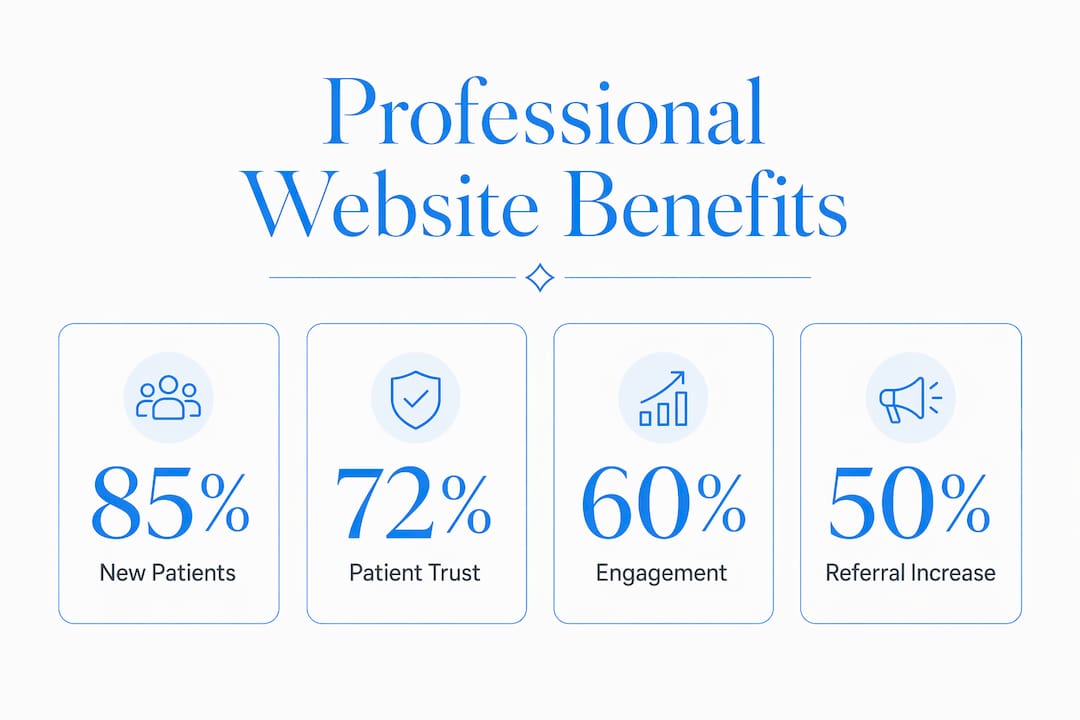
Discoverability is the mechanism that connects patient intent with your clinical services. When someone searches "cardiologist near Glendale AZ" or "pediatrician accepting new patients," your website either appears or it does not. There is no middle ground. The SEO advantages for healthcare practices in 2026 are significant, and physicians who invest in search visibility consistently outperform those who rely on referrals alone.
Getting found requires deliberate effort. Here is how search engine optimization applies specifically to medical websites:
- Claim and optimize your Google Business Profile. This is the single highest-return action a physician can take for local search visibility. It controls what appears in map results and the knowledge panel when patients search your name or specialty.
- Use location-specific service pages. A page titled "Family Medicine in Glendale, AZ" ranks far better than a generic services page with no geographic context.
- Publish condition-specific content. Blog posts and FAQ pages targeting specific diagnoses or procedures capture patients at the research stage of their decision.
- Earn backlinks from local health directories. Listings on Healthgrades, Zocdoc, and the American Medical Association directory signal authority to search engines.
- Optimize for mobile. Over 60% of health searches happen on smartphones. A site that loads slowly or displays poorly on mobile loses those patients immediately.
Social media platforms like Facebook and Instagram are convenient but they are not substitutes for a professional website. Pew Research 2026 data shows social media health information is perceived as less accurate and less personalized than information from provider sources. Convenience without credibility does not convert browsers into patients. For examples of SEO for doctors that translate into real patient growth, the strategy always starts with a strong website foundation.
How web presence improves patient engagement and care pathway clarity
A professional website does more than attract new patients. It shapes how existing patients understand and navigate their care. Pew Research 2026 found that 55% of Americans say health information from healthcare providers is extremely or very easy to understand, 52% say it is highly personalized, and 49% find it very convenient. Those numbers represent a real competitive advantage for physicians who invest in quality web content.
When your website clearly explains care pathways, appointment types, referral processes, and what to expect during a first visit, patients arrive better prepared. That reduces no-shows, shortens intake time, and improves the quality of the clinical encounter. Integrating your site with Electronic Health Records systems like Epic or athenahealth adds another layer of efficiency. Patients who can complete intake forms, review visit summaries, or message their care team through a patient portal linked from your website experience a smoother, more connected care journey.
The table below contrasts what patients experience with a professional medical website versus a practice with no web presence or a poorly maintained one.
| Patient experience factor | With a professional website | Without a professional website |
|---|---|---|
| First impression | Credible, organized, trustworthy | Uncertain, searches competitor instead |
| Pre-visit preparation | Reads FAQs, completes forms online | Calls office with basic questions |
| Appointment scheduling | Books online at any hour | Limited to phone during office hours |
| Health education | Accesses condition-specific resources | Relies on unverified third-party sites |
| Post-visit follow-up | Reviews care instructions via portal | Waits for mailed or faxed materials |
The gap is not subtle. Patients with access to a well-built practice website engage more, cancel less, and refer more often.
What makes a medical website actually effective
Knowing why physicians should have a website is only half the equation. The other half is building one that performs. Common medical website design mistakes include outdated service listings, broken scheduling links, and mismatched promises. That last point is critical. eMarketer 2026 research confirms that patients interpret discrepancies between website promises and real service delivery as low reliability. If your site advertises same-day appointments but your front desk cannot deliver them, you lose trust faster than if you had never made the claim.
Effective medical websites share these characteristics:
- A clear About page with photo, credentials, training history, and a personal statement about your clinical philosophy
- Service pages organized by condition or specialty, not by internal department structure
- A working online scheduling tool that syncs with your actual calendar
- Patient testimonials that are specific, recent, and verified
- A mobile-first design that loads in under three seconds on a 4G connection
- HIPAA-compliant contact forms that do not expose patient data
Navigation matters as much as content. Patients who cannot find what they need within two clicks leave. The best practices for clinic website navigation place scheduling, contact information, and service descriptions within one click of the homepage. Anything buried deeper than that loses a measurable percentage of visitors.
Pro Tip: Audit your website every six months. Check that every phone number, scheduling link, insurance list, and provider bio is current. Outdated information signals to patients that your practice is not attentive, and that perception carries into their expectations of your clinical care.
Key takeaways
A physician's professional website is the single most controllable factor in how patients find, evaluate, and choose a medical practice online.
| Point | Details |
|---|---|
| Trust requires transparency | Websites with visible credentials, evidence citations, and interactive features earn the highest patient trust. |
| Search is the primary discovery channel | 84.1% of patients use search engines for health information, making SEO a non-negotiable investment. |
| Web presence improves care quality | Patients who engage with a practice website arrive better prepared and require less intake time. |
| Promises must match operations | Advertising features like online scheduling that your practice cannot deliver destroys trust faster than having no website. |
| Social media does not replace a website | Social platforms are rated as convenient but less accurate and less personalized than provider-owned web content. |
What I've learned about doctors and their digital presence
After years of working with medical professionals on their web presence, the pattern I see most often is this: physicians underestimate how much work their website is doing before the patient ever walks in. They think of it as a business card. It is actually a triage system, a credibility audit, and a scheduling interface all at once.
The doctors who resist building a professional site usually cite two reasons. They say their referral network is strong enough, or they say they do not have time to manage a website. Both arguments miss the point. A well-built site does not require constant management. It requires one serious investment of time and expertise upfront, then periodic updates. And referral networks, while valuable, do not capture the growing segment of patients who search independently and choose based on what they find.
The other misconception I encounter is that a visually impressive site is enough. It is not. I have seen beautifully designed medical websites that list no credentials, cite no sources, and offer no way for a patient to interact. Those sites look professional but function poorly. Patients notice the absence of substance even when they cannot articulate why they left. The trust-building principles in website design are not optional extras. They are the core product.
My honest advice to any physician reading this: treat your website with the same rigor you apply to your clinical protocols. It represents you to every patient who searches your name before deciding whether to trust you with their health.
— Kate
Build a medical website that earns patient trust

Epdwebsites has designed professional websites for medical practices, attorneys, CPAs, and consultants since 2009. The team understands that a physician's website must do more than look polished. It needs to build credibility, rank in local search, and convert visitors into booked appointments. Every site Epdwebsites builds is mobile-optimized, HIPAA-conscious in its contact design, and structured to reflect the transparency and interactivity that patients now expect. If you are ready to establish a digital presence that reflects the quality of your practice, explore the professional web design options built specifically for healthcare and professional service providers. You can also learn about the AI visibility boost service that improves your search ranking and patient discovery.
FAQ
Why do doctors need a professional web presence?
A professional web presence allows physicians to be found by patients searching online, establish credibility through transparent credentials, and provide a convenient pathway to scheduling care. Without one, practices are invisible to the 84.1% of patients who start their healthcare search on search engines.
What should a medical website include?
An effective medical website includes a detailed About page with credentials, condition-specific service pages, a working online scheduling tool, patient testimonials, HIPAA-compliant contact forms, and mobile-optimized design. These elements together build the trust and usability patients expect.
Does social media replace a professional medical website?
Social media does not replace a medical website. Pew Research 2026 data shows that social media health information is rated as less accurate and less personalized than content from provider-owned sources, making a dedicated website the more credible and effective patient acquisition tool.
How does a website improve patient trust?
A 2026 Scientific Reports study found that patient trust is highest when health websites are both transparent and interactive. Displaying credentials, citing evidence, and offering interactive features like FAQs and scheduling forms are the specific factors that drive trust.
How often should a medical website be updated?
Medical websites should be audited at minimum every six months to verify that scheduling tools, insurance lists, provider bios, and contact information are current. Outdated information signals unreliability to patients and damages the credibility the site is meant to build.