
A professional bio page on an accounting website is a structured personal profile that communicates your credentials, specialties, and client value proposition in one focused location. For CPAs, enrolled agents, and fractional CFOs, this page does more than introduce you. It qualifies prospects, builds trust before the first call, and signals to search engines that a real, credentialed expert stands behind the firm. Done right, a financial professional biography converts visitors into consultations. Done poorly, it costs you clients who never reach out.
What should every accounting professional bio page include?
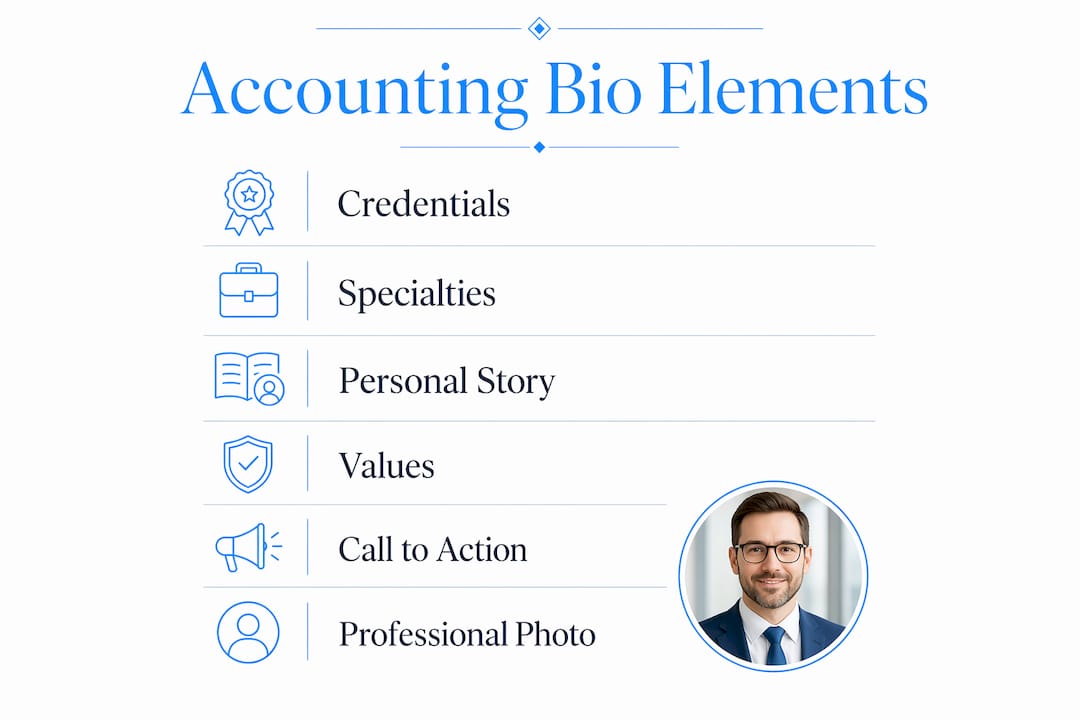
The most effective accounting bio pages share six core elements, and missing even one weakens the overall impression. Start with your credentials stated explicitly. Licenses like CPA, EA, and MAAC should appear in the first two sentences, not buried in a paragraph. Real-world examples like Shannon Duke, CPA at Precision Advisory Group, show that CPA and EA credentials paired with claims like "27+ years of tax planning experience" create immediate authority signals that prospects and search engines both recognize.
Your specialty areas belong in the second element. Tax planning, bookkeeping, multi-state compliance, CFO advisory, and system implementations are all distinct services. Naming them specifically lets a visitor self-qualify within seconds. A business owner searching for a fractional CFO will leave a generic bio immediately, but will read a bio that names their exact situation.

The third element is a personal narrative. A short founding story or career path paragraph humanizes the page and differentiates you from every other CPA in your market. Four or five sentences about why you entered accounting, who you serve, and what drives your practice create a connection that a credential list alone never will.
The fourth element is your professional values. One short paragraph on your working principles, whether that is transparency in pricing, proactive communication, or industry specialization, tells clients what to expect from the relationship.
The fifth element is a single, clear call-to-action. A 2026 personal branding guide confirms that one primary CTA repeated consistently outperforms pages with multiple competing buttons. "Schedule a free consultation" or "Contact us today" placed at the end of the bio is enough.
The sixth element is a professional photograph. A real headshot builds more trust than any stock image. Clients are hiring a person, not a logo.
Pro Tip: Write your bio in the third person for the website page itself, then keep a first-person version for LinkedIn. This gives you a formal, authoritative tone on your site while sounding approachable on social platforms.
How to structure your accounting bio page for maximum engagement
The structure of your CPA personal page matters as much as the content inside it. Research from Webflow developer Pravin Kumar confirms that cutting to five focused sections improves page quality, ease of updating, and AI citation rates compared to sprawling twelve-section pages. The five sections that work best for accounting professionals are:
- Hero section. Your name, title, and a one-sentence value statement. This is the first thing a visitor sees. Make it specific: "Shannon Duke, CPA | Fractional CFO serving mid-market manufacturing firms" beats "Experienced accounting professional."
- Story section. Three to five sentences on your background, career path, and what brought you to your current specialty. Concrete details outperform vague claims every time.
- Team overview. For solo practitioners, this becomes a credentials and specialties block. For firms, it introduces key staff with individual links to their own bio pages.
- Values and principles. A short list or paragraph explaining how you work and what clients can expect. This section does the heavy lifting for client fit.
- Next-steps CTA. A single, direct prompt to schedule a call, send an email, or visit a contact page. Placing the CTA at the bio end with a link to a dedicated contact page is the most effective placement for conversion.
Pages under 1,200 words with focused, concrete content receive 1.4x higher AI entity citation rates than pages over 2,500 words. This means a tighter bio actually performs better in AI-powered search results than a longer one. Resist the urge to add sections for every service you offer.
Pro Tip: Use your H1 heading for your name and title, H2 headings for each of the five sections, and keep paragraphs to three sentences maximum. Visitors scan before they read, and clear heading structure is what keeps them on the page.
For a broader look at how professional CPA websites are structured to maximize engagement, the principles of bio page design connect directly to overall site architecture.
What tools and technical practices make a bio page stand out?
Building a standout accounting bio page requires more than good writing. The technical layer underneath the content determines how search engines and AI systems interpret and cite your page.
Structured data markup is the most overlooked element in accounting website design. Using JSON-LD Person schema with hasCredential arrays and author.url properties linking back to your bio page tells AI systems exactly who you are and what you are qualified to do. The key rule: avoid redundant schema blocks and use recognizedBy and identifier markers to verify credentials. Duplicate schema entries confuse crawlers and dilute your entity authority.
Photography and image format matter more than most accountants realize. A real headshot in WebP format loads faster than a JPEG and signals technical care to visitors. Avoid stock photos entirely. Clients who have seen the same "handshake over a desk" image on three other accounting sites will notice.
Metadata and keyword optimization for the bio page itself should target your name, credentials, and specialty. A page title like "Jane Smith, CPA | Tax Planning and Fractional CFO Services | Phoenix, AZ" performs better than "About Us" in both search rankings and click-through rates.
Accessibility compliance is a practical requirement for professional service websites in 2026. The 2026 accessibility guide for professional sites covers alt text for images, sufficient color contrast, and keyboard navigation, all of which affect both compliance and user experience.
Canonical bio consistency across platforms is the final technical layer. Your website bio functions as the master record. LinkedIn, Google Business Profile, and any directory listings should link back to it. A canonical bio on your website acts as the authoritative source that AI systems use to resolve your identity across the web.
If your bio page collects any client information through a contact form, a clear privacy policy stating how that data is used is required. Accounting firm privacy policies should describe data handling explicitly, including that client information is not sold or rented to third parties.
Common mistakes that undermine your accounting bio page
The most frequent mistake in writing an accountant bio is substituting vague adjectives for concrete proof. Phrases like "dedicated professional" and "client-focused approach" say nothing. Replace them with specifics: "15 years of multi-state tax compliance for e-commerce businesses" tells a prospect exactly whether you are the right fit.
The second major mistake is using multiple CTAs that compete for attention. A bio page with buttons for "Schedule a call," "Download our guide," "View our services," and "Follow us on LinkedIn" creates decision paralysis. One CTA wins every time.
The third mistake is inconsistent first-person use. Some accountants write their bio in first person on their website and third person on LinkedIn, then switch again on directory listings. This inconsistency signals a lack of attention to detail, which is the last impression a financial professional wants to make. Decide on one voice for your website and stick with it across all platforms.
The fourth mistake is ignoring schema markup entirely or implementing it incorrectly with redundant structured data that creates SEO conflicts. A single, clean Person schema block is better than three competing blocks with overlapping properties.
The fifth mistake is letting the bio go stale. A bio that still lists your 2019 credentials and omits a new CPA specialty or a recent industry award tells prospects you are not paying attention. Set a calendar reminder to review and update your bio every six months.
Pro Tip: Ask a current client to read your bio and tell you whether it accurately describes the problem you solved for them. If they say "not really," rewrite the specialty section using their exact words.
Key takeaways
A well-structured accounting bio page built on five focused sections, real credentials, and clean schema markup is the single most effective credibility tool on your accounting website.
| Point | Details |
|---|---|
| Five-section structure | Use hero, story, team, values, and CTA sections to improve clarity and AI citation rates. |
| Credentials front and center | State CPA, EA, or MAAC licenses in the first two sentences, not buried in body text. |
| One CTA only | A single, consistent call-to-action at the bio end outperforms multiple competing buttons. |
| Schema markup required | JSON-LD Person schema with hasCredential arrays increases AI and search engine recognition. |
| Canonical bio consistency | Your website bio is the master record; all external profiles should link back to it. |
Why most accounting bios undersell the person behind the practice
I have reviewed hundreds of accounting websites over the years, and the pattern is almost always the same. The homepage looks polished, the services page is thorough, and then the bio page is three sentences and a stock photo. It is the most personal page on the site and somehow the most neglected.
What I have found is that accountants tend to underestimate how much clients are buying them, not just their services. Two CPAs with identical credentials will win or lose a client based on whether the prospect felt a connection during the research phase. Your bio page is where that connection either forms or fails.
The accountants whose bios actually convert share one trait: they are specific about who they help and what problems they solve. Shannon Duke's bio at Precision Advisory Group names exact business types and risk categories. That specificity lets a prospect read it and think "this person understands my situation." Generic bios never create that moment.
I also want to push back on the idea that a longer bio signals more expertise. The data says the opposite. Concise pages with clear content ownership perform better in both human engagement and AI citation. Write less, say more, and update it regularly as your practice grows.
For solo practitioners especially, the bio page carries more weight than any other page on the site. You are the brand. Treat that page accordingly.
— Kate
How Epdwebsites builds bio pages that work for accounting professionals
Epdwebsites has designed premium websites for CPAs, enrolled agents, and accounting firms since 2009, and the bio page is always a priority in every project. The team understands that a financial professional biography is not just an "About" page. It is a conversion tool, a credibility signal, and a personal branding asset all in one. Epdwebsites builds bio pages using the five-section structure, real photography integration, and schema markup implementation that 2026 best practices require. If you are ready to see what a professionally designed accounting website looks like, explore the web design features built specifically for professional service providers, or browse the completed portfolio for real examples. Contact Epdwebsites today for a personalized consultation.
FAQ
What should I include in my CPA personal page?
A CPA personal page should include your credentials (CPA, EA, MAAC), years of experience, specialty areas, a short personal narrative, your professional values, and one clear call-to-action. Real credentials and specific client types served are the two elements that most directly build trust.
How long should an accountant bio be?
Pages under 1,200 words with focused content receive higher AI entity citation rates than longer pages. Aim for 600 to 900 words across five structured sections for the best balance of depth and scannability.
Why does schema markup matter for an accounting bio page?
Person schema with hasCredential arrays tells AI systems and search engines exactly who you are and what licenses you hold. Clean, non-redundant JSON-LD markup increases the likelihood that your bio is cited in AI-powered search results.
How often should I update my accounting website bio?
Review and update your bio at minimum every six months. Add new credentials, updated specialties, or recent client industries served. A stale bio signals inattention, which is a credibility risk for any financial professional.
Should I write my bio in first person or third person?
Use third person on your website bio page for a formal, authoritative tone. Keep a first-person version for LinkedIn and social profiles. Consistency within each platform matters more than matching the voice across all of them.