
Start here: claim your Google Business Profile and domain name, lock in one clear niche statement, and get a professional headshot within the next 72 hours. Those three moves, done in that order, put the foundation of your real estate agent branding in place before you spend a dollar on logos or color palettes.
Do these three things this week:
- Define your niche and write a one-line UVP. "I help first-time buyers navigate historic district renovations in [your city]" beats "full-service realtor" every time.
- Get a current headshot and match it everywhere. Same photo on your MLS profile, Zillow, LinkedIn, and Google Business Profile. Mismatched photos across platforms quietly erode trust before a lead even calls.
- Claim your domain and Google Business Profile. Entity branding (how search engines and AI tools recognize you as a distinct, trustworthy business) now outweighs visual polish for discoverability.
Watch for these signals at the 90-day mark: a measurable uptick in branded searches for your name, your first 10 Google reviews, and a lower cost per lead compared to your paid-ad baseline. If none of those move, the problem usually isn't your logo. It's your foundation.
Key Takeaways
Real estate agent branding works when you build discoverability first, layer visual identity second, and measure results the whole way through.
| Point | Details |
|---|---|
| Entity before visuals | Claim your Google Business Profile and domain before investing in logo design or color palettes. |
| Photography pays back fast | Professional photos correlate with roughly double the commission versus agents without them. |
| Reviews need a system | Request feedback within seven days of closing; target 10 Google reviews in your first six months. |
| Budget by career stage | Starter agents should plan for $500–$1,500; top producers scale to $15,000 and beyond. |
| Track five KPIs only | Watch CPL, branded search volume, review sentiment, referral share, and content engagement. |
Table of Contents
- Why Real Estate Agent Branding Actually Moves the Needle
- What Actually Goes Into a Strong Agent Brand
- How Do You Build Your Brand at Each Career Stage?
- Which Platforms and Content Should You Prioritize?
- What Should You Track to Know If Your Branding Is Working?
- What Should You Actually Budget, and When Does It Pay Off?
- What Should You Look for in a Web or Branding Partner?
- Why Every Touchpoint Needs to Match
- How Do You Turn Your Personal Story Into a Brand Asset?
- What Legal Rules Apply to Real Estate Branding?
- How Does Local Networking Reinforce Your Brand?
- Can Email Marketing Actually Nurture Your Brand?
- What the Research Actually Says About Building an Agent Brand
- Sources
Why Real Estate Agent Branding Actually Moves the Needle
Agents who invest in professional photography earn roughly double the commission of agents who skip it, and their listings tend to sell faster and closer to asking price, according to RealScout's branding research. That's not a marginal edge. That's the difference between a slow year and a record one, and it starts with something as basic as who's behind the camera.
Consistency compounds that effect. Guides tracking brand execution across industries put the visibility gain from consistent branding at up to 3.5 times, with revenue growth around 23 percent tied to the same discipline, per RealScout's data. Real estate agent branding isn't a nice-to-have layer on top of your business. It's the mechanism that decides whether a homeowner picks you off a search results page or scrolls past you to the next name.
Here's where most agents get the sequence backward. They hire a designer for a logo before anyone can even find them online. Entity branding (your consistent business listings, schema markup, and review profile) is what search engines and AI tools use to verify you're a real, trustworthy operator. Visual branding (your logo, colors, and templates) is what humans see once they've already found you.
Entity branding multiplies the return on visual branding in AI-driven discovery environments. A polished logo attached to an inconsistent, unclaimed business profile is a wasted investment, because the algorithms deciding who shows up first can't verify you exist as a coherent business.
That ordering matters more in 2026 than it did five years ago. AI-assisted search tools now surface agents based on structured data and consistent citations before they ever render a logo on screen, per Jeff Lenney's analysis of real estate branding. Get the entity right first, then let the visual identity reinforce what's already discoverable.
The behavioral shift is real too. A homeowner comparing three agents with similar experience and similar listing history will usually pick the one whose brand feels most specific to their situation. Vague "I sell homes" messaging blends into the pack. A clear niche, backed by visible reviews and a professional presence, gives sellers permission to choose you and to refer you without hesitation. Some agents even command higher commission conversations because their brand signals expertise the seller can't easily find elsewhere.
What Actually Goes Into a Strong Agent Brand
Break your brand into five components you can build and audit individually. Trying to build "a brand" as one abstract project is how agents end up stalled for months. Trying to build five specific things is how they finish in weeks.
- Niche and unique value proposition (UVP). Pick a lane: luxury condos, relocation buyers, military families, historic renovations, whatever matches your actual deal history. Write one sentence that states who you serve and what makes you different, then test it on five past clients. If they nod immediately, it's working. If they ask you to explain, rewrite it.
- Visual identity. This means a current headshot (updated every 2 to 3 years), a simple logo, two or three brand colors, one primary font, and templates for listing flyers and social posts. The goal isn't originality. It's recognition. A client should be able to spot your marketing in a crowded feed without reading your name.
- Website as your home base. Your own domain, not a page buried on your brokerage's site or a free listing aggregator profile. Your homepage should state your UVP above the fold, include neighborhood-specific landing pages if you farm a geographic area, display testimonials prominently, and use basic schema markup so search engines understand who you are and where you operate.
- Reputation infrastructure. Reviews, testimonials, and press mentions are proof, not decoration. Set a minimum goal of 10 Google reviews within your first six months and request each one within seven days of closing, while the transaction is still fresh in the client's mind, per Power Unit Coaching's guidance on agent branding.
- Listing assets. Professional photography, virtual tours, and floorplans aren't optional add-ons for the luxury market anymore. Buyers scroll fast, and listings without polished visuals get skipped regardless of price point.
Here's the practical build order within each component:
- Validate your niche against actual closed deals, not aspirational ones.
- Book a headshot session and update every platform the same week, not over months.
- Buy your domain even if you're not ready to build the full site.
- Set up a simple review-request workflow (text or email) that triggers automatically at closing.
- Standardize your listing photography vendor so every property gets the same quality treatment.
The website deserves particular attention because it's the one asset you fully own. Your MLS profile, your brokerage bio page, your Zillow listing, none of those belong to you. If your brokerage changes its website vendor or you switch companies, that content disappears. A professionally designed website that you control is the only piece of your brand immune to those disruptions, and it's also the piece structured content and schema markup can make visible to AI-powered search tools that increasingly shape how buyers and sellers find agents.
How Do You Build Your Brand at Each Career Stage?
The right investment depends entirely on where you are right now. An agent six months into the business doesn't need what a top producer needs, and spending top-producer money on a starter-stage brand usually means overspending on polish nobody can find yet.
Starter stage (0 to 6 months). Focus on entity and basics only.
- Get a professional headshot and use it everywhere.
- Write your one-line UVP and put it on every profile bio.
- Claim your domain name, even a simple starter site.
- Set up and fully complete your Google Business Profile.
- Pick one social platform and post consistently rather than spreading thin across four.
Budget range: $500 to $1,500, covering a basic starter package with a headshot, a simple AI-assisted logo, and a lightweight website, according to RealScout's cost benchmarks.
Mid-career stage (6 to 24 months). This is where you move from surviving to compounding.
- Invest in a custom website with neighborhood pages and lead capture forms.
- Establish a content cadence (weekly minimum) across your primary platform.
- Build an email list from every closed transaction and open house sign-in.
- Layer in paid ads, but only to amplify content that's already performing organically.
Budget range: several thousand dollars, which typically covers a custom website build, a content system, and initial paid amplification.
Top-producer stage (team level). At this point, branding stops being a personal project and becomes a business system.
- Commission a full custom brand package, including video assets and a refined visual identity across every touchpoint.
- Build advanced SEO infrastructure, including schema markup, structured neighborhood content, and technical site performance.
- Install a real measurement system that tracks lead source, cost per lead, and branded search volume monthly.
Budget range: tens of thousands of dollars and up, scaling with team size and market competitiveness.
Notice the sequencing logic running through all three tiers: entity first, visuals second, paid scale last. Skipping straight to paid ads before your website and Google Business Profile are solid is the single most common way agents waste marketing budget, since owned foundations have to exist before paid channels can amplify them effectively.
Pro Tip: Outsource your website build and professional photography at every stage, since both require technical skill you likely don't have time to develop. Handle your own social captions and client follow-up yourself. Those need your voice, not a contractor's.
Which Platforms and Content Should You Prioritize?
Rank your channels by ownership, not popularity. Your website and Google Business Profile come first because you control them completely. Instagram comes next for visual listing content and local reach. YouTube follows for long-form neighborhood and buyer-education video, which tends to build trust faster than any other format. LinkedIn sits last for most residential agents, useful mainly for referral partnerships with lenders, attorneys, and relocation specialists.
Four content pillars cover nearly everything a residential agent needs to post:
- Market education. Local price trends, inventory shifts, and rate changes explained in plain language.
- Listing showcases. Walkthrough videos, photo carousels, and open house recaps.
- Client stories. Closing photos, testimonial clips, and "why they chose this neighborhood" narratives.
- Personal story. Behind-the-scenes glimpses that show the person behind the license number.
Post weekly at minimum on your primary platform, and repurpose aggressively rather than creating from scratch every time. Film one listing walkthrough video, then cut it into three short clips for Instagram and YouTube Shorts, pull the transcript into a blog post for your website, and send a summary to your email list. One piece of content, four formats, a fraction of the original time investment.
AI tools can speed up drafts, captions, and first-pass editing, but they can't replicate the specific detail that makes your brand yours: the exact street name of the listing, the actual objection a buyer raised, the real reason you chose your niche. Use AI for structure and speed. Keep the specifics human, or your content starts sounding like every other agent's AI-generated feed.
Two quick templates worth stealing:
Neighborhood guide outline: Opening hook (what makes this area distinct) → school and commute data → three to five local business recommendations → current price range and inventory snapshot → closing call to action.
Listing walkthrough script: Address and headline feature (5 seconds) → room-by-room walkthrough highlighting one standout detail per room → neighborhood context → price and showing availability → direct contact prompt.
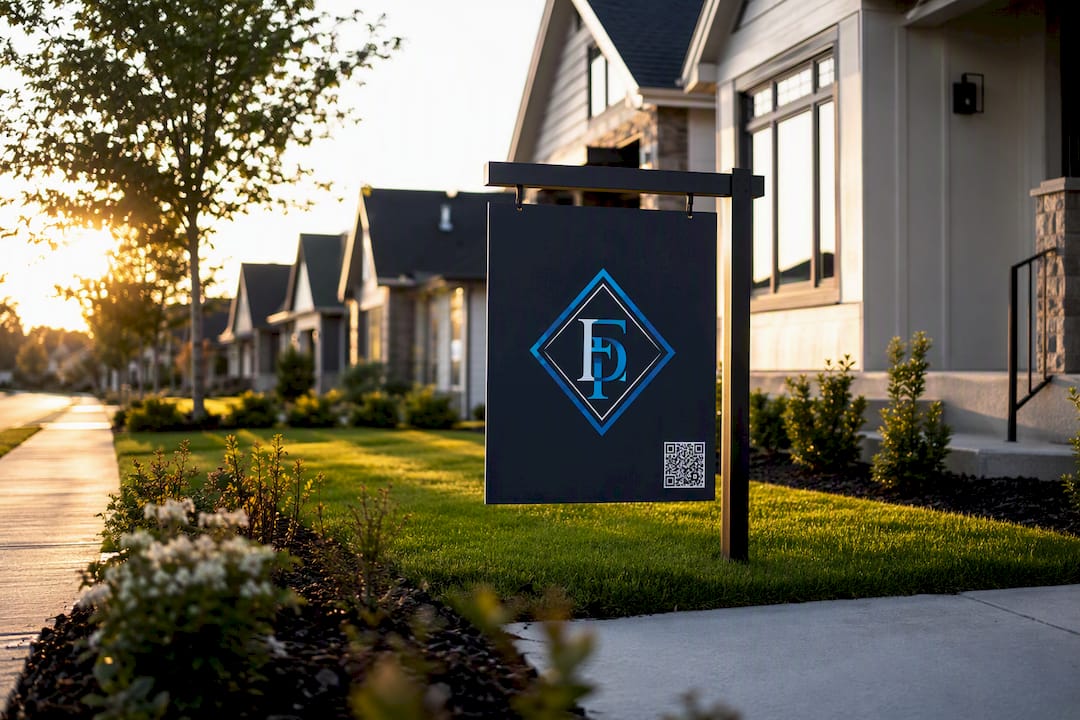
Yard signs still matter more than most digital-first agents assume. Nearly half of buyers report using yard signs as an information source during their search, according to RealScout's citation of NAR data. Adding a QR code to your signage turns that old-school tool into a trackable digital touchpoint.
Pro Tip: Batch a full month of content in one afternoon using the repurposing matrix above. Agents who create content daily under deadline pressure burn out fast; agents who batch monthly stay consistent for years.
What Should You Track to Know If Your Branding Is Working?
Track five numbers, not fifty. Cost per lead (CPL) tells you whether your marketing spend is efficient. Branded search volume, meaning how many people search your actual name each month, tells you whether your reputation is growing independent of any single ad campaign. Review count and sentiment tell you whether past clients trust you enough to vouch publicly. Referral share tells you what percentage of new business comes from past clients rather than cold marketing. Content engagement rounds it out as a leading indicator before leads even show up.
Attribution doesn't require expensive software. Put a QR code on every yard sign and track scans separately from your other channels. Add UTM parameters to every link you share on social media so your website analytics show exactly where traffic originated. Ask a single question on every intake form: "How did you hear about us?" That one field, tracked consistently, often reveals more than a full paid analytics suite.
Reporting cadence should match your career stage. Starter agents can check monthly. Mid-career and top-producer agents should review weekly, since paid spend and content volume are both high enough that a bad week compounds quickly if it goes unnoticed.
Sample targets by stage:
- Starter: 10 Google reviews by month six, one branded search increase per quarter.
- Mid-career: CPL trending down quarter over quarter, referral share above 20 percent.
- Top-producer: branded search volume as the dominant lead source, review sentiment tracked and responded to within 48 hours.
When a metric stalls for two consecutive reporting periods, that's your signal to change something specific, not to overhaul the whole strategy. A flat CPL usually points to a landing page problem. Flat branded search usually points to inconsistent content cadence. Diagnose before you rebuild.
What Should You Actually Budget, and When Does It Pay Off?
Budget in phases, and match spend to what actually reduces your cost per lead or raises your average sale price, rather than spending evenly across every category at once.
Professional photography of yourself and your listings tends to pay back fastest, given the roughly 2x commission difference tied to agents who invest in it. That's a near-term return measured in months, not years.
If your budget is tight, sequence spending this way:
- Headshot and entity setup first (cheapest, fastest payoff).
- Website second, since it's the asset you own permanently.
- Content system third, because it needs the website as a home base.
- Paid ads last, once organic content proves what messaging actually converts.
Here's a simple illustration of how the pieces stack. An agent spending $300 on a professional headshot and pairing it with a conversion-optimized landing page (clear UVP, one call to action, mobile-friendly load speed) commonly sees cost per lead drop within the first one to two months, since profile photo quality and page design directly affect click-through and conversion rates on paid and organic traffic alike. The photo alone doesn't do it. The photo plus a page built to convert does.
What Should You Look for in a Web or Branding Partner?
Since 2009, Epdwebsites has built websites specifically for professional service providers, including real estate agents, attorneys, CPAs, and consultants who need a site that signals credibility the moment a prospect lands on it. That vertical focus matters because a real estate agent's website has different needs than a restaurant's: neighborhood pages, IDX integration considerations, schema markup for local search, and testimonial placement that builds trust fast.
When evaluating any web or branding partner, request specifics rather than accepting vague promises:
- Ask for case studies with real before-and-after metrics, not just visual portfolio samples.
- Ask for a clear timeline with milestones, not an open-ended "it depends" answer.
- Ask what the ongoing maintenance plan includes, since a website that isn't updated and monitored degrades in search rankings over time.
- Ask to see the actual portfolio of completed projects across your specific industry.
A useful case study answers three questions in order: what was the starting metric, what changed, and what's the client's own account of the result. Skip any partner who can't produce that structure.
A strong template to request from any partner looks like this: baseline metric before the project (CPL, site traffic, conversion rate), the specific changes made, the metric after a defined period, and a direct client quote describing the experience. If a partner can't produce that level of specificity, that's worth noting before you sign anything.
Why Every Touchpoint Needs to Match
Inconsistency is the quiet brand killer. A polished website paired with a blurry, outdated headshot on your Facebook profile tells a prospective client your standards are inconsistent, and clients notice inconsistency faster than they notice quality.
Build a simple brand bible, even a one-page document, listing your exact color codes, your approved logo files, your font choices, and your bio copy in both short and long versions. Store it somewhere you can access instantly, because you'll need to hand it to a print shop, a virtual assistant, or a new marketing contractor eventually, and rebuilding it from memory each time wastes hours.
Apply that document everywhere: your yard signs, your business cards, your email signature, your social profile banners, your listing flyers. The goal is that a client who's seen your Instagram post recognizes your yard sign, and a client who's seen your yard sign recognizes your website the second it loads. That recognition is what compounds into referrals, since referring someone is easier when the referrer can describe your brand in one clear sentence.
Revisit the brand bible annually. Update your headshot every two to three years, adjust your color palette only if you're rebranding intentionally, and never let a rushed listing flyer use last year's logo file because nobody could find the updated version. Small inconsistencies pile up into a brand that feels amateur even when the underlying service is excellent.
How Do You Turn Your Personal Story Into a Brand Asset?
Clients don't hire a license number. They hire a person, and the agents who convert best usually have a clear answer to "why real estate, and why you." That story doesn't need to be dramatic. It needs to be specific.
Maybe you grew up in the neighborhood you now farm and know every school district's actual reputation, not just its ranking. Maybe you switched careers from finance and bring a numbers-first approach to negotiation. Maybe you're a parent who understands exactly what a young family needs in a starter home because you've been there yourself. Whatever it is, the specificity is what makes it usable, not the size of the story.
Put that story in three places consistently: your website's about page, your social bio, and the first conversation with a new lead. Keep it to two or three sentences for quick contexts and expand it into a full paragraph for your website, where a client is already invested enough to read further.
The mistake most agents make here is generic positioning: "I'm passionate about helping people find their dream home." That sentence could describe any of the thousands of agents in your market. Specificity is what makes a personal story function as a brand asset instead of filler copy, since a clear point of differentiation naturally repels the leads who aren't a fit and attracts the ones who are.
What Legal Rules Apply to Real Estate Branding?
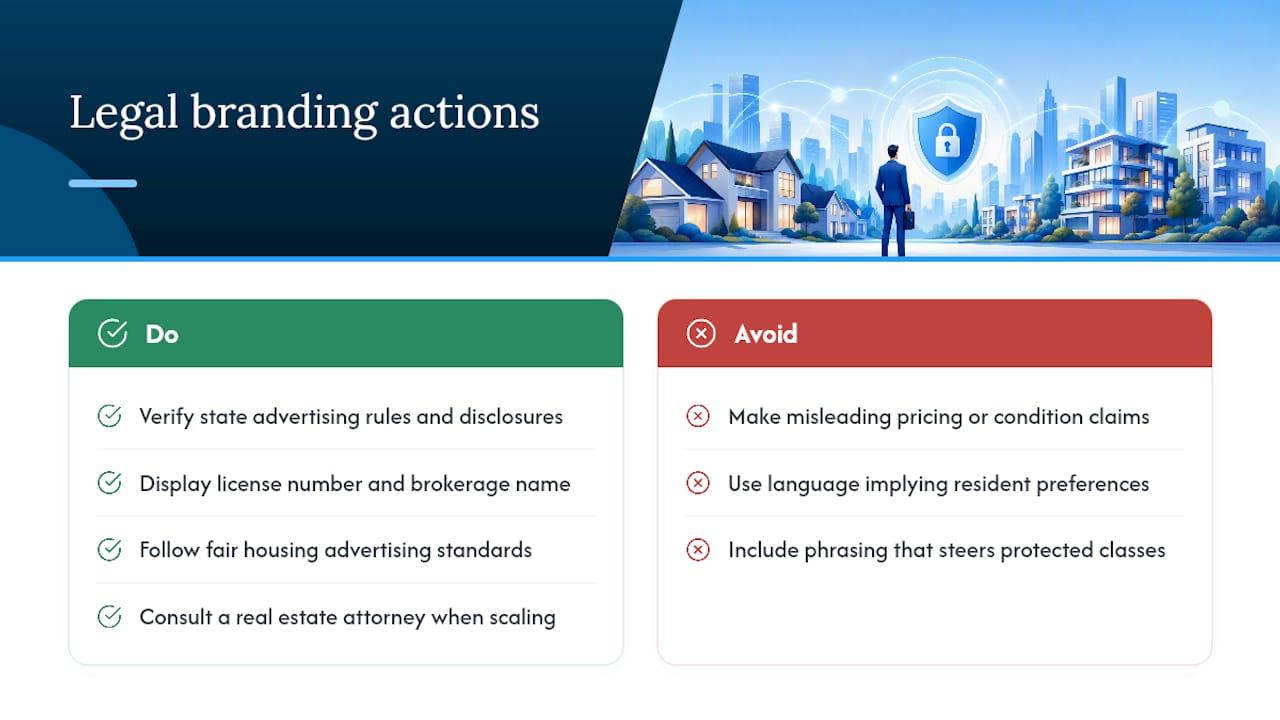
Trademark your name or logo if you're building a long-term brand identity you plan to license or franchise eventually, but for most solo agents, trademark registration is optional rather than urgent. What isn't optional is compliance with your state real estate commission's advertising rules, which typically require your license number, brokerage name, and sometimes your broker's name to appear on marketing materials, signage, and digital ads.
Rules vary by state, so check your specific real estate commission's advertising guidelines rather than assuming national uniformity. Common requirements include disclosing brokerage affiliation on all marketing, avoiding misleading claims about pricing or property condition, and following fair housing advertising standards that prohibit language suggesting preference based on protected characteristics.
Fair housing compliance deserves particular attention in your content and photography choices. Avoid language implying who should or shouldn't live in a neighborhood, and review your listing descriptions for phrasing that could be read as steering buyers based on family status, national origin, or other protected classes.
If you're building a team brand or licensing your name to other agents, consult a real estate attorney about trademark protection and brokerage agreement terms before scaling. For most individual agents building a personal brand, the priority is simpler: confirm your marketing meets your state's disclosure requirements and keep your advertising claims accurate and verifiable.
How Does Local Networking Reinforce Your Brand?
Digital branding gets most of the attention, but local presence still closes deals in ways an Instagram post can't. Sponsoring a youth sports team, joining your local chamber of commerce, or speaking at a community homeowners' association meeting puts your name in front of people who'll remember you specifically when they're ready to sell.
The advantage of local networking is that it reinforces your digital brand rather than competing with it. Someone who meets you at a community event and later searches your name online should find a consistent, professional presence waiting, the same headshot, the same reviews, the same clear niche statement. That alignment between in-person impression and online proof is what converts a friendly acquaintance into an actual referral.
Prioritize recurring visibility over one-off appearances. A single sponsored event generates a brief impression. Showing up consistently at the same farmers market booth, the same monthly networking breakfast, or the same school fundraiser builds familiarity that compounds over a year or two, the same way consistent content posting does online.
Track which local activities actually generate leads by asking your intake form question consistently: "How did you hear about us?" If a specific community event or organization keeps showing up in the answers, double down there rather than spreading effort across every local opportunity that comes up.
Can Email Marketing Actually Nurture Your Brand?
Email remains one of the highest-return channels available to agents, mainly because you own the list completely, unlike a social media following that a platform algorithm controls. Every past client, every open house sign-in, and every website lead capture form should feed into one consistent email list.
Send value before you send asks. A monthly market update, a neighborhood spotlight, or a simple maintenance tip for homeowners keeps your name visible without feeling like a sales pitch every time you land in someone's inbox. Save direct asks, referral requests or "know someone selling?" prompts, for occasional, clearly separated messages.
Segment your list where possible. Past clients need different content than active leads still deciding whether to work with you. A past client wants market trends and home value updates. An active lead wants answers to the specific objections that are keeping them from moving forward.
Consistency matters here as much as anywhere else in your brand. A monthly email that always arrives the same week, with the same visual template and the same voice, builds a small but real expectation in your reader's inbox. That expectation is what keeps your name top of mind for the eighteen months between when someone starts thinking about moving and when they actually list their home.
What the Research Actually Says About Building an Agent Brand
Most branding advice for agents starts with the fun part: logos, colors, photo shoots. The research doesn't support that order. It supports claiming your digital entity first, because that's what determines whether anyone finds you at all before they ever see your color palette.
The conventional advice also underrates measurement. Agents will spend thousands on a rebrand and never track whether branded search volume moved or cost per lead dropped. Without that feedback loop, you're guessing whether the investment worked, and guessing is expensive at real estate marketing prices.
If you take one thing from this guide, prioritize the staged approach: entity, then visuals, then paid scale. Skipping stages doesn't just waste budget. It builds a brand nobody can find in the first place.
— Kate
Sources
- Jeff Lenney: Real estate branding in 2026
- RealScout: Real estate branding strategies
- Keeping Current Matters: Digital marketing playbook for 2026
- Power Unit Coaching: Real estate personal branding