
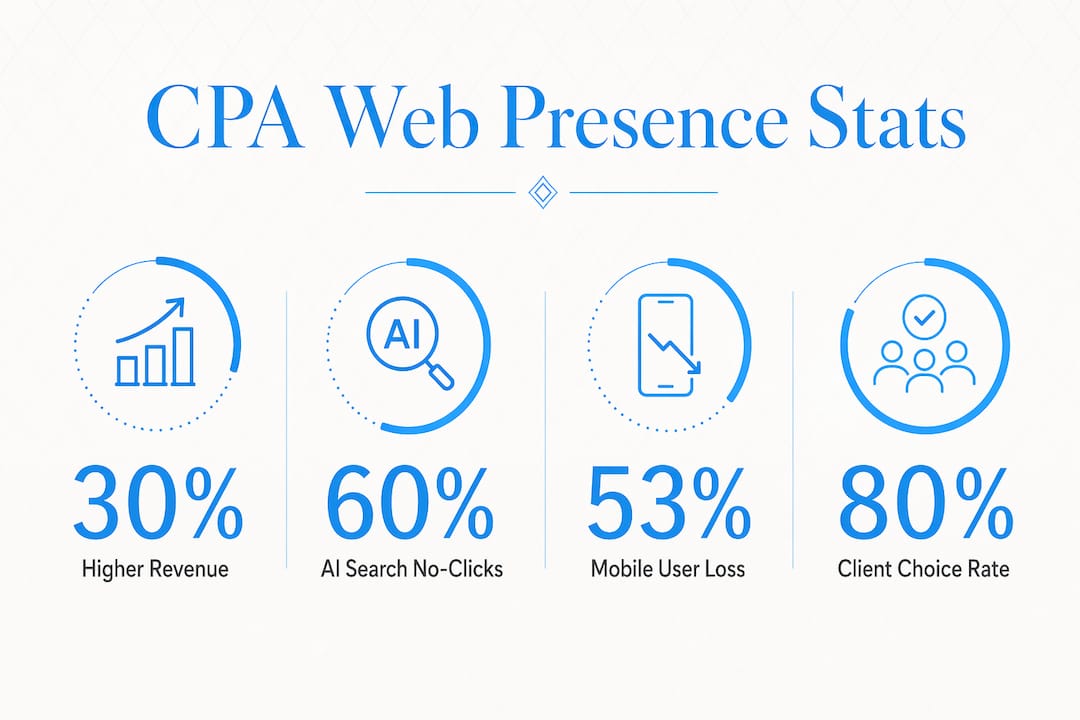
A differentiated web presence is the deliberate strategy of positioning a CPA firm's website and online identity to stand apart from generic competitors by showcasing specific expertise, client outcomes, and a distinct brand voice. Over 80% of business owners research potential accountants online before making contact. That single fact changes everything about how CPA firms must think about their websites. A generic "we do tax and accounting" site no longer earns trust. It earns a back button. Why CPAs need a differentiated web presence comes down to one reality: the firms that clearly communicate who they serve and why they are the right choice win the client. The firms that don't, lose to the ones that do.
Why CPAs need differentiated web presence to win clients
Generic positioning is the most expensive mistake a CPA firm can make online. When your website reads like every other firm's, prospects have no reason to choose you over the next result in Google. A differentiated web presence solves this by making your firm the obvious choice for a specific type of client.
Niche positioning drives measurable revenue results. Firms focused on CFO-level business insights generate over 30% higher monthly recurring revenue than compliance-focused firms. The reason is simple: clients who find a firm that speaks directly to their situation convert faster and stay longer.

Niche focus also triggers what researchers call the recognition effect. When a restaurant owner searches "CPA for restaurant businesses" and your homepage speaks directly to food service tax challenges, you become the obvious referral. Niche focus does not shrink your prospective client pool. It makes you the first name that comes to mind when someone in that niche needs help.
The SEO benefits compound this advantage. Search engines reward depth and specificity. A CPA firm with dedicated service pages for real estate investors, medical practices, and small business owners ranks for more targeted searches than a firm with one generic "services" page. Each niche page captures a different search query and a different type of qualified prospect.
- Build a focused homepage that speaks to your primary client type
- Create deep service pages for each niche you serve
- Use client-outcome language, not service-category language
- Link niche pages internally to reinforce topical authority
Pro Tip: Keep your homepage messaging tightly focused on your primary niche. Then build separate, detailed service pages for secondary audiences. This gives you the conversion power of specificity and the SEO reach of breadth.
What digital marketing strategies actually improve CPA online visibility?
Search engine optimization is the foundation of CPA online visibility. Firms ranking in the top three Google map results receive 67% of all local search clicks. If your firm does not appear in that top tier, the majority of local prospects never see you.
Google Business Profile optimization is the fastest path to local map visibility. A complete profile with accurate categories, service descriptions, photos, and a steady stream of client reviews signals relevance to Google's local algorithm. Directories like Yelp, Bing Places, and industry-specific listings reinforce that signal through consistent name, address, and phone citations.
Content marketing builds authority over time. Structured reputation marketing includes actively requesting reviews, posting educational insights regularly, and optimizing Google Business Profiles to stay top-of-mind and influence local search algorithms. This is not passive word-of-mouth. It is a deliberate, repeatable system.
LinkedIn activity amplifies credibility beyond your website. When a prospect Googles your name and finds a consistent stream of tax insights, client success posts, and professional commentary, your authority is confirmed before the first call. That pre-call credibility shortens sales conversations and raises the quality of inbound leads.
- Claim and fully complete your Google Business Profile
- Build citations across legal directories, Yelp, and Bing Places
- Publish one educational article or post per week on a client question you hear repeatedly
- Request reviews from satisfied clients within 48 hours of project completion
- Maintain consistent NAP (name, address, phone) data across every platform
How should CPA websites be designed to convert visitors into clients?
Website design for CPAs is not about aesthetics. It is about conversion. The first design decision that matters is messaging. Phrases like "trusted accounting services" and "we handle all your tax needs" appear on thousands of CPA websites. They communicate nothing specific and convert poorly.
Replace generic service descriptions with client-outcome statements. Instead of "we offer tax planning," write "we help Arizona medical practices keep more of what they earn." That sentence tells a specific prospect they are in the right place. Targeted calls to action on CPA websites can increase consultation bookings by 285%, and personalized CTAs convert 42% more visitors than generic ones. Every service page needs a clear, specific call to action above the fold.
Real team photos outperform stock images on every metric that matters. Prospects hire people, not logos. A photo of you and your team in your actual office builds more trust in three seconds than any stock photo of a handshake or a calculator.
Site speed and mobile responsiveness are not optional. 53% of mobile users abandon sites that take more than 3 seconds to load. Mobile-friendly sites generate 12% more revenue and 40% more lead generation. That is a direct revenue consequence of a slow or broken mobile experience.
| Design Element | What to Do | Why It Matters |
|---|---|---|
| Homepage headline | Name your primary client type | Triggers recognition and reduces bounce rate |
| Calls to action | Use specific, outcome-focused CTAs | Increases consultation bookings significantly |
| Photography | Use real team and office photos | Builds personal trust before first contact |
| Mobile performance | Load in under 3 seconds | Prevents majority of mobile visitor abandonment |
| Language | Write for clients, not peers | Jargon alienates prospects who are not accountants |
Pro Tip: Run your homepage copy through a readability tool. If it reads above a 10th-grade level, rewrite it. Your clients are smart, but they are not reading your site for a technical education. They want to know if you can solve their problem.
For a deeper look at CPA website design standards that convert, the 2026 guide from Epdwebsites covers the specific features that separate high-performing CPA sites from average ones.
How does AI-driven search change CPA online visibility?
AI search tools are reshaping how prospects find professional services. Nearly 60% of Google searches now end without a click. AI-generated answers appear at the top of results and answer the prospect's question directly, before they ever visit a website. This means your website alone is no longer enough.
The firms that appear in AI-generated answers share a common trait: they publish content that directly answers specific client questions. Content that clearly answers "why" and "how" questions related to tax and advisory services is more likely to be surfaced by AI search than generic service descriptions. A blog post titled "Why Arizona restaurant owners overpay on payroll taxes" will appear in AI answers. A page that says "we offer payroll services" will not.
Third-party credibility reinforces AI visibility. When your name appears consistently across your website, Google Business Profile, LinkedIn, industry directories, and client reviews, AI systems treat you as a verified authority. Inconsistency across platforms signals unreliability and reduces your chances of being cited.
High-growth CPA firms treat digital visibility and thought leadership as intentional growth systems, not chance occurrences. A 10-second first impression on a website influences whether new clients book or move on. Firms that build consistent, credible content across multiple platforms shape client perception before the first conversation ever happens.
Early thought leadership changes the sales dynamic entirely. When a prospect has already read your article on tax strategy before calling, they arrive pre-sold on your expertise. The conversation shifts from "why should I hire you" to "when can we start."
Explore how AI visibility tools from Epdwebsites can help your firm appear in AI-generated search results and maintain authority across platforms.
Key Takeaways
A differentiated web presence is the single most controllable factor determining whether a CPA firm attracts premium clients or competes on price with generic competitors.
| Point | Details |
|---|---|
| Niche positioning drives revenue | Firms with niche-focused messaging generate over 30% higher monthly recurring revenue than generic competitors. |
| Local SEO determines visibility | The top three Google map results capture 67% of local clicks, making optimization non-negotiable. |
| CTAs directly impact bookings | Targeted, personalized calls to action increase consultation bookings by up to 285%. |
| Site speed affects revenue | 53% of mobile users leave sites that load in over 3 seconds, directly reducing lead generation. |
| AI search requires broader presence | With 60% of searches ending without a click, consistent cross-platform content is now required for visibility. |
What I've learned watching CPA firms grow and stall in 2026
The pattern I see most often is this: a CPA firm builds a decent website, gets a few referrals, and then stops. They treat the website as a business card rather than a growth asset. Then a competitor with a sharper niche and a faster site starts taking the clients they should have won.
The firms that grow consistently in 2026 are not the ones with the biggest marketing budgets. They are the ones that publish one useful article per month, ask every satisfied client for a review, and keep their Google Business Profile current. Small, consistent actions compound into authority. One well-written article on a specific tax challenge can generate qualified leads for three years.
The risk of delay is real. High-growth CPA firms deliberately build digital visibility and thought leadership as intentional growth systems rather than relying only on referrals. Firms that wait for referrals to carry them are ceding ground every month to firms that are actively building online authority.
The most important shift I'd encourage any CPA to make is this: stop thinking about your website as a cost and start treating it as your best salesperson. It works 24 hours a day, never asks for a raise, and reaches prospects you would never meet through referrals alone. The firms that internalize that shift are the ones still growing five years from now.
— Kate
Epdwebsites builds CPA websites that stand out and convert
CPAs who want to attract better clients need a website that does more than list services. It needs to communicate expertise, load fast on every device, and guide visitors toward booking a call.

Epdwebsites has specialized in professional web design for CPAs, attorneys, and consultants since 2009. Every site is built with niche-specific messaging, mobile performance, and local SEO in mind. The team handles design, hosting, branding, and ongoing site updates so you can focus on clients. If your current website is not generating consistent inquiries, it is time to see what a purpose-built CPA site looks like. Review the Epdwebsites portfolio to see real examples of professional sites built for firms like yours.
FAQ
Why do CPAs need a differentiated web presence?
A differentiated web presence makes a CPA firm the obvious choice for a specific type of client. Over 80% of business owners research accountants online before reaching out, so a generic site loses prospects to firms with clearer, more specific messaging.
How does niche positioning affect a CPA firm's revenue?
Firms with niche-focused digital messaging generate over 30% higher monthly recurring revenue than compliance-focused competitors. Specific positioning attracts higher-value clients who convert faster and stay longer.
What makes a CPA website convert visitors into clients?
Targeted calls to action, real team photos, client-outcome language, and fast mobile load times are the primary conversion drivers. Personalized CTAs convert 42% more visitors than generic ones.
How does AI search affect CPA online visibility?
Nearly 60% of Google searches now end without a click, meaning AI-generated answers shape client impressions before a website is ever visited. CPAs need content that answers specific "why" and "how" questions to appear in those AI results.
How can CPAs improve their local search rankings?
Optimizing a Google Business Profile, building consistent directory citations, and generating regular client reviews are the most direct paths to local map visibility. The top three map results capture 67% of all local search clicks.