
Yes, you can add IDX to your website right now, and for most agents the fastest MLS-compliant route is a vendor-managed IDX solution built on the RESO Web API. Your immediate next step: contact your local MLS to confirm its IDX policy and request feed credentials. From there, the two decisions that shape everything else are wrapper versus iframe display and vendor-managed versus custom-built integration.
TL;DR:
- Most agents should use a vendor-managed IDX solution built on the RESO Web API for quick, MLS-compliant integration, especially if managing multiple MLS feeds.
- Confirm your MLS's IDX policies, request feed credentials, and decide between wrapper and iframe display methods before starting setup.
- Connecting the IDX feed involves authentication, metadata, search, and media retrieval, with field mapping being the common source of early errors.
- Hosting listing pages on your root domain improves SEO, but using iframes or subdomains may be necessary on platform restrictions like Wix, which can impact indexability.
- Budget typically ranges from $50 to $150 monthly for vendor-managed IDX, with custom builds taking four to twelve weeks or more depending on scope and MLS responsiveness.
Table of Contents
- What Is Realtor IDX Integration, Exactly?
- What Should You Prepare Before Starting Idx Integration?
- How Do You Actually Set Up The Idx Feed?
- How Does Idx Work On Wordpress, Wix, And Other Platforms?
- How Do You Get MLS Approval For Your Idx Site?
- How Do You Turn Idx Traffic Into Real Leads?
- Does Idx Hurt Or Help Your Website's Seo?
- What Does Idx Integration Cost, And How Long Does It Take?
- Is Doing Idx Integration Yourself Actually A Good Idea?
- Ready To Build An Idx Site That Actually Converts?
- Where To Verify These Idx Rules Yourself
- Sources
What Is Realtor IDX Integration, Exactly?
IDX stands for Internet Data Exchange, the system that lets you display active MLS listings from other brokers on your own website, not just your personal listings. Every realtor IDX integration project runs through the same skeleton: a data feed from your MLS, a display layer on your site, and an approval process that confirms you're following the rules for attribution and data use.
The policy foundation comes from the National Association of Realtors, whose Internet Data Exchange (IDX) framework authorizes limited electronic display of MLS listings and sets the display and attribution standards your local MLS enforces. Your specific MLS then layers its own rules on top. Some are stricter about broker attribution placement, some require different refresh intervals, and some have opinions about how a "wrapper" page has to look before they'll turn on your feed.
What Should You Prepare Before Starting Idx Integration?
Handing this checklist to a developer or MLS admin saves you a week of back-and-forth emails.
- Confirm active MLS membership and locate your MLS's specific IDX participation rules.
- Request feed credentials in writing, and ask whether the feed uses RESO Web API or the older RETS standard.
- Decide between vendor-managed IDX and a custom RESO Web API build, and flag now if you need multiple MLS feeds.
- Choose your display method: a wrapper page on your root domain or an embedded widget.
- Identify which CRM fields need to capture lead data (name, email, saved searches, viewed properties).
- Set a testing window for search filters, mobile display, and lead forms before you notify the MLS.
- Schedule your MLS approval notification once the integration is live and verified.
How Do You Actually Set Up The Idx Feed?
Getting the feed live involves a sequence, not a single button. Start with credentials: your MLS will typically ask for your license number, brokerage affiliation, and confirmation that your website meets its display rules before it issues a feed key or API token.
Most MLS organizations now run on the RESO Web API rather than the older RETS standard, and by 2026 that's the dominant format across the country, with data refresh cycles ranging from roughly 15 minutes to a few hours depending on the MLS. RESO Web API tends to be more stable and easier for developers to work with than RETS, which is one reason vendors have largely moved their infrastructure over.
If you're working with a developer on a custom build, the MLS IDX API documentation describes the core transactions you'll rely on:
- Login – authenticates your session before any data request
- Metadata – returns the field structure and lookup values for your specific MLS
- Search – pulls listings based on your query parameters (price, status, location)
- GetObject – retrieves photos and media tied to each listing
Some implementations require digest authentication and active session management, so a developer needs to plan for token expiration rather than assuming one login lasts indefinitely.
Once the feed connects, field mapping is where most early bugs live. Check that photos load at full resolution, price fields match currency formatting, addresses parse correctly into your search filters, and listing status (active, pending, sold) updates on schedule. Run a manual comparison between five or six listings on your site against the same listings on your MLS portal.
Pro Tip: Test your lead capture forms on a listing detail page before you go live, not after. A broken form on a property page is the single most common reason a promising IDX lead never reaches your CRM.
Before calling it finished, verify search filters return accurate counts, listing detail pages load correctly on mobile, and every form actually delivers a test lead to your inbox or CRM.
How Does Idx Work On Wordpress, Wix, And Other Platforms?
Your platform determines how much flexibility you have, and this is where a lot of agents get tripped up.
- WordPress is the most IDX-friendly platform, largely because of plugins like IMPress for IDX Broker, which handle field mapping and generate indexable, root-domain pages automatically.
- Wix and similar builders often restrict dynamic wrapper pages, so Wix integrations usually rely on iframes, HTML embed blocks, or a partner developer to work around the platform's limitations.
- CMS-agnostic sites can use widget or embed codes for a quick setup, but a direct RESO Web API integration gives you more control over layout and SEO if you have developer resources.
- Framing is sometimes unavoidable on locked-down platforms. Document the tradeoff for your MLS approval request: framed pages generally hurt indexability, so note your plan for original content elsewhere on the site.
How Do You Get MLS Approval For Your Idx Site?
MLS approval isn't a formality. It's a checkpoint most agents underestimate until their feed gets delayed over an attribution error.
- Review your MLS's specific display and attribution requirements before requesting credentials. Broker name, MLS logo, and "last updated" timestamps are common non-negotiables.
- Build a working wrapper page first. Vendor documentation on IDX Broker Integration for MLS Approval confirms that many MLSs want to see a live, functioning page before they'll approve full access.
- Once your integration is live and tested, notify the MLS through whatever channel it specifies. Some require an email with your live URL; others use a portal submission.
- Watch for the usual rejection triggers: missing attribution text, broken image links from a mismatched field mapping, or redirects that strip the wrapper page's URL structure. Fix these before resubmitting rather than waiting for a second denial.
How Do You Turn Idx Traffic Into Real Leads?
An IDX feed without a lead strategy is just a free tool for tire-kickers to browse listings anonymously. The fix is in how and when you ask for information.
- Place registration prompts after a visitor views three or four listings, not on their first click. Early gates kill browsing and tank your conversion rate.
- Build saved-search and listing-alert opt-ins directly into search results pages, and confirm the opt-in language matches your MLS's compliance requirements for data use.
- Capture behavioral signals like properties viewed and searches saved, then map those fields into your CRM so a follow-up call references specific homes instead of a generic "saw you signed up" line.
- Set routing rules for team accounts so leads reach the right agent automatically, and QA the pipeline monthly to confirm leads are actually landing where they should.
Pro Tip: Run a test lead through your entire pipeline once a month, from form submission to CRM entry to your phone. IDX integrations quietly break at the routing stage more often than at the feed level, and you won't notice until a hot lead goes cold in someone's inbox.
Does Idx Hurt Or Help Your Website's Seo?
Where your IDX pages live matters more than most agents realize. Hosting listing pages on your root domain, rather than behind an iframe or on a vendor subdomain, generally produces better indexability because search engines can crawl and rank pages under your own site's authority.
- IDX alone isn't an SEO strategy. Listings churn and get reused across hundreds of competing sites, so pair every neighborhood search page with original local content that only you could write.
- Sync frequency and caching affect load speed, and slow listing pages lose mobile visitors before they see a single property.
- Lead forms tied to IDX pages should run over secure connections and follow basic data-handling practices, especially since they're collecting names, emails, and phone numbers.
What Does Idx Integration Cost, And How Long Does It Take?
Budget depends heavily on whether you go vendor-managed or custom.
- Vendor-managed IDX typically runs $50 to $150 or more per month, with add-on fees for extra MLS connections or advanced widgets.
- Custom RESO Web API builds cost more upfront, since developer time for field mapping, wrapper design, and multi-MLS support adds up quickly.
- Timelines run from a few days to two or three weeks for vendor-managed setups, versus four to twelve or more weeks for custom development, depending on MLS responsiveness and scope.
- Before committing, ask any vendor or developer about per-MLS fees, support response times, and what happens if your MLS changes its data standard.
Is Doing Idx Integration Yourself Actually A Good Idea?
Epdwebsites has been building websites for professional service providers since 2009, and IDX projects follow a pattern we've seen play out the same way for over a decade: the feed itself is rarely the hard part. What trips agents up is everything wrapped around it, matching the IDX design to your brand, wiring leads into a CRM without leaks, and keeping pages fast enough that visitors don't bounce before a listing loads.
A vendor subscription handles single-MLS agents just fine. But once you're juggling multiple MLS feeds, custom lead routing across a team, or a site design your brand actually needs to look sharp, that's when hiring a developer earns back its cost in fewer support tickets and cleaner data.
— Kate
Ready To Build An Idx Site That Actually Converts?
Where a vendor plugin gives you a generic search box, Epdwebsites builds the wrapper pages, CRM wiring, and branded design around your IDX feed so the whole site looks like one product instead of a plugin bolted onto a template.

We handle the parts that generic IDX vendors don't touch: custom website design that matches your brand instead of a stock template, hosting built for listing-heavy pages, and CRM field mapping so leads land where your team can actually work them. If you want to see how past projects turned out, our portfolio of completed builds covers a range of professional service sites, including agents who needed IDX done right the first time. When you're ready to talk specifics, review our website features and services and request a quote. Have your current MLS name, feed status, and CRM platform ready. That's the information that gets a project moving fastest.
Where To Verify These Idx Rules Yourself
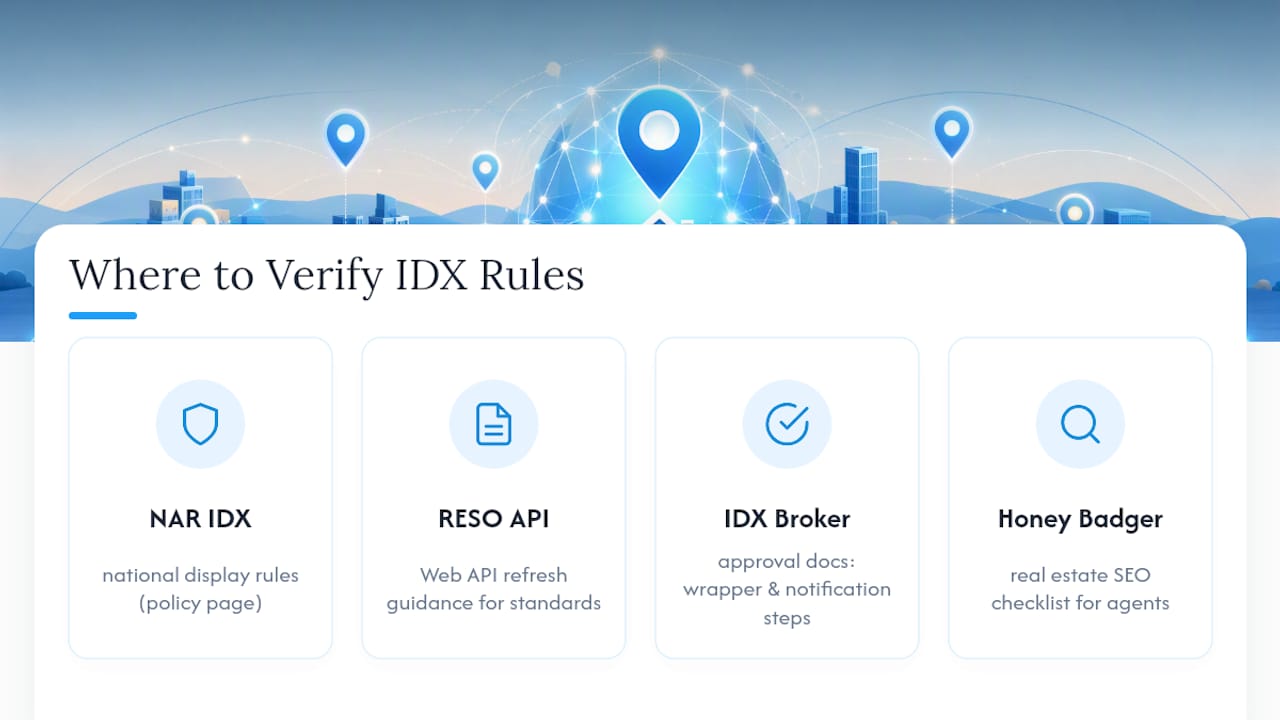
For policy and technical details straight from the source, start with NAR's IDX policy page for national display rules, the RESO Web API refresh guidance for data standards, and IDX Broker's approval documentation for wrapper and notification steps. For SEO groundwork before your feed goes live, agents in competitive coastal markets can also reference Honey Badger SEO's real estate checklist.