
White label hosting is the practice of reselling web hosting services under your own brand while a third-party provider manages the servers, infrastructure, and backend operations. If you have ever wondered what does white label hosting mean in practical terms, the answer is straightforward: your agency or business becomes the visible host to clients, while the upstream provider stays completely invisible. Tools like Web Host Manager (WHM) and cPanel give resellers full administrative control without owning a single server. Providers like SiteGround and GoDaddy operate similar infrastructure models that agencies build on top of.
What does white label hosting mean in practice?
White label hosting allows agencies to act as server administrators without owning data centers, using tools like WHM to manage client accounts entirely under their brand. The parent company's name never appears in any client-facing interface. Your clients see your logo, your nameservers, and your billing portal. The provider's identity stays behind the curtain.
Here is how the operational flow works:
- Infrastructure purchase: You buy server resources or hosting packages wholesale from a provider like SiteGround or a WHM-compatible host.
- Account provisioning: You create individual client accounts inside WHM, each isolated from the others for security.
- Custom branding: You configure custom nameservers (for example, ns1.youragency.com) and a branded billing portal so clients never see the provider's name.
- Client interaction: Clients log into your branded control panel, receive invoices from your business, and contact your support team.
- Backend management: The provider handles server maintenance, hardware, and data center operations without any client contact.
Account isolation is critical to security in this model. Providers offer isolated environments such as individual cPanel accounts or containerized setups, so a breach in one client's site cannot spread to another. That protection matters enormously when you are managing hosting for attorneys, medical practices, or CPAs who handle sensitive data.
Pro Tip: Set up custom nameservers before you onboard your first client. Changing nameservers after the fact disrupts DNS and creates unnecessary downtime that damages your reputation.

The key distinction from simply referring clients to a third-party host is ownership. When you refer a client to GoDaddy, GoDaddy owns that relationship. With white label hosting, you own the billing, the support boundary, and the brand experience from start to finish.
What are the benefits of white label hosting for agencies?
The benefits of white label hosting go well beyond adding a line item to your invoice. This model reshapes how your agency relates to clients and generates revenue.
-
You own the client relationship. Unlike referral programs, white label hosting lets the reseller control billing, pricing, and support rather than earning one-time commissions and handing the client to someone else. That ownership compounds over time as clients renew and expand.
-
Recurring revenue becomes predictable. White label hosting enables predictable recurring revenue and improves client retention by strengthening brand consistency. Monthly hosting fees create a stable income floor that project-based work cannot provide.
-
Upselling becomes natural. When you control the hosting environment, adding SSL certificates, backups, performance upgrades, or security monitoring is a simple conversation. You are already the trusted provider.
-
Brand consistency builds trust. Clients who see your name on every invoice, every dashboard, and every support ticket develop a stronger relationship with your agency. That consistency is impossible when a third-party host's branding appears in their inbox.
-
Security is managed by experts. The reseller handles branding and client relationships while the provider manages server maintenance and backups. You get enterprise-grade infrastructure without the overhead of running it yourself.
"White label hosting is not just reselling server space. It is about owning the client experience while outsourcing infrastructure risk to experts." — WP Agency Stack
Poor third-party hosting is one of the fastest ways to lose a client. When a client's site goes down and they call GoDaddy support instead of you, you lose control of the narrative. White label hosting keeps you in the conversation and in control of the resolution.
How does white label hosting compare to reseller and managed hosting?
These three terms get confused constantly. Understanding the differences helps you choose the right model for your agency.
| Feature | White label hosting | Reseller hosting | Managed hosting |
|---|---|---|---|
| Your brand visible to clients | Yes | Sometimes | No |
| You control billing and pricing | Yes | Yes | No |
| Provider branding hidden | Yes | Partially | No |
| Server management by provider | Yes | Yes | Yes |
| Client relationship ownership | Full | Partial | None |
| Custom nameservers | Yes | Sometimes | No |
| Upsell control | Full | Partial | None |
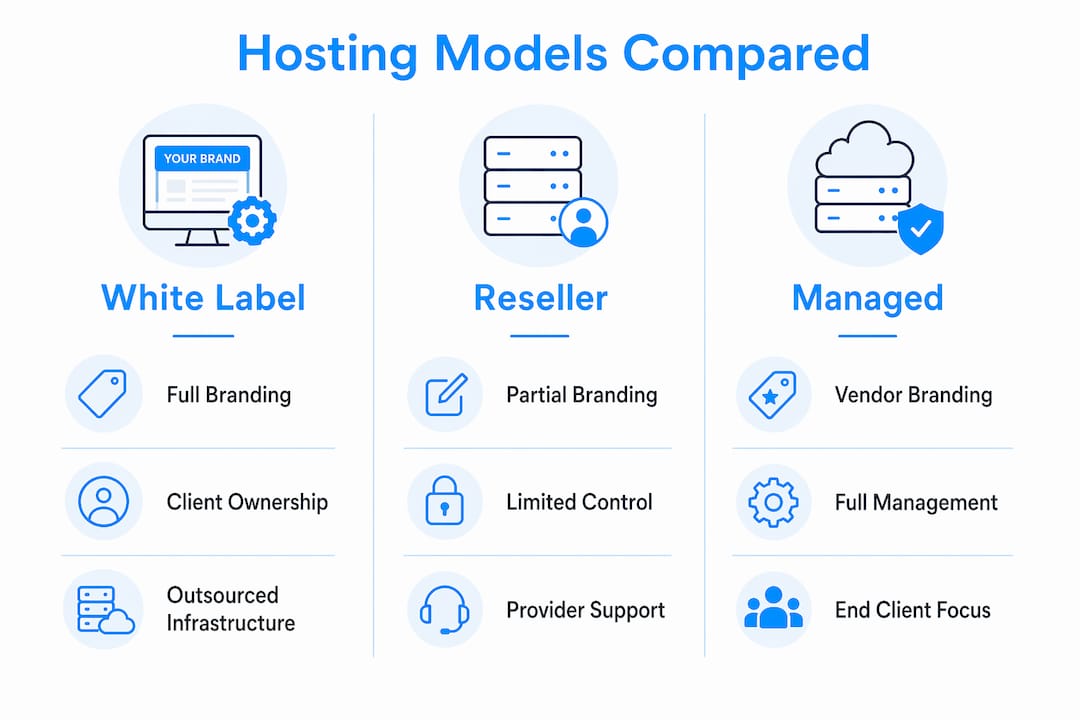
Reseller hosting gives you the ability to sell hosting packages, but the provider's branding often bleeds through in control panels, support tickets, or nameservers. You resell capacity without always controlling the full client experience.
Referral and affiliate programs are the simplest model but the weakest for agencies. You send a client to a provider, earn a one-time or recurring commission, and lose all control. The provider owns the relationship, sets the pricing, and handles support. Compared to managed hosting, white label hosting provides more brand control and client ownership while still leveraging third-party infrastructure.
Managed hosting is typically vendor-branded and designed for end clients who want someone else to handle everything. It lacks the reseller's branding control entirely. A law firm buying managed hosting from WP Engine deals directly with WP Engine. There is no room for your agency's brand in that arrangement.
White label hosting sits at the intersection of full control and outsourced infrastructure. You get the brand authority of running your own hosting company without the capital expense of owning servers. For agencies serving professional service clients, that combination is the strongest available model.
How to choose a white label hosting provider
Choosing the wrong provider is the most expensive mistake an agency can make in this space. Provider choice impacts long-term uptime, client satisfaction, and the agency's reputation, which makes the selection criteria non-negotiable.
Evaluate every candidate provider on these criteria:
- Account isolation: Confirm that each client account runs in an isolated environment, either individual cPanel accounts or containerized hosting. This is your first line of defense against cross-client security incidents.
- Uptime guarantees: Look for a 99.9% or higher uptime SLA with documented monitoring. Anything less puts your clients' sites at risk and your agency's credibility on the line.
- Agency-centric support: Choosing a white label hosting provider requires assessing agency-centric features like proactive support and customizable client portals. You need a provider that treats you as a partner, not just another account number.
- Custom branding tools: Verify that the provider supports custom nameservers, branded billing portals, and white-labeled control panels before you sign anything.
- Scalability: Your hosting infrastructure should grow with your client roster. Ask providers how they handle resource allocation as you add accounts.
- Backup and disaster recovery: Confirm automated backups and a clear recovery process. Clients in legal, medical, or financial fields cannot afford data loss.
For agencies serving professional service providers, you can also review managed hosting considerations specific to regulated industries to understand what compliance and reliability standards your provider must meet.
Pro Tip: Before committing to a provider, host one test client account for 30 days and deliberately contact support three times with technical questions. The quality and speed of those responses tells you exactly what your clients will experience.
Successful agencies choose providers that serve as brand extensions offering professional support and monitoring, not simply server space. That distinction separates a profitable white label operation from a support nightmare.
Key Takeaways
White label hosting gives agencies full brand control and client relationship ownership by reselling provider infrastructure under their own name, making it the strongest hosting model for agencies that prioritize recurring revenue and client trust.
| Point | Details |
|---|---|
| White label hosting definition | You resell hosting under your brand while the provider manages servers and stays invisible to clients. |
| Account isolation protects clients | Individual cPanel or containerized accounts prevent one client's breach from affecting others. |
| You own the client relationship | Billing, pricing, and support stay under your brand, unlike referral or affiliate models. |
| Provider selection is critical | Uptime guarantees, agency support, and custom branding tools determine long-term success. |
| Recurring revenue is the core advantage | Monthly hosting fees create predictable income that project-based work alone cannot deliver. |
Why white label hosting is not as passive as it looks
I have worked with agencies that launched white label hosting expecting it to run itself. It does not. The biggest misconception I see is treating this model as a passive revenue stream. In reality, white label hosting requires active management and consistent brand control to keep clients satisfied and secure.
The agencies that do this well treat their hosting operation like a product, not a side service. They monitor uptime, communicate proactively about maintenance windows, and review their provider's performance quarterly. They also invest in the client-facing experience: clean branded portals, fast support responses, and clear billing. Those details are what separate a hosting operation that builds loyalty from one that quietly erodes it.
Provider partnerships deserve more scrutiny than most agencies give them. I have seen agencies lose multiple clients in a single week because their upstream provider had a major outage and offered no proactive communication. The agency looked incompetent even though the fault was entirely upstream. That is the reputational risk of choosing a provider based on price alone.
Long-term, your brand is only as strong as the infrastructure behind it. Clients in professional services, whether attorneys, CPAs, or consultants, expect their websites to be available around the clock. When you control the hosting relationship, you control the narrative when something goes wrong. That control is worth more than the margin you save by cutting corners on provider quality. For a deeper look at how agency capacity and support scale alongside hosting growth, the operational parallels are worth understanding.
— Kate
How Epdwebsites supports agencies with premium hosting
Epdwebsites has delivered premium web design and hosting services to professional service providers since 2009, and the white label model is central to how we help agencies maintain brand authority with their clients.

Our hosting and design features are built for agencies that serve attorneys, CPAs, real estate professionals, and medical practices. You get branded portals, reliable infrastructure, and direct expert support from a team that understands professional services. We do not hand you a ticket number and disappear. If you are ready to explore a hosting partnership that protects your brand and your clients, review our hosting options and see how Epdwebsites operates as a true extension of your agency.
FAQ
What does white label hosting mean in simple terms?
White label hosting means you resell web hosting services under your own brand while a third-party provider manages the servers and infrastructure. Your clients see only your branding, never the provider's name.
How is white label hosting different from reseller hosting?
Reseller hosting gives you capacity to sell hosting packages, but the provider's branding often remains visible. White label hosting goes further by hiding the provider completely through custom nameservers, branded portals, and white-labeled control panels.
Is white label hosting secure for professional service clients?
Yes, when account isolation is properly configured. Providers use individual cPanel accounts or containerized environments so a security incident in one client's account cannot affect others, which is critical for legal, medical, and financial clients.
Can a small agency realistically offer white label hosting?
A small agency can offer white label hosting without owning any servers. You purchase infrastructure wholesale from a provider, configure branded client accounts via WHM, and manage client relationships directly while the provider handles backend operations.
What is the biggest risk of white label hosting?
The biggest risk is choosing a provider based on price rather than reliability and support quality. Provider outages and poor communication reflect directly on your agency's brand, not the provider's, since clients only see your name on the service.