
A corporate lawyer's portfolio page is a structured digital profile that proves expertise, builds client trust, and signals authority to both human prospects and AI search tools. With over 1.3 million U.S. attorneys competing for the same clients in 2026, a static bio on a firm website no longer separates you from the crowd. Understanding why corporate lawyers need portfolio pages starts with recognizing that these pages function as brand headquarters, not just digital resumes. They combine case outcomes, publications, client testimonials, and thought leadership into one authoritative hub that clients and AI tools both rely on to evaluate your credibility.
Why corporate lawyers need portfolio pages more than ever
A portfolio page is not a resume with a headshot. It is a living, structured digital profile that answers the one question every prospective client asks: "Why should I trust this lawyer with my problem?"
Attorney bios drive roughly 80% of website traffic and are read three times more than any other page on a law firm's site. That number alone tells you where clients go first. They skip the homepage and go straight to the person they are considering hiring.

The importance of lawyer portfolios becomes clear when you understand how clients actually make decisions. They are not evaluating credentials in isolation. They are looking for proof that you have solved problems like theirs before. A portfolio page that shows a $50 million merger you closed, a regulatory crisis you resolved, or a cross-border acquisition you structured tells that story in a way a list of bar admissions never will.
The E-E-A-T framework, which Google uses to assess Experience, Expertise, Authoritativeness, and Trustworthiness, rewards exactly this kind of structured, evidence-rich content. Lawyers who build portfolio pages aligned with E-E-A-T principles rank higher in search results and appear more frequently in AI-generated answers from tools like ChatGPT and Perplexity.
How portfolio pages demonstrate expertise and build client trust
Expertise without proof is just a claim. Portfolio pages convert claims into evidence that clients can evaluate before they ever pick up the phone.
The most effective trust signals fall into three categories:
- Case outcomes and deal summaries. Describe the matter, the challenge, and the result. You do not need to name clients. You need to show the scale and complexity of work you handle.
- Attorney-authored publications. Embedding thought leadership directly into lawyer profiles improves the firm's E-E-A-T signal and builds topical authority for niche legal keywords. A published analysis of Delaware corporate governance or SEC disclosure rules does more for your search ranking than any keyword-stuffed bio paragraph.
- Video case stories and origin narratives. Video case stories answer the trust question better than traditional resumes or bios. A two-minute video where you explain how you approached a complex restructuring creates a personal connection that text alone cannot replicate.
- Client testimonials. Specific, outcome-focused testimonials validate hiring decisions for general counsel and C-suite executives who need to justify their choice internally.
The benefits of corporate portfolios extend beyond first impressions. Clients return to portfolio pages repeatedly to check for new publications, confirm your current practice focus, and assess cultural fit before expanding a relationship. A well-maintained portfolio page keeps you visible at every stage of the client relationship, not just the initial pitch.
Pro Tip: Add a "Recent Work" or "Insights" section to your portfolio page and update it at least quarterly. Fresh content signals to both clients and search engines that you are active and current in your practice area.
For a deeper look at how attorney website design affects client perception, the structural choices you make matter as much as the content you publish.
How do portfolio pages compare to traditional bios?
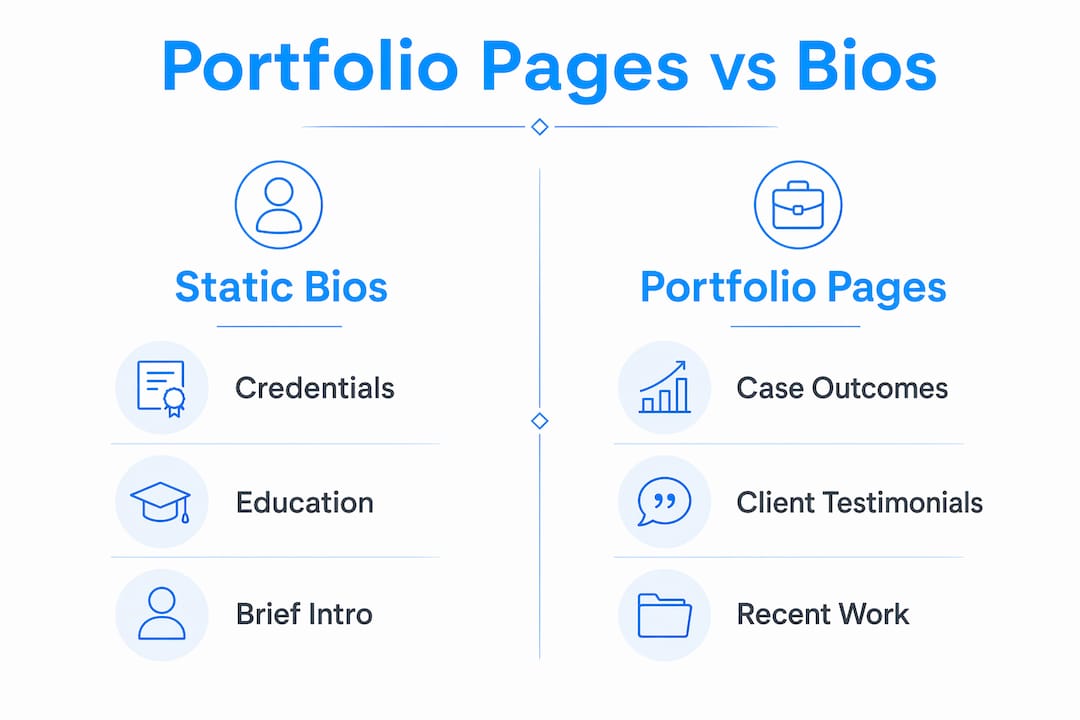
Static bios describe who you are. Portfolio pages prove what you do. That distinction drives every meaningful difference between the two formats.
| Feature | Static bio | Portfolio page |
|---|---|---|
| Content type | Credentials and education | Case outcomes, publications, video, testimonials |
| AI discoverability | Low, minimal structured data | High, rich structured content indexed by AI tools |
| Client trust signals | Weak, credential-only | Strong, evidence-based proof of results |
| SEO value | Minimal, thin content | High, keyword-targeted and regularly updated |
| Client engagement | One-time read | Repeated visits across the client lifecycle |
AI systems require clear, structured, authoritative digital footprints to rank lawyers in their responses. A static bio with your law school and practice areas gives AI tools almost nothing to work with. A portfolio page with publications, case summaries, and structured metadata gives those tools exactly what they need to surface your name when a prospect asks, "Who handles complex M&A transactions in Arizona?"
The legal market is saturated. Clients use profiles to validate hiring decisions and assess cultural fit, not just confirm credentials. A portfolio page that communicates your personality, your approach, and your track record does that work. A static bio does not.
Pro Tip: Treat your portfolio page as your primary marketing asset, not an afterthought. Allocate the same attention to it that you would give a pitch deck for a major client.
What should be in a lawyer portfolio page?
A strong corporate lawyer portfolio page contains five core content types and follows clear design principles that serve both human readers and AI tools.
Core content elements
- Practice area summaries with case context. Write one to two paragraphs per practice area that describe the types of matters you handle and include anonymized deal or case highlights. Specificity builds credibility.
- Publications and thought leadership. Link every article, brief, or client alert you have authored. These pages become indexed assets that target niche legal keywords and build topical authority.
- Client testimonials and peer endorsements. Place these near the top of the page. Proof converts better than promises, and the profile page is the top traffic and engagement driver on most law firm websites.
- Video content. A short origin story or case walkthrough video increases time-on-page and creates the personal connection that drives conversion.
- Certifications, awards, and speaking engagements. These add credibility signals without replacing the outcome-focused content that clients actually care about.
Design and SEO best practices
| Element | Best practice |
|---|---|
| Page architecture | Clear headings, logical sections, fast load time |
| Author attribution | Every publication linked back to your portfolio page |
| Keyword targeting | Practice area terms, jurisdiction, deal types |
| Structured data | Schema markup for person and attorney entities |
| Update frequency | Quarterly minimum, monthly for active practices |
A professional portfolio website centralizes certifications, case history, and your winning track record to establish digital credibility and attract high-value clients. Integration with your firm's practice area pages and your LinkedIn profile multiplies the reach of every piece of content you publish.
How can corporate lawyers use portfolio pages for client acquisition?
Portfolio pages are not passive marketing tools. Used strategically, they drive inbound inquiries, support business development conversations, and keep you visible to clients between matters.
- Inbound discovery. When a general counsel searches for a lawyer who handles cross-border acquisitions in a specific industry, a well-structured portfolio page with relevant publications and case summaries appears in those results. A static bio does not.
- Business development support. Portfolio finance principles show that packaging legal expertise effectively enables lawyers to approach clients with attractive fee arrangements without renegotiating terms individually for each matter. A portfolio page that clearly communicates your expertise and track record supports those conversations before they begin.
- Referral reinforcement. When a colleague refers you to a new client, that client goes directly to your portfolio page to confirm the referral was a good one. A strong page closes that loop. A weak page creates doubt.
- AI search visibility. Modern attorney bios serve both humans and AI, balancing discoverability with authentic human engagement. Lawyers who maintain rich, structured portfolio pages appear in AI-generated answers on ChatGPT, Perplexity, and Google's AI Overviews. Lawyers without them are invisible in those results.
- Client retention touchpoints. Returning clients check your portfolio page for new publications and practice updates. Fresh content keeps you top of mind and signals that you are actively engaged in their industry.
Lawyer portfolio best practices for client acquisition center on one principle: every page element should answer a client's question or remove a barrier to hiring you. The impact of portfolios on legal careers compounds over time as your published content accumulates authority and your case history grows.
Key Takeaways
Corporate lawyers who build structured, evidence-rich portfolio pages gain a measurable advantage in client trust, AI search visibility, and long-term business development over those who rely on static bios.
| Point | Details |
|---|---|
| Portfolio pages outperform static bios | Dynamic content with case outcomes and publications builds trust that credentials alone cannot. |
| AI visibility depends on structure | Lawyers without rich, structured portfolio data are invisible to ChatGPT, Perplexity, and Google AI. |
| Client proof drives conversion | Video case stories, testimonials, and deal summaries convert prospects better than credential lists. |
| Frequent updates compound authority | Quarterly content updates improve E-E-A-T signals and keep clients engaged across the relationship. |
| Portfolio pages support business development | A strong page reinforces referrals, supports fee discussions, and drives inbound inquiries. |
The uncomfortable truth about lawyer visibility in 2026
I have worked with attorneys across dozens of professional service websites, and the pattern is consistent. The lawyers who resist building portfolio pages almost always say the same thing: "My reputation speaks for itself." That belief made sense in 1995. It does not hold up in 2026.
The market has changed structurally. Clients now conduct independent research before they ever contact a firm. AI tools now filter and rank lawyers based on the quality and structure of their digital presence. A lawyer with 30 years of experience and a two-paragraph bio is invisible to those systems. A lawyer with five years of experience and a well-built portfolio page with publications, case summaries, and client testimonials ranks above them in every meaningful channel.
The trust-building function of portfolio pages is not a marketing gimmick. It is the mechanism by which clients decide whether to call you or someone else. Prospective clients are looking for solutions to specific crises. They want proof that you have handled their situation before. A portfolio page that delivers that proof wins the call. One that does not, loses it.
The lawyers I see winning new business consistently are the ones who treat their portfolio page as their primary professional asset. They update it when they close a significant matter. They add publications the week they are released. They treat it the way a surgeon treats their surgical record or an architect treats their project portfolio. The credential is the baseline. The portfolio is the proof.
— Kate
Build a portfolio page that works as hard as you do
Corporate lawyers who invest in a professionally designed portfolio page stop losing clients to competitors with weaker credentials but stronger digital presence. Epdwebsites has built premium websites for attorneys and professional service providers since 2009, with a focus on design that commands respect and content architecture that performs in AI-driven search.

If you are ready to build a portfolio page that reflects the quality of your work, explore the professional portfolio design services at Epdwebsites. Every project includes SEO structure, AI visibility optimization, and the kind of personalized support that gets your page live fast and performing from day one. Visit Epdwebsites.com to see completed projects and get started.
FAQ
Why do corporate lawyers need portfolio pages?
Corporate lawyers need portfolio pages because clients use them to validate hiring decisions, assess expertise, and confirm cultural fit before making contact. Attorney bios drive roughly 80% of law firm website traffic, making them the most critical page on any legal website.
What should a corporate lawyer include in a portfolio page?
A corporate lawyer's portfolio page should include anonymized case outcomes, attorney-authored publications, client testimonials, video content, and practice area summaries with deal context. These elements build the E-E-A-T signals that both clients and AI search tools use to evaluate credibility.
How do portfolio pages improve AI search visibility?
AI tools like ChatGPT and Perplexity require structured, authoritative digital content to surface lawyers in their responses. Profiles lacking rich, organized content are excluded from AI-generated results regardless of the attorney's actual experience.
How often should a lawyer update their portfolio page?
Lawyers should update their portfolio page at minimum quarterly, adding new publications, recent case highlights, and updated practice area content. Frequent updates signal active expertise to both search engines and returning clients.
Are portfolio pages different from a law firm's standard attorney bio?
Yes. A standard attorney bio lists credentials and education. A portfolio page integrates case outcomes, publications, video, and testimonials into a dynamic profile that proves value rather than just stating it.