
Most law firms know they need a website. Far fewer understand why a generic template site is quietly costing them clients. The question of why law firms need custom websites goes deeper than aesthetics. Your website is the first place a prospective client forms an opinion about your firm, and that opinion forms fast. A site that looks like every other attorney's site sends an immediate signal: ordinary. This article breaks down exactly what a custom website does that a template cannot, and why the difference shows up directly in your client intake numbers.
Table of Contents
- Key takeaways
- Why law firms need custom websites to build real credibility
- Custom vs. template: the technical and business gap
- How custom websites turn visitors into clients
- Maintaining and scaling your custom site over time
- My honest take on why firms keep getting this wrong
- Ready to build a site that works as hard as you do?
- FAQ
Key takeaways
| Point | Details |
|---|---|
| Credibility starts online | Tailored attorney bios and practice area pages build trust before a client ever calls your office. |
| Templates limit your growth | Off-the-shelf sites restrict SEO, integrations, and scalability as your firm evolves. |
| Engagement drives inquiries | Custom navigation, calls to action, and mobile optimization convert visitors into actual leads. |
| Hosting is a business decision | Managed hosting with dedicated support protects uptime, security, and lead capture reliability. |
| Your site should scale with you | A custom site can add practice areas, attorneys, and content without starting from scratch. |
Why law firms need custom websites to build real credibility
When a potential client searches for an attorney, they are not just looking for a name. They are looking for confidence. They want to know you have handled cases like theirs, that you understand their situation, and that your firm is the kind of place they can trust with something that matters.
Practice area pages and attorney bios are the content features that do this work. A custom website lets you build those pages around your firm's actual strengths, not around whatever a template happens to offer. A family law attorney in Phoenix has completely different credibility signals than a corporate litigator in Chicago. A template treats them identically. A custom site does not.
Here is what a well-built custom site includes that templates routinely miss:
- Detailed attorney bios that go beyond a headshot and a law school name, covering case experience, client outcomes, and professional philosophy
- Practice area pages written for the specific questions your clients are actually asking, not generic legal descriptions
- Client testimonials placed strategically near calls to action, not buried in a footer
- Resource pages and FAQs that demonstrate your knowledge and answer the questions prospects have before they pick up the phone
- Professional branding that is consistent across your logo, color palette, typography, and photography
Tailored design and client-focused content outperform generic templates in conversions. That is not a design opinion. It is a measurable business outcome. And generic template sites make firms look undifferentiated and less trustworthy in a market where trust is the entire product.
Pro Tip: Ask your web designer to write your practice area pages using the exact language your clients use when they call your office. That alignment between how clients describe their problem and how your site describes your services is what drives both SEO and conversions.
Custom vs. template: the technical and business gap
The most common argument for a template site is cost. It is cheaper upfront. That framing ignores what you are actually paying for when you choose a template. You are paying for a site that was built for everyone, which means it was optimized for no one.
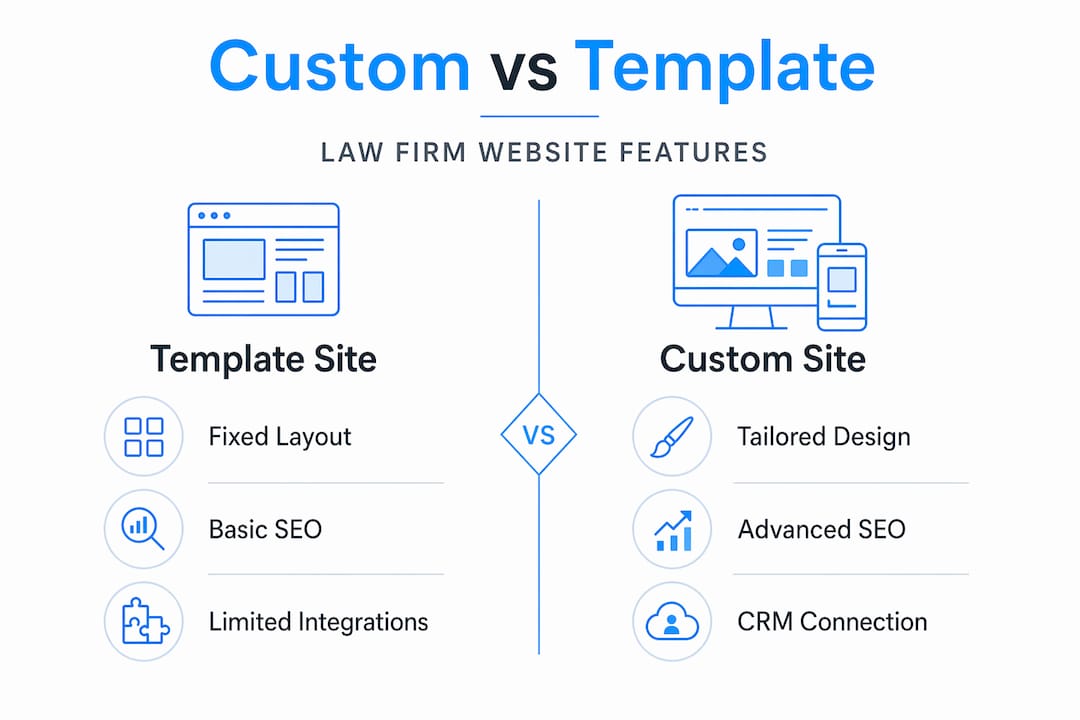
Here is how the two approaches compare on the metrics that actually affect your business:
| Factor | Template site | Custom site |
|---|---|---|
| SEO architecture | Fixed, often bloated | Built for your firm's target keywords |
| Mobile performance | Inconsistent across devices | Designed and tested for mobile first |
| Lead capture forms | Basic, limited customization | Complex intake forms with CRM integration |
| Scalability | Difficult to expand cleanly | Built to grow with your practice |
| Page load speed | Often slowed by unused code | Lean, optimized codebase |
| Brand differentiation | Looks like competitors | Unique to your firm |
Template websites lack the scalability and flexibility that growing law firms need. When you add a new practice area or bring on a partner attorney, a template site becomes a workaround exercise. A custom site accommodates that growth by design.
The technical advantages go further than layout. Integrations like automated contact forms and CRM connections link your website directly to your client intake workflow. When someone fills out a form at 11 p.m. on a Sunday, that lead hits your system immediately instead of sitting in a generic inbox until Monday morning. That speed of follow-up is a real competitive advantage in legal services.

Website hosting directly affects your firm's performance, uptime, and lead generation capabilities. Managed WordPress hosting with dedicated IPs reduces the risks that come with shared hosting, including downtime during high-traffic periods and failed lead notifications. This is not a minor technical detail. It is the infrastructure that determines whether your marketing investment actually pays off.
Pro Tip: When evaluating web developers, ask specifically about your site's hosting environment. Shared hosting plans that put hundreds of sites on one server can drag your load times down and create security vulnerabilities. Dedicated or managed hosting is the right call for any firm that takes client acquisition seriously.
How custom websites turn visitors into clients
Getting traffic to your site is one challenge. Converting that traffic into actual inquiries is a different one entirely. This is where the advantages of tailored law firm websites become most visible, because conversion is a design and content problem, not just a marketing problem.
Here are the specific features that separate high-converting law firm websites from the ones that get traffic and lose leads:
-
Clear calls to action on every page. A visitor should never have to wonder what to do next. "Schedule a free consultation" placed prominently above the fold is worth more than a dozen pages of legal content with no clear next step.
-
Intuitive navigation built around how clients think. Most attorneys organize their sites around practice areas as they define them internally. Clients search by their problem. "I was in a car accident" is different from "Personal Injury." Custom navigation can bridge that gap.
-
Mobile optimization that actually works. Mobile-friendly design improves engagement and search rankings in ways that affect your firm's visibility before a client even reaches your site. Over 60% of legal searches now happen on mobile devices. A site that frustrates mobile users loses those leads immediately.
-
A blog and resource section that answers real questions. Regular content tailored to client questions helps with SEO and builds ongoing trust with visitors who are not ready to call yet. A well-written post on "what to do after a DUI arrest in Arizona" brings in targeted traffic and positions your firm as the obvious next call.
-
Analytics and behavior tracking. Custom sites can be built with proper analytics from day one, showing you which pages convert, where visitors drop off, and which practice areas are driving the most interest. That data shapes every future decision about your site and your marketing.
Pro Tip: Set up goal tracking in Google Analytics for every contact form submission and phone number click on your site. Most firms have no idea which pages are actually generating leads. This data is free and takes about 30 minutes to configure properly.
For a deeper look at how content strategy fits into this picture, the legal content writing guide from Epdwebsites covers exactly how to structure website content that ranks and converts.
Maintaining and scaling your custom site over time
A custom website is not a one-time project. It is an ongoing asset that needs attention to stay effective. The firms that get the most out of their websites treat them the way they treat their client relationships: with consistent care.
Here is what that looks like in practice:
- Managed hosting with proactive monitoring. Managed hosting reduces reactive troubleshooting by providing dedicated support familiar with your site's architecture. When something breaks, it gets fixed before it costs you leads, not after.
- Planned scalability for growth. If you are adding a new practice area or a new attorney to the team, your site should be able to accommodate that without a full rebuild. Custom sites are built with that flexibility in mind.
- Routine maintenance to prevent technical decay. Plugins go out of date, security patches need applying, and forms occasionally break. A maintenance plan catches these issues before they affect your client experience.
- Accessibility and compliance updates. Web accessibility standards continue to evolve. A site that is not accessible to users with disabilities creates both a poor user experience and a potential legal exposure that no attorney should ignore.
- Content updates that reflect your current practice. An attorney bio that still lists a practice area you dropped two years ago, or a blog section that has not been updated since 2022, signals neglect. Keeping your site current is part of keeping your reputation current.
Partnering with a provider who understands professional service websites makes all of this easier. You should not need to become a technical expert to keep your firm's site performing. That is what the right web partner is for. For more on what professional attorney website design involves at a practical level, the Epdwebsites blog covers the full scope.
My honest take on why firms keep getting this wrong
I have worked with professional service providers long enough to see a clear pattern. The firms that resist investing in a custom website almost always frame the decision the same way: "We already have a website. It works fine." What they mean is that it exists and it has not broken. That is not the same as working.
I have seen firms lose leads they never knew they had, simply because their contact form was broken for three months and no one noticed. I have seen attorneys with genuinely impressive track records get passed over by prospective clients who found a competitor's site more reassuring, even though the competitor had less experience. The site made the difference.
What changes the conversation is when a firm starts treating its website as a core business asset rather than a line item. The moment you ask "what is this site costing us in lost leads?" instead of "what does this site cost to maintain?", the math looks completely different.
The internal resistance I hear most often is "our clients come from referrals." That may be true today. But the first thing a referred client does after getting your name is look you up online. What they find either confirms the referral or creates doubt. Your website is doing that work whether you are paying attention to it or not.
— Kate
Ready to build a site that works as hard as you do?
If this article has clarified what your current website might be costing you, the next step is straightforward. Epdwebsites has been building custom professional websites since 2009, with a specific focus on attorneys and white-collar professionals who need sites that command respect and convert visitors into clients.

Every site Epdwebsites builds is designed around your firm's specific practice areas, brand, and client intake needs. That includes managed hosting, professional branding, and the kind of personalized support that means you are never left troubleshooting on your own. You can explore the full range of custom design features built specifically for professional service providers, or browse the completed portfolio to see what a well-built professional website actually looks like. When you are ready to talk, Epdwebsites is ready to listen.
FAQ
Why do law firms need custom websites instead of templates?
Template sites are built for general use and cannot be optimized for a specific firm's practice areas, client intake workflows, or SEO strategy. Custom sites are built around your firm's actual goals and convert visitors at a significantly higher rate.
How does a custom website help a law firm get more clients?
A custom site uses targeted content, clear calls to action, mobile optimization, and integrated lead capture forms to turn website visitors into inquiries. Client-focused content and design consistently outperform generic templates in converting prospective clients.
What website features matter most for law firms?
Attorney bios, practice area pages, client testimonials, a resource blog, and a fast mobile experience are the highest-impact features. Integrating your contact forms with a CRM also dramatically improves follow-up speed and lead conversion.
How does hosting affect a law firm's website performance?
Poor hosting causes downtime, slow load speeds, and failed lead notifications. Managed hosting with dedicated support keeps your site stable, secure, and performing at the level your marketing investment requires.
How often should a law firm update its website?
At minimum, review your site's content, security, and technical performance every quarter. Attorney bios, practice area pages, and blog content should be updated whenever your firm's focus or team changes to keep your online presence accurate and current.