
.CPA is a restricted, CPA-only top-level domain (TLD) run by the AICPA and its technology arm, CPA.com, under ICANN authorization. Only licensed CPA firms and individually licensed CPAs can register one, and every application goes through credential verification before a domain is allocated. The registry publishes a base annual fee, though premium and short names may carry higher pricing. To find out whether your preferred name is still available, check availability and start your application at the official registry now.
At a glance:
- .CPA is a restricted TLD: not open to the public, only to verified CPAs and CPA firms
- Operated by AICPA and CPA.com; authorized by ICANN
- Requires license verification before any domain is allocated
- Base annual fee applies; premium names cost more
- Available in the United States and other jurisdictions including Canada
Key Takeaways
A .cpa domain is a verified, restricted TLD run by the AICPA and CPA.com that only licensed CPAs and CPA firms can register, requiring credential verification before any domain is allocated.
| Point | Details |
|---|---|
| Eligibility is strict | Only licensed CPA firms and individually licensed CPAs qualify; verification against state board records is required. |
| Verification gates allocation | Paying the fee does not guarantee the domain; the registry must confirm your license before allocating the name. |
| Protect your .com | Set up 301 redirects from your existing .com to your .cpa (or vice versa) to preserve SEO equity and catch misdirected traffic. |
| Security benefit is real | Restricted registration makes impersonation harder; automatic WHOIS privacy removes registrant data from scraping exposure. |
| Epdwebsites simplifies the move | Epdwebsites handles registration assistance, DNS/email setup, SSL, hosting, and staged cutovers for CPA firms. |
Table of Contents
- What are .CPA domain names and who runs them?
- Who is eligible to register a .CPA domain?
- How do you register a .CPA domain step by step?
- What does a .CPA domain cost?
- What are the benefits and tradeoffs of a .CPA domain?
- How should you choose your .CPA domain name?
- What technical setup does a .CPA domain require?
- How does .CPA verification reduce phishing risk?
- An editorial perspective on when .CPA is actually worth it
- Epdwebsites handles your .CPA setup from registration to launch
- Sources
What are .CPA domain names and who runs them?
The .cpa TLD is owned and administered by the American Institute of Certified Public Accountants (AICPA) and CPA.com, the AICPA's technology subsidiary. Their authorization to operate the registry came through ICANN's new gTLD program, the same process that created hundreds of industry-specific and community TLDs over the past decade.
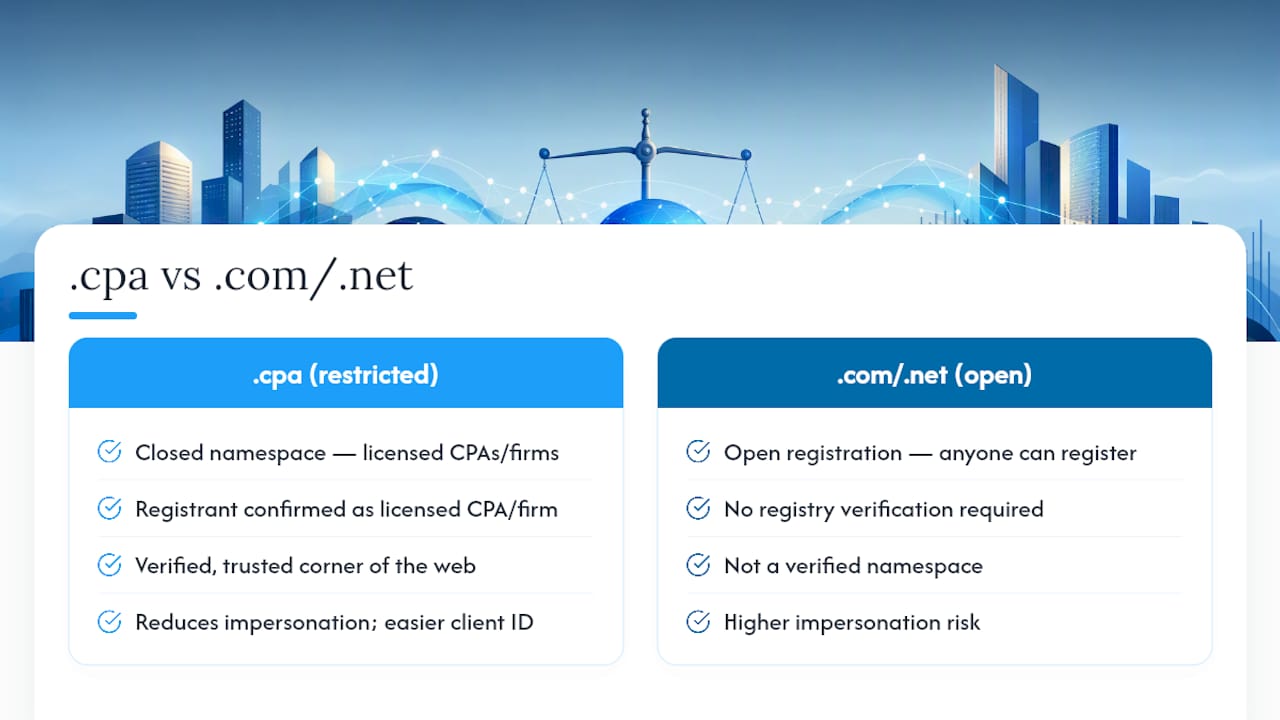
The core purpose of .cpa is restriction. Unlike .com or .net, which anyone can register, .cpa is a closed namespace. The AICPA designed it specifically to give the accounting profession a verified, trusted corner of the web, one where every registrant has been confirmed as a licensed CPA or CPA firm. That restriction is the whole point: it makes impersonation harder and gives clients a fast way to identify a legitimate practitioner.
The AICPA and CPA.com operate a range of member-facing digital services, from AICPA web portals to continuing education platforms, which give them the infrastructure to support the registry at scale. The official registrar for .cpa domains is Encirca, and applications are processed through the domains.cpa portal. The TLD launched in the United States and has since expanded to additional markets, including Canada.
Who is eligible to register a .CPA domain?
Registry FAQs confirm two eligible categories: licensed CPA firms (registered under a firm license) and individually licensed CPAs. A bookkeeper, enrolled agent, or unlicensed tax preparer cannot register one, regardless of how closely their work resembles a CPA's.
Before you apply, gather the following:
- Your state board-issued CPA license number (individual) or firm license number
- The name of the state board that issued the license
- Your existing domain name, if you have one (speeds up the verification process)
- Contact details for the firm's primary license holder
The registry cross-checks license data against state board records. If the information you submit doesn't match what the board has on file, your application will be rejected. Common rejection reasons include a lapsed license, a name mismatch between the application and the license record, or submitting a firm license number when an individual license is required (or vice versa).
Verification turnaround varies. Some applications clear within a few business days; others take longer if the registry needs to follow up with a state board. The domain is not allocated until verification is complete, so paying the fee does not guarantee you get the name.
Pro Tip: Before you submit, log into your state board's public license lookup and confirm your license status is "active" and that your name appears exactly as it does on your CPA certificate. A single character mismatch between your application and the board record is enough to trigger a rejection.
How do you register a .CPA domain step by step?
General Availability is first-come, first-served, but allocation is still gated by verification. Moving fast on a name matters, but accuracy matters more.
- Check availability. Go to register.domains.cpa and search your preferred name. If it's taken or reserved, the registry will show alternatives.
- Submit your application. Enter your license details (firm or individual), the issuing state board, and your contact information. Double-check every field against your license record.
- Registry verification. Encirca and the registry team verify your credentials against state board data. This step is manual and typically takes a few business days, though complex cases can take longer.
- Payment and allocation. Once verification passes, you pay the annual registration fee and the domain is allocated to your account.
- DNS and hosting activation. Log into your registrar account, point the domain's nameservers to your hosting provider, and configure your DNS records. Your site goes live once DNS propagates.
If your preferred name is already taken, the registry's User Agreement includes bad-faith registration prohibitions and a dispute resolution process. A legitimate CPA can still claim a name that matches another firm's trading name, provided they prove eligibility. For reserved or premium names, expect a higher one-time fee on top of the annual renewal.
Pro Tip: If you already have an active .com site, list that domain in your application. The registry can use it to cross-reference your firm's identity, which often speeds up the manual verification step.
What does a .CPA domain cost?
The registry publishes a base annual fee for standard .cpa registrations. Premium names, which include short two- or three-character strings, geographic terms, and high-value keywords, carry higher fees set by the registry at the time of registration.
Renewal pricing mirrors the initial registration fee for standard names. Watch for any registry maintenance or verification renewal requirements in your registrar agreement, since the registry can require periodic re-verification of your license to confirm continued eligibility.
For a small solo CPA practice, the annual domain cost is a single line item. Add hosting and email service costs on top of that, and the total annual spend for a professionally hosted .cpa site is comparable to what many firms already pay for a .com setup. Mid-size firms with multiple partners may also want to register defensive variants (initials, alternate spellings) to prevent name conflicts, which multiplies the domain line item accordingly.
AICPA members should check whether any promotional pricing or member discounts apply at the time of registration. The most reliable place to confirm current rates is the official registry portal, since pricing can change and third-party sources often lag behind.
Pricing note: The registry's published base fee is the floor. Always verify the exact annual cost for your specific name before submitting an application, since premium pricing is applied at the registry level and is not negotiable through the registrar.
What are the benefits and tradeoffs of a .CPA domain?
Security and trust advantages
The restricted namespace is the clearest security benefit. Because only verified CPAs can register .cpa domains, a phisher or impersonator cannot simply register smithcpa.cpa and set up a convincing lookalike site. The registry's privacy protections automatically make registrant contact details private, which reduces exposure to WHOIS scraping and the targeted phishing campaigns that rely on it.
From a branding standpoint, shorter and cleaner second-level domains (SLDs) are available on .cpa that would be long gone on .com. If your firm name is two words, you may be able to register a crisp, memorable name that your .com equivalent can't match.
Tradeoffs worth knowing
- Annual cost. The base fee is higher than a standard .com registration, and premium names cost more still. For a cost-sensitive solo practice, that recurring expense needs a clear return.
- Client confusion. Most people still default to typing .com. A client who hears your domain name verbally may type the .com version out of habit. Owning and redirecting the .com equivalent is not optional; it's necessary.
- Email deliverability. Some older spam filters and corporate mail gateways flag unfamiliar TLDs. A new .cpa email address may land in spam for some recipients until the domain builds a sending reputation. This is manageable with proper SPF, DKIM, and DMARC records, but it's a real consideration during the first few months.
- SEO starting point. A new domain starts with zero domain authority. If your .com has years of backlinks and search history, a hard cutover without proper redirects will cost you rankings.
When .cpa makes sense: Brand-first firms doing a refresh, security-conscious practices handling sensitive financial data, and firms whose preferred .com name is already taken. When to defer: Practices heavily reliant on referral traffic to an established .com, or solo practitioners where the annual cost outweighs the branding benefit.
For a deeper look at how domain choice fits into a broader CPA web presence strategy, the tradeoffs become clearer when you see them in the context of your full site.
How should you choose your .CPA domain name?
The second-level domain (the part before .cpa) is where most of the strategic thinking happens.
Patterns that work well:
- Firm name or abbreviation: smithjones.cpa or sjcpa.cpa. Clean, professional, and easy to say aloud. Works best when the firm name is short.
- City + firm name: austinsmith.cpa. Adds local context and can reinforce geographic SEO signals when paired with location-specific content.
- Initials or acronym: If your firm is already known by its initials (e.g., MBT), then mbt.cpa is a strong, short option.
- Brandable single word: A coined or distinctive word that isn't the firm's legal name but functions as a brand. Higher risk, higher reward.
What to avoid:
- Hyphens (smith-jones.cpa reads as two words and is harder to communicate verbally)
- Long descriptive strings (certifiedpublicaccountingservices.cpa defeats the purpose of a clean namespace)
- Anything that implies a credential or service you don't hold
- Names that closely mimic another firm's established brand
Protect your existing .com. Register it if you haven't already, and set up a 301 redirect from the .com to the .cpa (or vice versa, depending on which you make canonical). This preserves SEO equity and catches clients who type the wrong extension. For more on how naming decisions affect client trust and local acquisition, see this guide on CPA website branding.
Pro Tip: Register at least one defensive variant of your chosen .cpa name — your initials, a common misspelling, or a city-prefixed version — and redirect them all to your primary domain. The cost is low; the protection against name confusion is real.
What technical setup does a .CPA domain require?
Getting a .cpa domain live and running email reliably requires a short but specific checklist. Here are the DNS and email records you'll typically configure:
| Record Type | Example Value | Purpose |
|---|---|---|
| A | your host IP address | Points domain to web server |
| CNAME | www → yourdomain.cpa | Resolves www subdomain |
| MX | mail.youremailprovider.com | Routes inbound email |
| SPF (TXT) | v=spf1 include:youresp.com ~all | Authorizes sending servers |
| DKIM (TXT) | v=DKIM1; k=rsa; p=[key] | Signs outbound email |
| DMARC (TXT) | v=DMARC1; p=quarantine; rua=mailto:you@yourdomain.cpa | Sets policy for failed auth |
| SSL/TLS | Via host or Cloudflare | Encrypts web traffic |
A few notes on each layer:
- Hosting: Any standard web host that supports custom domains works with .cpa. There's nothing TLD-specific about the hosting layer. For guidance on choosing a host that fits a CPA firm's needs, the CPA website hosting guide covers the key selection criteria.
- SSL/TLS: Get a certificate from your host or use Cloudflare's free option. Enable HSTS once the site is stable to prevent downgrade attacks.
- Email deliverability: SPF, DKIM, and DMARC are non-negotiable on a new domain. Without them, your outbound email will fail authentication checks at major providers. Set DMARC to
p=nonefirst to monitor, then tighten top=quarantineorp=rejectafter two to four weeks of clean data. - Registrant privacy: The registry automatically makes your WHOIS contact data private, which reduces scraping exposure from day one.
Checklist before going live:
- DNS propagation confirmed (use a tool like dnschecker.org)
- SSL certificate active and auto-renewing
- 301 redirects from old domain(s) verified
- SPF, DKIM, DMARC records published and tested
- Send a test email from the new address and confirm delivery to Gmail, Outlook, and a corporate domain
Pro Tip: Run a staged cutover. Keep your old domain live and pointing to your site while you test the new .cpa domain on a staging URL. Only flip the public DNS once email flow, SSL, and redirects are confirmed working. Tax season is the wrong time to discover a misconfigured MX record.
How does .CPA verification reduce phishing risk?
Most phishing attacks against accounting clients rely on impersonation: a fake site or email that looks like it came from a real CPA firm. The .cpa registry's verification controls interrupt that pattern at the registration level.
Because every .cpa registrant must prove a valid CPA license before a domain is allocated, a bad actor cannot register a convincing lookalike domain without a real CPA credential. That's a meaningful barrier compared to .com, where anyone can register any available name in minutes with no identity check.
ICANN's materials on new gTLDs frame industry-specific TLDs as a mechanism for adding provenance and trust signals to credentialed communities. The .cpa TLD is one of the clearest examples of that principle in practice: the namespace itself functions as a credential check.
The registry's automatic WHOIS privacy adds a second layer. Phishing campaigns often start with WHOIS data harvesting to identify firm contacts and build targeted lures. By making registrant contact details private by default, the registry removes that data from the equation before a firm even thinks to ask.
For decision-makers: the security case for .cpa is strongest at firms that handle sensitive client financial data, file returns electronically, or operate client portals where impersonation would cause direct financial harm.
An editorial perspective on when .CPA is actually worth it
The .cpa TLD is genuinely useful, but the profession's conversation about it tends to split into two camps: enthusiasts who treat it as a must-have trust signal, and skeptics who see it as an expensive vanity item. Both camps are partly right, and both miss the more practical question.
The real issue isn't whether .cpa is trustworthy. It clearly is. The issue is whether your clients will recognize that trust signal when they see it. For most CPA firms right now, the answer is: probably not yet. The TLD is still building public awareness. A client who receives an email from kate@smithjones.cpa may not know that .cpa is a verified, restricted namespace. They may just wonder if it's a typo.
That doesn't make .cpa a bad investment. It makes the timing of the investment the real decision. Firms doing a full brand refresh, launching a new practice, or building a security-first client portal have the most to gain. The .cpa domain becomes part of a coherent story: new look, new site, verified domain. For a firm that already has strong .com equity and a stable client base, the calculus is different. The cost is real, the client confusion risk is real, and the trust signal benefit may not land for another few years as the TLD gains wider recognition.
The naming strategy matters more than most guides admit. A short, clean SLD on .cpa beats a long, hyphenated .com every time for verbal communication. That alone can justify the switch for firms whose ideal .com name was taken years ago.
Epdwebsites handles your .CPA setup from registration to launch
Getting a .cpa domain live involves more moving parts than a standard .com migration: credential verification, DNS configuration, email authentication records, SSL, and staged cutovers. Epdwebsites has handled this full workflow for CPA firms and professional service providers since 2009.

When you work with Epdwebsites, you get a team that already knows the features a CPA website needs to convert visitors into clients, and that can configure your .cpa domain, email records, and hosting in a single coordinated project. Services include registration assistance and verification document prep, DNS and email setup (MX, SPF, DKIM, DMARC), SSL configuration, hosting, and staged cutovers that keep your existing site live until the new one is confirmed working. The model is a one-time setup fee plus monthly hosting, with no long-term lock-in. To get started, request a quote or review the full service list at Epdwebsites.
Sources
Use these primary sources to verify current rules, pricing, and technical requirements before you apply:
- Register .CPA – Apply for your .cpa Domain Here
- Why .cpa – Register .CPA
- cpa | ICANN New gTLDs
- .CPA web domain launches in Canada | News
- Benefits of new gTLDs — ICANN
Quick navigation: If you're ready to apply, open the registry portal first. If you're still evaluating eligibility, start with the FAQs. For technical DNS and email setup, the registry portal's help documentation and your hosting provider's DNS guide are the two resources you'll use most.