
Custom photography for medical websites is the practice of capturing original images of your actual doctors, nurses, staff, and clinical facilities to create authentic, brand-specific visual content that generic stock photos cannot replicate. Where a stock library offers a smiling model in scrubs, custom photos show real people and real spaces. That distinction matters more than most practice owners realize. Patients research providers before booking. What they see in those first seconds shapes whether they trust you enough to call. This guide covers what custom medical photography involves, how it differs from stock imagery, what HIPAA requires, and how to plan a shoot that produces images you can use confidently across your entire digital presence.
What is custom photography for medical websites?
Custom photography for medical websites means commissioning a professional photographer to capture images of your specific practice. The subjects are your physicians, nurses, front desk staff, exam rooms, waiting areas, and equipment. The result is a library of visual assets that belong exclusively to your brand and cannot appear on a competitor's site.
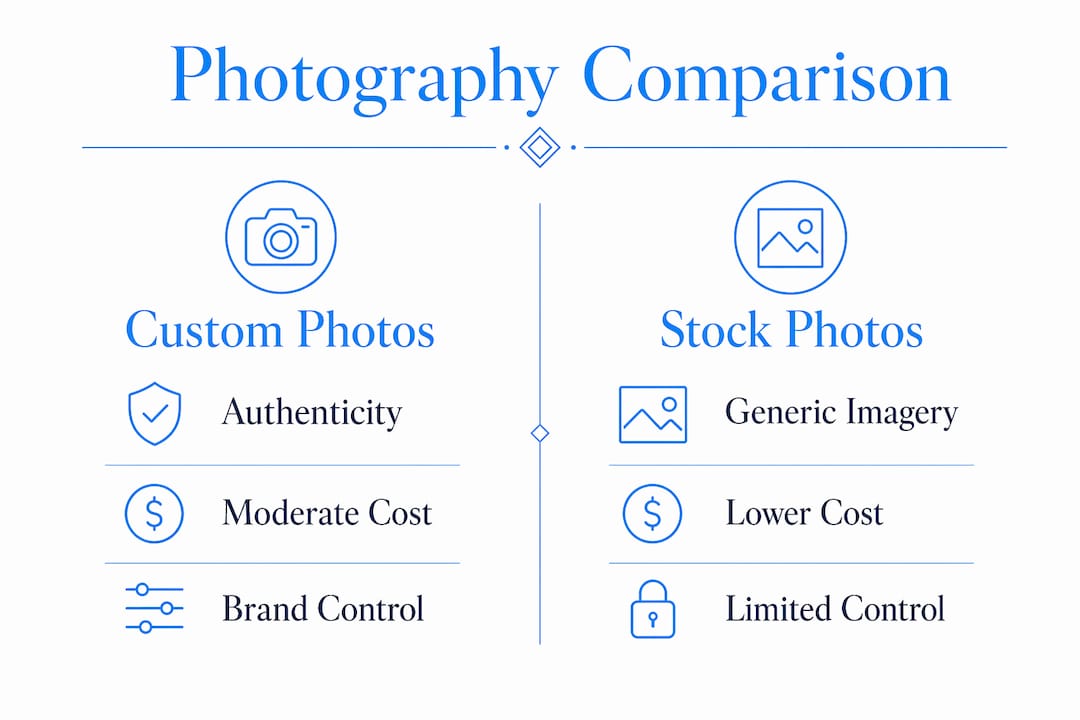
Stock photos cost less and take minutes to download. Custom photography takes days or weeks to plan and execute, and the investment is moderate to significant depending on the scope. The trade-off is control. With custom images, you decide the setting, the lighting, the tone, and the story being told. With stock, you accept whatever the library offers and hope a competing clinic in your city has not purchased the same image.

The industry term for this practice is healthcare brand content photography, and it covers everything from physician headshots to procedure room walkthroughs. Custom images showcase real people and real equipment, which directly increases patient confidence. A prospective patient who sees your actual waiting room and your actual team faces far less uncertainty than one who sees a polished but obviously generic photo. That reduction in uncertainty translates to higher conversion rates and more appointment bookings.
How does custom photography differ from stock photos in healthcare marketing?
The core difference is authenticity, but the practical differences extend to cost, control, and long-term brand risk. The table below maps the key variables side by side.
| Factor | Custom photography | Stock photography |
|---|---|---|
| Cost | Moderate to high upfront | Low per image |
| Turnaround | Days to weeks | Minutes |
| Brand exclusivity | Fully exclusive | Shared across users |
| Patient trust impact | High, shows real team | Lower, generic feel |
| Control over content | Complete | None |
| Compliance risk | Manageable with workflow | Low for non-patient images |
Custom photography requires a real time investment. You need to coordinate staff schedules, prepare the facility, and work with a photographer who understands healthcare environments. That overhead is real. However, building a scalable brand library with consistent lighting, framing, and style pays dividends across every channel you use, from your website to your Google Business Profile to printed brochures.
Stock photos carry a specific risk that healthcare marketers often underestimate. A patient who recognizes a stock model from another website immediately questions your credibility. That moment of doubt is hard to recover from. Custom images eliminate that risk entirely because no other practice has your team.
Pro Tip: Before your shoot, audit your current website for any stock images that appear on competitor sites. A reverse image search using Google Images takes under five minutes and often reveals surprising overlaps.
The conversion argument for custom photography is not theoretical. Custom images reduce patient risk perception materially, which is the same mechanism that drives purchase decisions in any service business. When a patient can see your real office and your real team before they arrive, the first visit feels less like a gamble.
How does HIPAA affect patient and staff photography for medical websites?
HIPAA is the single most important compliance consideration in medical website photography, and it is the area where most practices make avoidable mistakes. The rule is straightforward: patient photos are protected health information (PHI) under HIPAA if they identify an individual and relate to their healthcare or payment. Using a patient's image on your website for marketing purposes without written authorization is a HIPAA violation, regardless of how the photo was taken.
The distinction between treatment use and marketing use is critical. A photo taken during a procedure for clinical documentation purposes does not require marketing authorization. The moment that same photo appears on your website or social media, it requires a separate, specific written authorization from the patient. Masked or partially obscured images may still qualify as PHI if contextual clues, such as a visible tattoo, distinctive background, or unique medical device, allow identification.
Key compliance requirements for patient photography include:
- Written authorization must specify the exact purpose, such as website publication or social media use.
- Authorization must name the specific platforms where the image will appear.
- Patient permission forms specify publication and cannot always be revoked once content is published electronically.
- Retraction is difficult once an image is indexed online, so getting authorization right before publication is far safer than trying to remove content later.
- De-identification must meet the HIPAA Safe Harbor standard, which requires removing 18 specific identifiers. Cropping a face is not sufficient.
Staff and provider photography operates under a different standard. Your physicians, nurses, and administrative team are not patients. A standard model release or employment agreement clause covers their images for marketing use. Separating provider and facility content from patient-identifiable content is the single most effective way to simplify your compliance workflow. Build your primary photo library around staff, facilities, and equipment. Reserve patient photography for cases where you have airtight, documented authorization.
Pro Tip: Create a two-folder asset management system: one folder for staff and facility images with model releases attached, and one for any patient-approved images with HIPAA authorizations stored alongside them. This structure makes compliance audits straightforward and protects you if a patient later disputes consent.
Most medical marketing professionals underestimate the importance of photo consent workflows until they face a compliance audit or a patient complaint. Building the workflow before the shoot costs almost nothing. Rebuilding it after a problem is expensive and stressful.
What steps are involved in planning a custom medical photography shoot?
A well-executed shoot follows a defined workflow. Improvising on the day produces inconsistent results and often requires a costly reshoot. Here is the sequence that professional healthcare photographers use:
-
Pre-shoot consultation. Meet with your photographer to align on your marketing goals, brand colors, and the specific pages where images will appear. A homepage hero image requires different framing than a headshot for a provider bio page. Bring your healthcare website design brief to this meeting so the photographer understands the visual context.
-
Develop a detailed shot list. Categorize shots into three groups: headshots for each provider and key staff member, facility shots covering reception, waiting areas, exam rooms, and any specialized equipment, and action shots showing care delivery such as a consultation or a procedure walkthrough. A shot list prevents gaps and keeps the shoot day efficient.
-
Integrate consent and privacy workflows. Before any camera appears, confirm that every staff member has signed a model release. If any patients will be photographed, obtain written HIPAA-compliant authorization in advance. Managing PHI and non-PHI assets with clear separation and proper document retention is a requirement, not a suggestion.
-
Address lighting and equipment. Medical environments present specific challenges. Fluorescent overhead lighting creates unflattering color casts. A professional photographer brings portable strobes or LED panels to control the light and produce images that look polished rather than institutional. Natural light from windows can supplement artificial lighting effectively in waiting areas.
-
Post-shoot retouching and delivery. A standard healthcare photography workflow includes retouching, color grading, and delivery within five to seven days. Confirm this timeline and the file formats you need, typically high-resolution JPEGs for print and compressed web versions for fast page loading.
-
Clarify usage rights. Confirm in writing that you own full commercial usage rights for web, social media, print, and any future platforms. Some photographers license images rather than transferring ownership, which creates complications when you want to update your website or repurpose images years later.
How to use custom photography effectively across your medical website
Producing great images is only half the work. Deploying them strategically determines whether they actually improve patient engagement.
- Hero images on the homepage should feature your team or your facility, not abstract medical imagery. A patient's first impression of your practice is formed in under three seconds. A real photo of your actual team signals immediately that you are a specific, trustworthy practice.
- Provider bio pages benefit most from consistent headshots with identical backgrounds, lighting, and framing. Mismatched headshots, where one physician has a formal studio portrait and another has a casual smartphone photo, undermine the professional credibility you are trying to build.
- Service pages perform better with contextual images. A page about orthopedic consultations should show a consultation in progress, not a generic skeleton diagram.
- Google Business Profile accepts photos directly and repurposing custom images across your Google profile, social media, and print materials increases your return on the photography investment while reinforcing consistent branding.
- Periodic refresh matters more than most practices acknowledge. Staff turnover, facility renovations, and new equipment all create visual inconsistencies between your website and the actual patient experience. A brief annual or biannual shoot keeps your site current and accurate.
A professional web presence for doctors depends on visual content that matches the quality of care you deliver. Outdated or mismatched photos send the wrong signal before a patient ever walks through your door.
Key takeaways
Custom photography for medical websites works because it replaces generic stock imagery with verified, brand-specific visuals that reduce patient uncertainty and increase appointment conversions.
| Point | Details |
|---|---|
| Define the asset type | Custom photos show your real team and facility, making them exclusively yours and impossible to replicate. |
| Prioritize HIPAA compliance | Patient images require written authorization for marketing use; staff images need only a model release. |
| Follow a structured workflow | Pre-shoot planning, a detailed shot list, and clear usage rights prevent costly reshoots and legal gaps. |
| Deploy images strategically | Place custom photos on hero sections, bio pages, and service pages for maximum patient trust impact. |
| Repurpose across channels | Using the same images on Google Business Profile and social media multiplies ROI without additional cost. |
Why most practices underinvest in photography and pay for it later
I have reviewed hundreds of medical practice websites over the years, and the pattern is consistent. A practice invests in a well-designed site, then populates it with stock photos because the photography budget felt like a luxury. Six months later, the site looks polished but generic. Patients cannot tell it apart from the clinic down the street.
The compliance piece is where I see the most avoidable damage. Practices photograph a grateful patient for a testimonial page, skip the written authorization because the patient seemed enthusiastic, and then face a complaint or audit months later. The image is already indexed. Removing it from Google's cache takes time and effort that far exceeds what a proper consent form would have cost.
My honest observation is that custom photography is not a decorative upgrade. It is a proof point. When a patient sees your actual exam room and your actual physician before their first visit, you have already done a significant portion of the trust-building work. That is a material business advantage, not a vanity expense. The practices that treat photography as infrastructure rather than decoration consistently present better online and convert more website visitors into patients.
— Kate
How Epdwebsites helps medical practices showcase custom photography
Medical practices that invest in custom photography need a website built to display those images at their best. Epdwebsites designs premium websites for medical professionals with layouts optimized for high-resolution imagery, fast load times, and the kind of visual hierarchy that guides patients from a hero photo to a booking form without friction.

Since 2009, Epdwebsites has built websites for physicians, specialists, and healthcare practices across Glendale, AZ, and beyond. The team understands how to structure a site so your custom photography does the heavy lifting on patient trust. If you want to see how custom images perform inside a professionally designed medical site, browse the portfolio or reach out directly to discuss your practice's needs.
FAQ
What is custom photography for medical websites?
Custom photography for medical websites is the process of capturing original images of your real physicians, staff, and clinical facilities for use as website and marketing visuals. Unlike stock photos, these images are exclusive to your practice and cannot appear on any other site.
How much does custom medical photography cost?
Custom medical photography costs more than stock photos upfront, with pricing varying by photographer, shoot duration, and deliverables. The investment is justified by brand exclusivity, stronger patient trust, and full commercial usage rights.
Do patient photos require HIPAA authorization for website use?
Yes. Patient photos are PHI under HIPAA if they identify an individual and relate to their care, and written authorization is required before using them for marketing or website publication.
Can staff photos be used on a medical website without special consent?
Staff and provider photos are not subject to HIPAA patient privacy rules. A standard model release or employment agreement clause covering marketing use is sufficient for physician and staff headshots.
How often should a medical practice update its website photography?
A medical practice should refresh its website photography at least once every one to two years, or sooner after significant staff changes, facility renovations, or the addition of new services or equipment.