
Hosting reliability for law firms is the measure of a hosting provider's ability to deliver secure, uninterrupted, and fast website performance that meets legal industry standards. In the legal profession, this concept goes by a more formal name: service availability assurance. It covers uptime guarantees, data security, regulatory compliance, and the speed at which clients and staff can access your website and documents. Law firm administrators who treat hosting as a commodity purchase are making a costly mistake. Your website is often the first point of contact for a potential client, and a slow or unavailable site signals exactly the wrong thing about your practice.
What is hosting reliability for law firms?
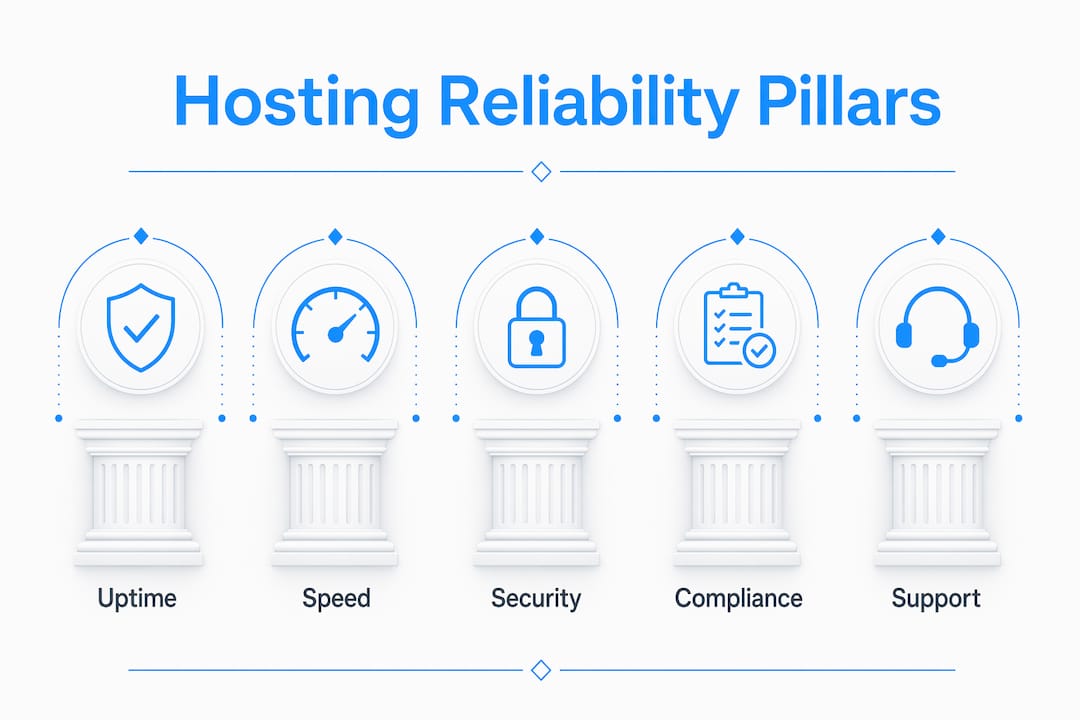
Hosting reliability for law firms is defined by five measurable pillars: uptime, speed, security, compliance, and support. Each one directly affects your firm's ability to serve clients and protect sensitive data. Understanding each pillar helps you ask the right questions before signing any hosting agreement.
Uptime and continuous accessibility
Law firms require 99.9% uptime guarantees as a baseline. That figure translates to less than nine hours of downtime per year. Any provider that cannot commit to this in writing should not be on your shortlist.
Speed and hardware performance

NVMe drives significantly accelerate document retrieval during case preparation. For a firm managing large discovery files, this is not a technical detail. It is a billable-hour issue.
Security measures
Reliable hosting includes SSL certificates, active firewalls, malware scanning, and encrypted data transfer. These are not optional add-ons. They are the minimum standard for any firm handling confidential client communications.
Compliance with legal standards
Hosting must meet ABA, HIPAA, and GDPR standards where applicable. The American Bar Association's Model Rules of Professional Conduct require attorneys to take reasonable steps to protect client data. Hosting that fails this standard creates professional liability exposure.
Backup and disaster recovery
A reliable host runs automated daily backups and maintains a tested recovery process. "Tested" is the key word. Many providers back up data but never verify that restoration actually works.
24/7 live expert support
Live 24/7/365 support with legal tech knowledge is not standard across the industry. Verify that your provider offers human experts, not just automated ticketing. A support delay of 48 hours is unacceptable when a client cannot reach your intake form.
Pro Tip: Ask any hosting provider to show you their last backup restoration test. If they cannot produce documentation, treat that as a red flag.
How does hosting reliability affect client experience and firm performance?
Hosting lapses carry real costs. They are not abstract IT problems. They show up as lost clients, damaged reputation, and lower search rankings.
The speed problem
Bounce rates increase by 32% when a website takes more than three seconds to load. For a law firm, a visitor who bounces is a potential client who called someone else. Speed is not a design preference. It is a client acquisition factor.
The SEO problem
Slow hosting negatively affects Google Core Web Vitals, which directly reduces your firm's search visibility. Google measures load time, interactivity, and visual stability as ranking signals. A host that cannot deliver fast server response times will cost you organic traffic regardless of how well your content is written.
The trust problem
A security breach or data leak does not just expose client information. It triggers bar association reporting obligations, potential malpractice claims, and the kind of press coverage no firm wants. Reliable hosting with active threat monitoring prevents most breach scenarios before they escalate.
The eDiscovery problem
Fast data access matters beyond the client-facing website. Firms that store case files on hosted platforms need audit trails and data sovereignty that can withstand court scrutiny. A hosting provider that cannot demonstrate a defensible chain of custody creates risk in litigation.
| Hosting failure type | Direct consequence | Risk level |
|---|---|---|
| Downtime during business hours | Clients cannot reach intake forms or contact pages | High |
| Slow load times over 3 seconds | 32% increase in bounce rate, lost leads | High |
| Security breach or data leak | Bar reporting obligation, malpractice exposure | Critical |
| No audit trail for hosted data | eDiscovery defensibility compromised | Critical |
| 48-hour support delays | Extended outage, client communication failure | High |
The pattern across all five failure types is the same. Hosting problems that look like IT issues are actually client service and compliance issues.
How to choose a hosting provider for your law firm
Choosing the right host requires a structured evaluation, not a price comparison. The attorney website hosting guide from Epdwebsites outlines the core criteria legal professionals should apply. Use this process to evaluate any provider.
-
Confirm the uptime SLA in writing. A service level agreement that guarantees 99.9% or higher uptime, with defined penalties for failure, is non-negotiable. Verbal assurances do not count.
-
Identify the hosting type that fits your risk profile. Shared hosting increases confidentiality risk; VPS and dedicated hosting are preferred for law firms. Cloud hosting offers traffic flexibility, and 94% of enterprises now use cloud services, but cloud costs more than VPS at comparable performance levels. Match the hosting type to your firm's size and data sensitivity.
-
Ask about data sovereignty. Where are your servers physically located? Can the provider guarantee that your data stays within U.S. jurisdiction? For firms subject to state bar rules or federal regulations, this question has a compliance answer, not just a preference answer.
-
Verify backup and recovery procedures. Ask how often backups run, where they are stored, and how long restoration takes. Request documentation of a recent test.
-
Test the support channel before you sign. Call or chat with support at an off-hour. Measure how long it takes to reach a human who understands legal hosting requirements. 24/7 live support is not standard, so verify it directly rather than assuming it from the marketing page.
-
Review compliance certifications. Ask for documentation of ABA, HIPAA, or GDPR compliance measures. A provider that cannot produce this documentation is not equipped for legal industry clients.
-
Calculate the true cost of downtime. A cheaper hosting plan that goes down twice a year costs more in lost business than a premium plan with a strong SLA. Factor risk into the price comparison, not just the monthly fee.
Pro Tip: Cloud hosting handles traffic spikes well. If your firm is involved in a high-profile case that drives sudden web traffic, a cloud-based host will absorb that surge without crashing your site.
What common mistakes compromise law firm hosting reliability?
Most hosting failures at law firms trace back to decisions made at the start of the vendor relationship, not to technical failures mid-contract.
-
Choosing shared hosting to reduce costs. Shared hosting places your site on a server with hundreds of other websites. A traffic surge or security incident on any neighboring site can degrade your performance or expose your data. The cost savings do not offset the confidentiality and performance risk.
-
Ignoring data residency requirements. Some firms select offshore hosting without realizing it creates compliance problems under state bar rules or federal data protection standards. Always confirm server location before signing.
-
Accepting automated support as sufficient. A ticketing system that responds in 48 hours is not support. It is a liability. When your site goes down during a filing deadline or client emergency, you need a human on the phone, not a ticket number.
-
Skipping backup verification. Automated backups that have never been tested are not a safety net. They are a false sense of security. Require your provider to demonstrate a successful restoration before you commit.
-
Underestimating the SEO impact of slow hosting. A firm that invests in content marketing and paid search but runs on slow hosting is undermining its own investment. The law firm website benefits that drive client acquisition depend on fast, reliable delivery.
"The most expensive hosting decision a law firm makes is the one that prioritizes the monthly invoice over the annual cost of downtime, data exposure, and lost clients."
What I've learned about hosting reliability after years in legal web services
After working with attorneys, CPAs, and other professional service providers since 2009, I have seen the same pattern repeat itself. Firms that treat hosting as a background expense eventually face a foreground crisis.
The most common scenario I encounter is a firm that built a strong website, invested in good design, and then placed it on a shared hosting plan because it was included in a package deal. The site looks professional. The hosting is not. When a high-profile case brings traffic to the site, or when a security scanner flags a vulnerability, the firm discovers that their "support" is a form submission with a three-day response window.
The security threat environment has also changed. Ransomware attacks on professional service firms have increased sharply in recent years. A firm's website is not just a brochure. It is a data collection point, a communication channel, and in some cases a document portal. Each of those functions requires a hosting environment that actively monitors for threats, not one that reacts after the damage is done.
Cost is always part of the conversation, and I understand that. But the right framing is not "how much does hosting cost?" It is "what does a hosting failure cost?" When you calculate lost clients, bar reporting obligations, and recovery time, the premium for reliable hosting looks very different.
— Kate
Epdwebsites hosting solutions built for legal professionals
Law firms that need reliable, compliant hosting should not have to piece together a solution from generic providers.

Epdwebsites has served attorneys and professional service providers since 2009, building websites and hosting environments that meet the performance and security standards the legal industry requires. The hosting and web design features Epdwebsites offers include uptime guarantees, SSL security, and direct support from a team that understands what legal professionals need from their online presence. If your current hosting arrangement cannot answer the questions raised in this article, it may be time to review your options. You can also explore hosting payment options to find a plan that fits your firm's budget without compromising on reliability.
Key takeaways
Hosting reliability for law firms requires uptime guarantees, active security, compliance documentation, and live expert support. Firms that treat hosting as a commodity purchase accept risks that show up as lost clients, compliance failures, and damaged reputation.
| Point | Details |
|---|---|
| Uptime is non-negotiable | Require a written SLA guaranteeing 99.9% or higher uptime before signing any hosting agreement. |
| Speed affects client acquisition | Bounce rates rise 32% when load times exceed three seconds, directly reducing new client inquiries. |
| Compliance must be documented | Hosting must meet ABA, HIPAA, and GDPR standards; request written certification from any provider. |
| Shared hosting carries real risk | VPS or dedicated hosting protects confidentiality and performance better than shared environments. |
| Support quality determines recovery time | Verify live 24/7 human support before signing; automated ticketing is not adequate for legal firms. |
FAQ
What is hosting reliability for law firms?
Hosting reliability for law firms is a provider's ability to deliver consistent uptime, fast load speeds, active security, and compliance with ABA, HIPAA, and GDPR standards. It is the foundation of a law firm's online presence and client communication capability.
What uptime guarantee should a law firm require?
Law firms should require a minimum 99.9% uptime guarantee documented in a service level agreement. That standard limits downtime to fewer than nine hours per year and ensures clients can always reach your site.
Is shared hosting acceptable for a law firm website?
Shared hosting is not recommended for law firms. It increases the risk of data exposure and performance degradation. VPS or dedicated hosting provides the confidentiality and speed that legal work requires.
How does hosting speed affect a law firm's search rankings?
Slow hosting degrades Google Core Web Vitals scores, which directly lowers search rankings. A faster host improves visibility and reduces bounce rates, both of which support client acquisition.
What compliance standards apply to law firm hosting?
Law firm hosting must address ABA Model Rules of Professional Conduct, HIPAA where health-related legal matters are involved, and GDPR for firms with international clients. Providers should supply written documentation of how they meet each applicable standard.