
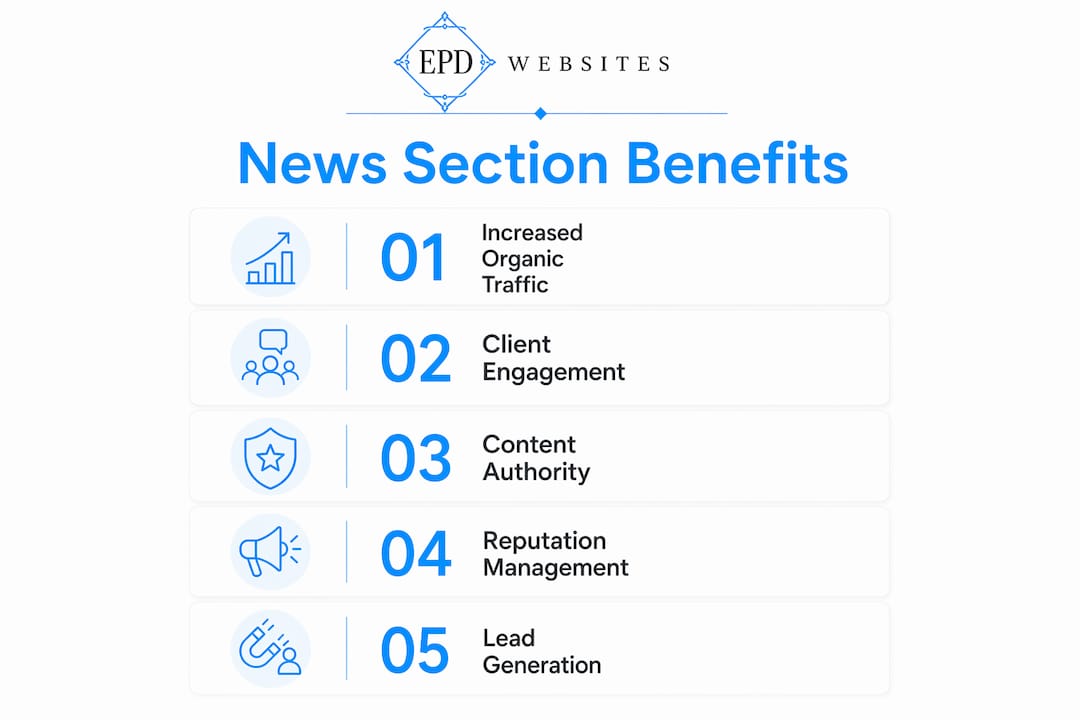
A well-built news section is one of the highest-return assets on any attorney website. It drives organic search traffic, signals that the firm is active and engaged, and gives prospective clients a reason to trust you before they ever pick up the phone. The role of a news section on attorney websites goes far beyond posting occasional updates. Done right, it functions as a content architecture system that connects your expertise to the exact questions clients are already searching for.
Here is what a strong attorney news section actually does:
- Targets long-tail search queries that practice area pages alone cannot rank for
- Signals firm activity to both visitors and search engines through consistent, dated publications
- Builds E-E-A-T (Experience, Expertise, Authoritativeness, Trustworthiness) through author attribution and practice area integration
- Guides prospective clients through their research phase before they are ready to hire
- Reduces dependence on paid advertising by compounding organic visibility over time
Frequency matters too. A news section with nothing posted since three years ago sends exactly the wrong message. As Farmhouse Creative put it plainly, it makes visitors wonder whether the firm is "old, cold, and ready to fold."
How attorney news sections improve SEO and client engagement
The SEO case for a law firm news section is straightforward: every published post is a new indexed page targeting queries your static practice area pages will never capture. A family law page ranks for "family law attorney Phoenix." A news post ranks for "what happens to a business during divorce in Arizona." Those are different searchers at different stages, and the second one is often closer to hiring.
- Long-tail, intent-driven posts attract visitors who are actively researching a legal problem
- Consistent publishing reduces reliance on costly pay-per-click advertising as organic traffic compounds
- Internal links from news posts to practice area pages build topical clusters that strengthen overall domain authority
- Featuring 2–3 recent posts on the homepage improves visitor trust and freshness signals simultaneously
- Every post should link to the relevant practice area page, the contact page, and at least two related posts
Firms that publish consistently and target client intent typically see meaningful increases in organic traffic and lead volume over time, according to content strategy research on legal websites. That timeline is longer than a paid campaign, but the results do not disappear the moment you stop spending. The law firm website benefits that come from a mature news section compound in a way that advertising simply cannot replicate.
Best practices for content selection and management
The biggest mistake attorneys make with a news section is treating it as a dumping ground. Award announcements, internal memos dressed up as posts, and four-paragraph summaries of legislation that add no original analysis all dilute the section's authority. The goal is a curated body of work, not a chronological archive of everything the firm has ever published.
- Prioritize client-centered topics. Write for the person facing a legal problem, not for other lawyers. Questions real people search for convert; legalese does not.
- Balance content types. A healthy mix includes legal alerts, practice area analyses, firm announcements, and client guidance, per Inbound Legal's blogging framework. No single type should dominate.
- Audit regularly. Unmanaged archives grow into SEO liabilities. Periodic review lets you archive thin posts, update outdated ones, and keep the section focused.
- Set a publishing cadence and keep it. One substantive post per month beats a burst of ten posts followed by six months of silence.
Pro Tip: Target content to the "People Also Ask" boxes in Google Search results for your practice areas. Those questions are exactly what prospective clients type when they are researching their situation, and answering them directly is the fastest path to qualified traffic.
Nigel Brown and Modern Law Office both emphasize that failing to audit content leads to clutter that erodes the section's impact. Think of it as tending a garden rather than filling a storage unit.

What technical architecture makes a news section actually work?
Structure separates a news section that drives results from one that just takes up server space. The design and taxonomy decisions you make at the outset determine whether your content feeds the rest of your site or sits in isolation.
- Taxonomy tagging. Tag every post by content type (legal alert, analysis, firm news) and by practice area. Without tags, a visitor interested in your employment law work has to scroll through unrelated posts to find it.
- Author attribution. Every post needs a named attorney byline linked to that attorney's profile page. This creates bidirectional links that strengthen both pages and satisfies Google's E-E-A-T requirements.
- Practice area integration. Each practice area page should display 2–4 recent posts tagged to that area, forming the topic cluster architecture that drives legal SEO.
- Schema markup and clean HTML. AI-powered search tools like ChatGPT, Perplexity, and Google AI Overviews favor structured, author-attributed content when selecting sources to cite.
- Automated CMS blocks. The homepage and attorney profile pages should pull recent posts automatically, without manual updates each time something is published.
Pro Tip: Set up your CMS so that tagging a post with a practice area automatically surfaces it on that practice area page. Manual curation breaks down the moment publishing volume increases.
Smotrów Design's work on institutional legal publications platforms demonstrates what this looks like at scale: multiple content types, multi-author attribution, and a CMS that lets editorial teams manage hundreds of posts without developer involvement.
Common pitfalls that quietly undermine your news section
Most news section problems are invisible until they show up as stalled rankings or declining traffic. The patterns repeat across firms of every size.
- A dormant section signals inactivity. If the most recent post is from last year, the entire site feels abandoned regardless of how polished the design is.
- Content bloat from unmanaged archives dilutes topical authority and wastes crawl budget on thin, low-value pages.
- Missing author attribution prevents the section from contributing to E-E-A-T and disconnects posts from attorney profiles.
- Publishing only promotional content (awards, events, internal announcements) alienates prospective clients who came looking for legal guidance.
- No taxonomy means no filtering, no topic clusters, and no connection to practice area pages.
Crescat Digital's audits of law firm websites consistently surface the same finding: a bloated news section is one of the most common and most fixable SEO problems a firm can have. The fix is a structured review process, not a wholesale deletion. Posts with no traffic, no internal links, and no topical relevance to current practice areas can be archived with a noindex directive, keeping the URL live for anyone who wants it while removing it from Google's quality assessment.
What successful attorney news sections look like in practice
The path from publication to client contact is well documented. A general counsel researching a regulatory change finds the firm's analysis through Google, reads it, notices the author's profile, explores the practice area page, and submits an inquiry. That sequence, described by Smotrów Design in their law firm publications guide, costs nothing in advertising and repeats every time a new post is indexed.
Epdwebsites has built attorney websites where the news section functions as exactly this kind of lead generation engine. The approach treats the section as an integrated content system, not a blog. Recent posts surface automatically on the homepage and on relevant practice area pages. Every post carries an attorney byline linked to a full profile. Tags connect content to practice areas so the site's topical authority is legible to both Google and AI search tools. For attorneys who want to see how this translates into a finished site, the Epdwebsites portfolio shows completed projects across legal and other professional service practices.
The law firm reputation management implications of a well-maintained news section are equally concrete. A firm that publishes regularly and attributes content to named attorneys builds a verifiable public record of expertise that no competitor can easily replicate.
How to measure whether your news section is actually working
Measurement starts in Google Search Console. The gap between submitted and indexed pages tells you whether Google is treating your content as valuable or thin. Click-through rates on news URLs reveal whether your headlines are matching search intent. Time on page and scroll depth (available in GA4) show whether visitors are reading or bouncing.
Three metrics matter most for a law firm news section:
- Organic impressions and clicks per post. Posts that generate impressions but few clicks need better titles. Posts with no impressions at all may need to be archived.
- Internal link click-through from news to practice area pages. This measures whether the content is moving visitors deeper into the site toward a contact form.
- Contact form submissions attributed to organic search. GA4's traffic source reporting can isolate how many inquiries originate from visitors who entered through a news post.
Review these numbers quarterly. A post that drove traffic 18 months ago but has since gone stale may need a content refresh rather than archiving. The website design for attorneys decisions that affect how news content is displayed, linked, and tracked all feed into these numbers directly.
Key Takeaways
A news section built as an integrated content system, not a chronological blog, is the single most effective long-term driver of organic traffic and client trust on an attorney website.
| Point | Details |
|---|---|
| Organic traffic compounds over time | Consistent, intent-focused publishing builds search visibility that paid ads cannot replicate. |
| Architecture determines impact | Taxonomy, author attribution, and practice area integration separate high-performing sections from ignored ones. |
| Dormancy destroys credibility | A section with no recent posts signals an inactive firm, regardless of how polished the rest of the site looks. |
| Auditing prevents dilution | Regular review and archiving of thin content keeps topical authority focused and crawl budget well spent. |
| Measurement drives improvement | Google Search Console and GA4 reveal which posts drive inquiries and which need refreshing or archiving. |
The case for treating your news section as infrastructure
Most attorneys think of a news section as a nice-to-have, something to fill in when time allows. That framing is the problem. A news section that is built with clean taxonomy, author attribution, and practice area integration does not just publish content. It feeds your homepage, strengthens your attorney profiles, builds topic clusters that support your most competitive practice area pages, and positions your firm as a citable source in AI-generated search results.
The firms that treat this section as infrastructure rather than a blog get compounding returns. The firms that treat it as an afterthought get a dormant archive that quietly signals to every visitor that nobody is home.
Epdwebsites approaches attorney news sections the same way it approaches the rest of a professional website: as a system with a purpose, not a feature to check off a list. Quick turnaround, clean architecture, and personalized guidance on content strategy are what separate a news section that works from one that wastes your time. If your current section is not driving traffic or client inquiries, the website features Epdwebsites builds for attorneys are designed to change that.