
Law firm website hierarchy is defined as the intentional arrangement of pages and navigation elements to guide both clients and search engines through your site's content in a logical, prioritized order. Understanding what does law firm website hierarchy mean is the first step toward building a legal site that ranks well and converts visitors into clients. The standard model is a three-tier hub-and-spoke system built around a homepage authority hub, practice area hubs, and specific service pages. W3C accessibility guidelines reinforce that logical hierarchies are not optional. They are a baseline requirement for inclusive, high-performing legal websites.
What does law firm website hierarchy mean in practice?
Law firm website hierarchy refers to the deliberate, layered organization of every page on your site. The industry term for this concept is information architecture, and it governs how content is grouped, labeled, and linked. Most attorneys and their marketing teams treat hierarchy as a design decision. It is actually a structural one that shapes SEO performance, user behavior, and accessibility compliance simultaneously.
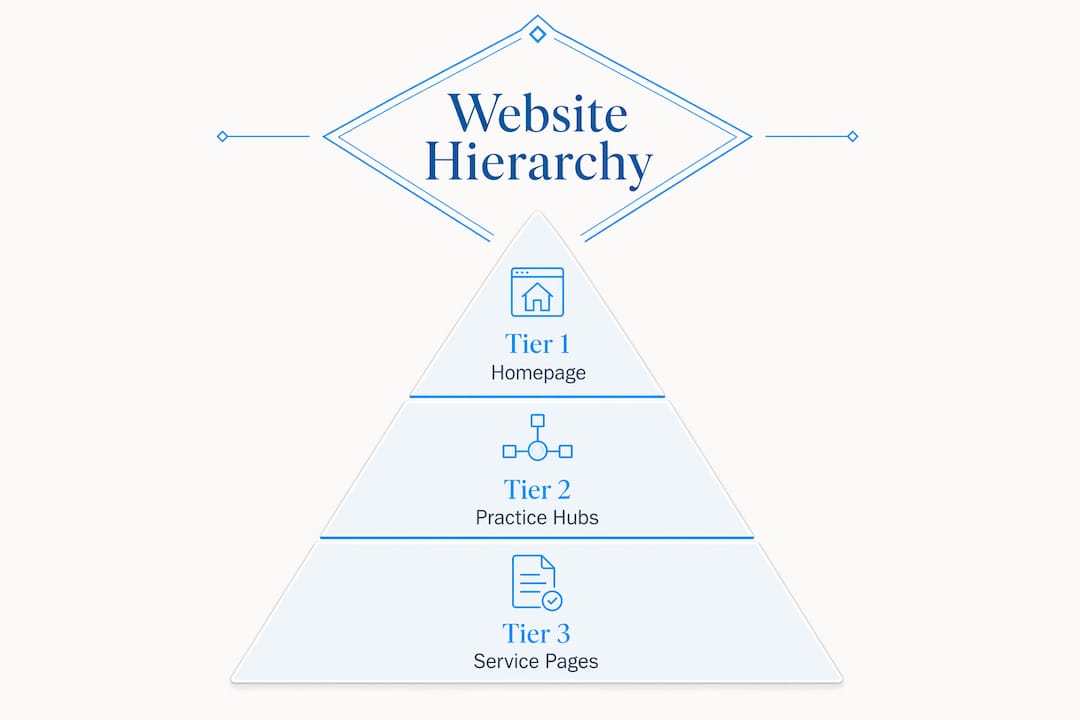
The three-tier hub-and-spoke model is the recognized standard for law firms managing 50 or more pages. Tier 1 is the homepage. It acts as the authority distribution hub, passing link equity down to every page below it. Tier 2 consists of practice area hubs such as Personal Injury, Family Law, or Estate Planning. Tier 3 holds the specific service pages, or "spokes," that sit beneath each hub. A Personal Injury hub, for example, links out to spokes covering car accidents, slip-and-fall cases, and wrongful death claims.

This model matters because pages nested deeper than three clicks from the homepage receive less crawl frequency and less link equity from search engines. That means a well-written page buried four levels deep will consistently underperform a thinner page placed at Tier 3. Depth is not a neutral choice. It is a ranking decision.
Pro Tip: Map your full site in a spreadsheet before building or redesigning. List every page, assign it a tier, and confirm no page sits deeper than three levels from the homepage.
The table below shows how the three tiers translate into real law firm pages:
| Tier | Label | Example pages |
|---|---|---|
| Tier 1 | Homepage | Home |
| Tier 2 | Practice area hubs | Personal Injury, Family Law, Criminal Defense |
| Tier 3 | Service spokes | Car Accidents, Divorce, DUI Defense |
A flat architecture keeping most pages within two clicks of the homepage is the goal. Every additional click between the homepage and a key conversion page weakens the authority signal reaching that page.
How does website hierarchy impact SEO and search engine crawling?
A clear law firm website structure directly controls how search engines allocate authority across your site. Google's crawlers follow internal links to discover and evaluate pages. When your hierarchy is logical, crawlers move efficiently from the homepage through practice hubs to service pages, indexing each one with the correct topical context.
Direct homepage links to key practice pages maximize SEO authority transfer. Linking to a generic "Services" landing page instead dilutes that authority before it reaches the pages that actually rank for client searches. This is one of the most common and costly structural mistakes on legal websites. The fix is straightforward: link your homepage navigation directly to each major practice area hub.
Internal linking within the hierarchy also funnels authority to conversion pages. The process works in four steps:
- The homepage links directly to each Tier 2 practice area hub.
- Each hub links to its Tier 3 service spokes.
- Each spoke links back to its parent hub and cross-links to related spokes.
- Schema.org breadcrumb markup reinforces these relationships for search engines and increases click-through rates in search results.
URL structure also signals hierarchy. A URL like /personal-injury/car-accidents/ tells both users and crawlers exactly where that page sits in the site. It builds trust and improves indexing. A URL like /page-id-4872/ communicates nothing. Practice area hubs linking to specific service spokes, which then link back and cross-link, create a web of topical authority that lifts rankings across the entire practice group.
Navigation is an SEO instrument. Every internal link transfers homepage authority to a conversion page. Treat your menu structure as a ranking tool, not just a usability feature. For a deeper look at how legal content planning connects to hierarchy, the relationship between page depth and content authority is worth examining closely.
What accessibility best practices support effective law firm website hierarchy?
Accessibility and hierarchy are not separate concerns. They reinforce each other. W3C accessibility guidelines require clear, perceivable navigation structures so that users with disabilities can understand and move through a site without confusion. A hierarchy that is logical for SEO is also a hierarchy that works for screen readers and keyboard navigation.
Visual design cues alone do not effectively communicate hierarchy to users with cognitive disabilities. A dropdown menu that expands on hover may be obvious to a sighted user but invisible to someone using assistive technology. Explicit structural indicators are required. These include:
- Clear, descriptive menu labels that name the practice area exactly (not "Our Work" or "What We Do")
- Open and close symbols on expandable submenus so users know additional options exist
- Breadcrumb navigation displayed prominently on every interior page
- Consistent label placement so users can predict where navigation appears on each page
- ARIA landmark roles coded into the site's HTML to identify navigation regions for screen readers
Breadcrumbs implemented with Schema.org markup serve double duty. They orient users within the site and signal page relationships to Google. A user on a "Car Accidents" page who sees "Home > Personal Injury > Car Accidents" immediately understands where they are and how to move up the hierarchy. That orientation reduces bounce rates and supports longer session times.
Pro Tip: Test your site's navigation using only a keyboard. If you cannot reach every page without a mouse, your hierarchy has an accessibility gap that also affects SEO crawlability.
The legal website accessibility compliance requirements for 2026 make this more than a best practice. Accessibility improvements broaden your client reach and protect the firm from ADA-related complaints. A well-structured hierarchy delivers both outcomes at once.
How to organize a law firm site to avoid orphan pages and content silos
The most damaging hierarchy mistakes are invisible until you audit your site. Orphan pages, pages with no internal links pointing to them, receive no crawl equity and rank for nothing. Content silos, groups of pages that do not link to related content elsewhere on the site, prevent topical authority from spreading across practice areas.
Avoid orphaned location pages by linking them bidirectionally with relevant practice area pages. A "Phoenix Personal Injury Attorney" location page should link to the Personal Injury hub, and the hub should link back to the location page. That two-way connection keeps both pages in the crawl path and reinforces topical relevance for local search.
A practical audit follows five steps:
- Export every URL on the site using a crawl tool such as Screaming Frog.
- Identify any page with zero internal links pointing to it. Those are your orphans.
- Confirm every page is reachable within three clicks from the homepage.
- Check that location pages link to their corresponding practice area hubs.
- Add cross-links between related service spokes, for example, linking a "Divorce" spoke to a "Child Custody" spoke within the Family Law hub.
Regular audits matter because sites grow organically. A new attorney bio page or a blog post added without a plan can become an orphan within days. The law firm website homepage structure sets the foundation, but ongoing link maintenance keeps the hierarchy intact as content scales.
The goal is a connected content ecosystem where every page reinforces every other page in its topical neighborhood. That ecosystem is what produces durable rankings, not individual page optimization in isolation.
Key Takeaways
A well-built law firm website hierarchy concentrates authority at the homepage, distributes it through practice area hubs, and delivers it to service pages where clients convert.
| Point | Details |
|---|---|
| Three-tier model is standard | Use homepage, practice area hubs, and service spokes for sites with 50 or more pages. |
| Page depth limits rankings | Pages more than three clicks from the homepage receive less crawl equity and rank lower. |
| Direct homepage links matter | Link the homepage directly to practice area hubs, not to a generic "Services" page. |
| Accessibility reinforces SEO | Explicit menu labels, breadcrumbs, and Schema.org markup improve both user experience and search rankings. |
| Audit regularly for orphans | Any page with no internal links pointing to it receives no authority and ranks for nothing. |
Why hierarchy is the most underrated decision in legal web design
Most law firm marketing professionals focus on content quality and keyword targeting. Those matter. But I have seen well-written, thoroughly researched practice area pages fail to rank simply because they were buried four levels deep in a site with no internal links pointing to them. The content was not the problem. The structure was.
What I find consistently true is that simplification outperforms complexity. Clients do not browse law firm websites the way they browse e-commerce stores. They arrive with a specific problem, scan for the relevant practice area, and want to reach a contact form in two or three clicks. A hierarchy that serves that behavior also serves Google's crawlers. The two goals are not in tension. They are the same goal expressed differently.
The collaboration between marketers and developers is where hierarchy decisions most often break down. Marketers want more pages and more content. Developers want clean code and fast load times. Neither group naturally thinks about link equity flow. The result is a site that grows without a plan, accumulates orphan pages, and gradually loses the topical authority it built in its first year. Reviewing law firm website layout options before a redesign helps both teams align on structure before content decisions are made.
Accessibility is the piece most teams add last, if at all. That is a mistake. Building explicit structural cues into the hierarchy from the start costs far less than retrofitting them later. And the SEO benefit is real. A site that screen readers can navigate cleanly is a site that crawlers can index cleanly.
— Kate
How Epdwebsites builds law firm sites with hierarchy built in
Law firm websites built without a clear hierarchy plan lose rankings as they grow. Epdwebsites has specialized in professional web design since 2009, with a client base that includes attorneys, CPAs, and consultants who need sites that perform, not just look good.

Every site Epdwebsites builds for a law firm starts with a documented page architecture: homepage authority hub, practice area hubs, and service spokes mapped before a single page goes live. Internal linking, breadcrumb markup, and accessible navigation are built into the structure from day one, not added as an afterthought. The result is a site that search engines can crawl efficiently and clients can use without friction. Explore the web design features Epdwebsites offers for law firms and professional service providers, or review the firm's portfolio to see hierarchy-driven design in action.
FAQ
What does law firm website hierarchy mean?
Law firm website hierarchy is the organized, layered structure of pages and navigation that guides users and search engines through a site. The standard model uses three tiers: homepage, practice area hubs, and specific service pages.
How many tiers should a law firm website have?
Most law firms benefit from a three-tier structure. The homepage sits at Tier 1, practice area hubs at Tier 2, and individual service pages at Tier 3, keeping all content within three clicks of the homepage.
Why does page depth affect SEO for law firm sites?
Pages nested deeper than three clicks from the homepage receive less crawl frequency and less link equity from search engines. That reduced authority directly lowers their ability to rank for competitive legal search terms.
How do breadcrumbs support law firm site navigation?
Breadcrumbs show users their location within the site hierarchy and, when coded with Schema.org markup, signal page relationships to Google. Both functions reduce bounce rates and improve search visibility.
What is an orphan page and why does it hurt a law firm site?
An orphan page is any page with no internal links pointing to it. Without those links, search engine crawlers rarely find the page, it receives no link equity, and it effectively does not exist for ranking purposes.