
Most professional service redesigns take 10 to 20 weeks from kickoff to launch, and the single biggest factor isn't scope or budget. It's how fast the client reviews, approves, and delivers content. A template refresh can ship relatively quickly; a firm juggling multiple stakeholders and no content plan can stretch a standard project considerably longer.
TL;DR:
- Content delays are the main bottleneck, often pushing projects beyond their planned timelines, especially if content is not prioritized early.
- Discovery and approval processes are consistently underestimated, but skipping or rushing these phases leads to costly rework and delays later.
- Launching a website within 10 to 16 weeks is feasible for small to mid-sized sites if content and approvals are prepared upfront.
- Complex projects with integrations and custom features can extend beyond 16 weeks, requiring phased development and staged QA.
- Establishing clear approval protocols and gathering all access and scope agreements before start prevents schedule stalls and ensures timely launches.
Table of Contents
- How Long Does a Website Redesign Take by Project Size?
- What Are the Phases of a Website Redesign?
- What Causes Website Redesign Delays and How Do You Prevent Them?
- What Does a Sample Website Redesign Schedule Look Like?
- What Should Clients Prepare Before a Website Redesign Starts?
- How Do You Protect SEO During a Website Launch?
- Why Timeline Discipline Matters More Than Speed
- A Redesign That Almost Slipped, and What Fixed It
- Get a Timeline Review Before You Commit to a Redesign Date
- Sources
How Long Does a Website Redesign Take by Project Size?
The right answer to "how long for a website redesign" depends almost entirely on scale and structure, not design complexity alone.
- Template refresh or light customization: 1–4 weeks. You're updating visuals on an existing structure, not rebuilding it.
- Small brochure site (5–15 pages): 6–10 weeks, a range that factors in how many pages a small business website should have. This covers most solo practitioners and small firms.
- Standard business site (15–50 pages): 10–16 weeks, matching what Nerd Stack's phased breakdown documents for mid-size projects.
- Large or enterprise site (50+ pages, integrations, e-commerce): 16–24+ weeks, often longer with multi-location content or custom software integrations.
These bands assume phases overlap somewhat, which is normal. Design typically starts before content is fully finalized, and development often begins once wireframes are approved rather than waiting for final visuals. The real bottleneck across nearly every project size is content. Firms underestimate how long it takes to write, gather, and approve copy, and that single phase routinely pushes a 10-week plan into its 14th week.
What Are the Phases of a Website Redesign?
A website redesign process breaks into six phases, and each one has a realistic duration range you can hold a vendor to.
Discovery. This covers analytics audits, stakeholder interviews, and a baseline SEO review of your current site, usually lasting a few weeks. Skipping this phase to save time almost always backfires: Lowcode Agency's timeline data shows that compressed discovery leads to costly rework later, not a faster finish.
Strategy and information architecture. Sitemap planning, redirect mapping, and a content strategy document get built here over a short period. This is also when you should identify every page that needs a 301 redirect at launch.
Design (2–4 weeks). Wireframes typically take 1 to 1.5 weeks, followed by 2 to 2.5 weeks for visual design, according to Lowcode's phase breakdown. Two client review rounds is standard; a third or fourth round is where timelines quietly die.
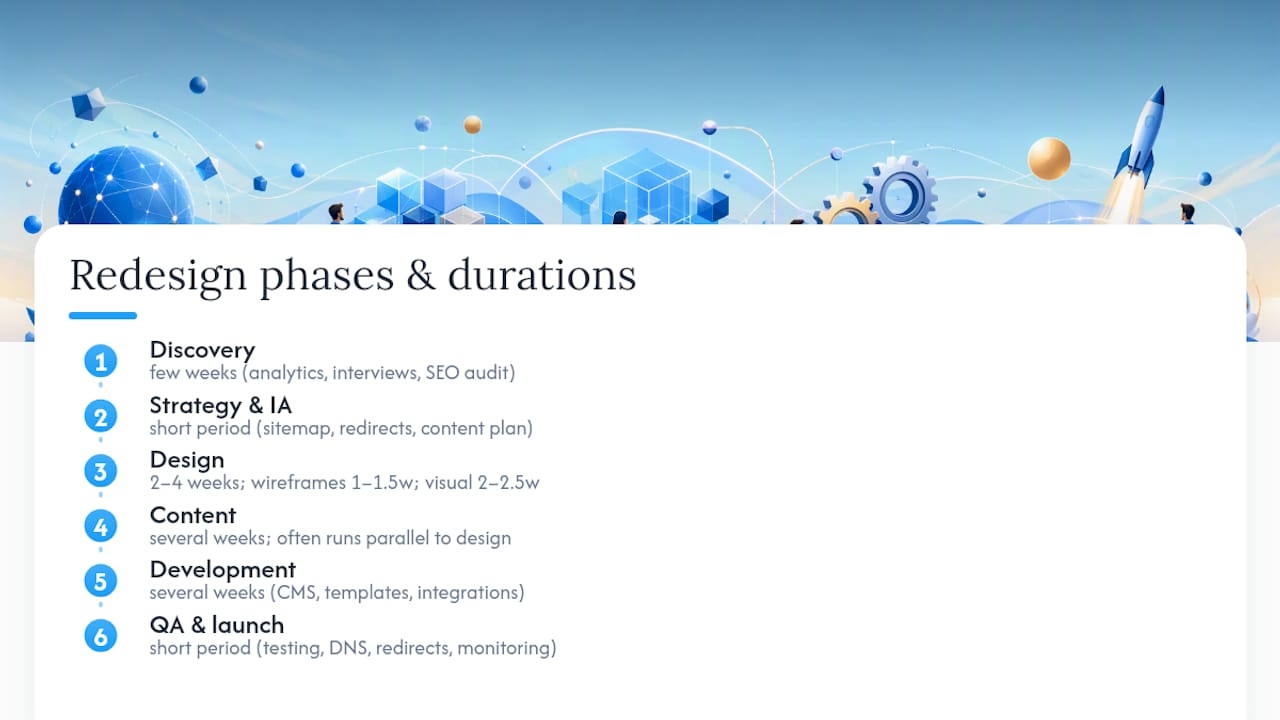
Content. Copywriting, photography, and case study development happen here over several weeks and often run parallel to design. Forbes Advisor's research notes that when content is ready before design starts, total project time drops to 10 to 14 weeks.
Development. CMS setup, integrations, template builds, and responsive testing across devices happen over several weeks.
QA and launch. Cross-device testing, accessibility spot checks, form verification, and tracking confirmation come first, followed by DNS changes, redirect verification, and day-one monitoring over a short period.
What Causes Website Redesign Delays and How Do You Prevent Them?
The five most common causes of a slipping schedule aren't technical. They're organizational.
- Content hold-ups. Assign a specific writer, set hard internal deadlines, and treat content like a deliverable with a due date, not an afterthought.
- Unstructured feedback. When five people send five conflicting rounds of notes, design stalls. Designate one final approver and consolidate all feedback into a single document per round.
- Scope creep. New feature requests mid-project should require a formal change request that states the time and cost impact before work begins.
- Integration complexity. Identify every API, booking tool, or CRM connection during discovery, not during development, and test credentials early.
- Skipped or rushed phases. Compressing discovery or cutting review rounds to hit a date typically adds time overall, since late-stage fixes cost more than early-stage planning.
Pro Tip: Put review deadlines on a shared calendar with specific dates, not vague "end of week" targets. A firm approval window of 48 to 72 hours keeps momentum without rushing quality.
What Does a Sample Website Redesign Schedule Look Like?
Concrete week-by-week plans help you stress-test a vendor's proposal against reality.
- Fast path (6–8 weeks): Requires content ready on day one and a single decision-maker. Week 1 to 2 covers discovery and IA. Weeks 3 to 5 run design and development in parallel. Weeks 6 to 8 cover QA, revisions, and launch.
- Standard path (10–14 weeks): Weeks 1 to 2 are discovery. Weeks 3 to 6 cover strategy and two design review rounds, with content development running alongside. Weeks 7 to 11 are development. Weeks 12 to 14 cover QA, final approvals, and launch.
- Complex path (16–24 weeks): Extended discovery for integrations and content migration planning, multiple stakeholder approval rounds, phased development by section, and staged QA across integrated systems.
If you have a hard external deadline (a conference, a rebrand announcement, a press date), launch your core pages first and roll out secondary content afterward. That protects your deadline without forcing every page through QA at once.
What Should Clients Prepare Before a Website Redesign Starts?
A missing password or an undecided approver can stall a project for a week. This checklist closes those gaps before they open.
- Sign-off structure: Name one final approver per phase and agree on a review cadence (weekly is typical).
- Content ownership: Assign who writes, who edits, and who approves, with dates attached to each.
- Access credentials: Domain registrar login, hosting access, API keys, and Google Analytics/Search Console access, gathered before kickoff.
- Scope lock: A written list of what's included and how any addition gets requested and priced.
- Launch logistics: Preferred launch day and time, a rollback plan if something breaks, and a named person watching the site for the first 24 hours.
How Do You Protect SEO During a Website Launch?
Launch day is where months of good work can quietly lose search rankings if a handful of technical steps get skipped.
- Verify every 301 redirect from old URLs to new ones before DNS changes propagate, not after.
- Resubmit your sitemap to Google Search Console and check for crawl errors within the first 48 hours.
- Confirm analytics and conversion tracking fire correctly on the new site, including form submissions and phone click events.
- Run Core Web Vitals and accessibility spot checks before launch, since accessibility testing built into design costs far less than retrofitting it later.
- Set a monitoring schedule with checks at day 7 and day 30, and name who owns each check.
A medical practice launch checklist or a law firm rebranding checklist gives you a template to adapt regardless of industry.
Why Timeline Discipline Matters More Than Speed
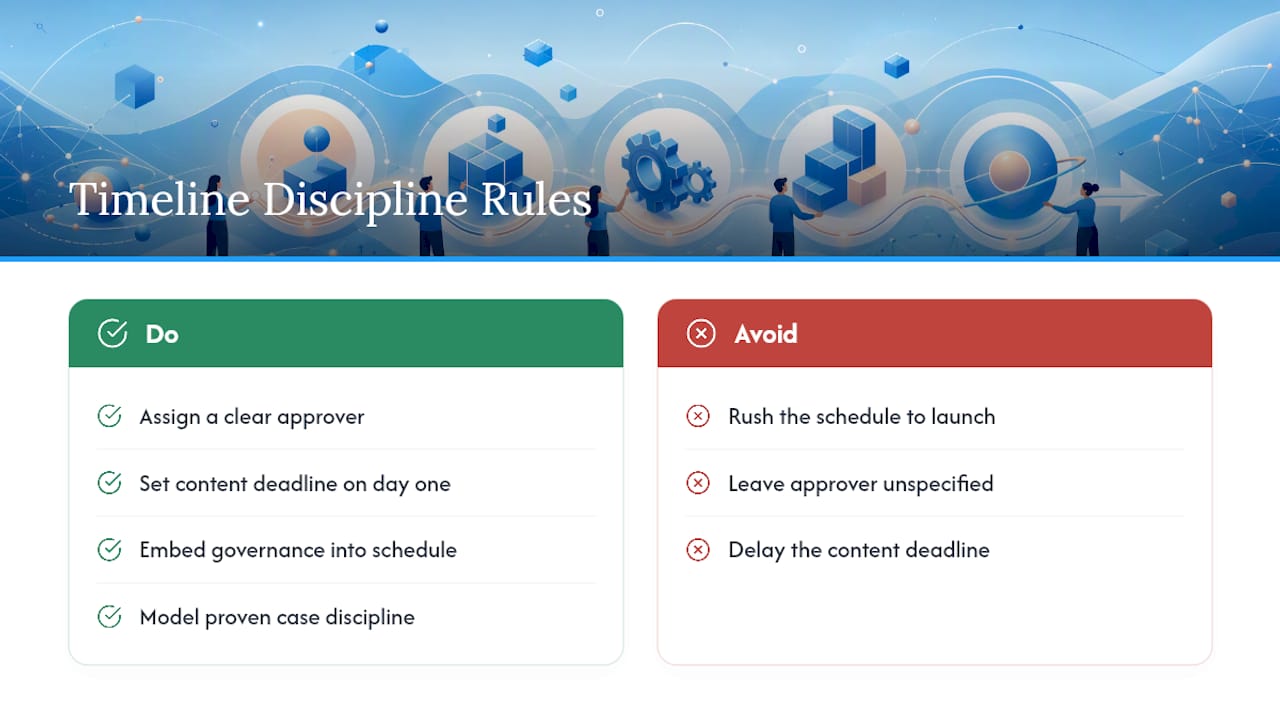
Epdwebsites has built and launched sites for attorneys, CPAs, and medical practices since 2009, and the pattern holds across nearly every project: firms that hit their launch date aren't the ones that rushed, they're the ones with a clear approver and a content deadline set on day one. The portfolio reflects projects built around exactly this kind of governance, and case examples from professional-service clients show the same fast-turnaround discipline this article recommends.
A Redesign That Almost Slipped, and What Fixed It
A law firm client once had five partners reviewing every design draft, and the second review round produced eleven pages of conflicting notes. We paused, asked the managing partner to name one final approver, and the project got back on schedule within a week. The takeaway: pick one decision-maker before design starts, not after the feedback pile up.
— Kate
Get a Timeline Review Before You Commit to a Redesign Date
If you've read this far, you already know the biggest risk to your launch date isn't your designer, it's an undefined approval process and content that isn't ready on day one. Epdwebsites offers something most agencies don't: a upfront timeline review that maps your specific project (page count, integrations, content status) against a realistic schedule before you sign anything, so you know your launch date is achievable, not aspirational.

A timeline review includes a proposed phase-by-phase schedule, a content deadline plan, and a cost estimate tied to your actual scope, not a generic package. Because Epdwebsites bundles design, hosting, and post-launch monitoring together, your launch doesn't end at go-live, someone is already watching your Core Web Vitals and uptime the next morning. Explore the full feature set on the website features page and request your timeline review to see exactly where your project falls in the schedule.
Sources
- Website Redesign Timeline: How Long Each Phase Takes
- The Website Redesign Process: A Week-by-Week Timeline | Nerd Stack Blog
- How long does it take to build a website? (Forbes Advisor)
- How Long Does a Website Redesign Take? Realistic Timelines | Laurel Web Co.