
A website wireframe is defined as a structural blueprint that maps out the layout, navigation, and content hierarchy of a law firm's website before any visual design begins. Understanding what a website wireframe means for lawyers is the first step toward building a site that converts visitors into clients. The wireframe shows where practice area pages, attorney bios, contact forms, and calls to action will live, without colors, fonts, or branding getting in the way. Law firm website projects typically span 8–12 weeks, and wireframing is the foundational phase that prevents expensive structural changes later.
What does a website wireframe mean for lawyers?
A wireframe is the visual skeleton of your law firm's website. It uses grayscale shapes, boxes, and lines to define where each element sits on the page. Wireframing focuses exclusively on structure without colors or branding, which keeps early conversations focused on what matters most: layout and user flow.
For lawyers, this distinction is critical. Your clients arrive at your site with a specific need, whether that is finding a criminal defense attorney, reading about estate planning, or submitting a consultation request. The wireframe decides whether those clients find what they need in seconds or leave frustrated. A well-structured wireframe maps the entire client pathway before a single line of code is written.

The industry term for this process is "information architecture," and it covers how content is organized, labeled, and connected across your site. Wireframing is the practical tool that makes information architecture visible. Think of it the way you would think of a floor plan before construction: you would never build a courthouse without one.
Pro Tip: Show your wireframe to a non-lawyer friend and ask them to find your contact form in under 10 seconds. If they struggle, your navigation needs work before design begins.
What elements does a law firm website wireframe typically include?
A law firm wireframe covers every major page type and the relationships between them. Each block in the wireframe represents a content zone, not a finished design. Here are the core elements lawyers should expect to see:
- Homepage layout: A header with your firm name and phone number, a headline that states your practice area, a brief credibility statement, and a prominent call-to-action button directing visitors to a consultation form.
- Practice area pages: Individual pages for each legal specialty, each with a clear heading, a short description of the service, and a client intake prompt at the bottom.
- Attorney bio pages: A photo placeholder, credentials summary, bar admissions, and a direct contact link. These pages build trust faster than any design element.
- Navigation structure: A top menu with no more than six primary links, plus a footer menu for secondary pages like privacy policy, disclaimer, and sitemap.
- Contact and intake forms: Positioned above the fold on contact pages and repeated as a sidebar element on practice area pages.
- Social proof zones: Placeholder blocks for client testimonials, bar association logos, and media mentions.
- Legal compliance elements: Dedicated footer zones for attorney disclaimers, privacy policy links, and accessibility statements.
CTAs on practice area pages and contact forms are mapped during wireframing to optimize the client conversion path. Placing a "Schedule a Free Consultation" button in the wrong location costs you inquiries every single day.
Pro Tip: Request that your wireframe includes a mobile view alongside the desktop layout. Most legal clients search for attorneys on their phones, so the mobile structure matters as much as the desktop version.
Why are wireframes especially important for lawyers?
Legal websites carry a trust burden that most industries do not face. A prospective client searching for a DUI attorney or a family law firm is often in a stressful situation. They make fast judgments about credibility based on what they see in the first few seconds.
A confusing layout damages a firm's perceived competence immediately. Design for lawyers extends beyond aesthetics to trust and professionalism, and wireframe-defined structure is critical for building client confidence long before the intake form appears.
This is why wireframing is not optional for law firm web design. It is the phase where trust is either built into the structure or left out entirely. A homepage that buries the practice area list below a long biography, or a contact page with no visible phone number, signals disorganization to a potential client. Those structural errors are invisible during the design phase but obvious to every visitor after launch.
Wireframes must reflect actual lawyer workflows to reduce cognitive load for both the attorney managing the site and the client using it. A personal injury firm, for example, has a very different client journey than a corporate transactions practice. The wireframe should reflect that difference in how pages are sequenced and how intake prompts are worded.
The cost argument is equally compelling. Refactoring website architecture after development can cost 50 times more than revising a wireframe. Catching a navigation problem in a grayscale sketch takes minutes. Fixing the same problem after a developer has built the site takes days and costs real money.
Pro Tip: Ask your web designer to walk you through the wireframe page by page before approving it. Treat it like a deposition outline: every section should have a clear purpose and a logical sequence.
How does wireframing fit into the law firm website design process?
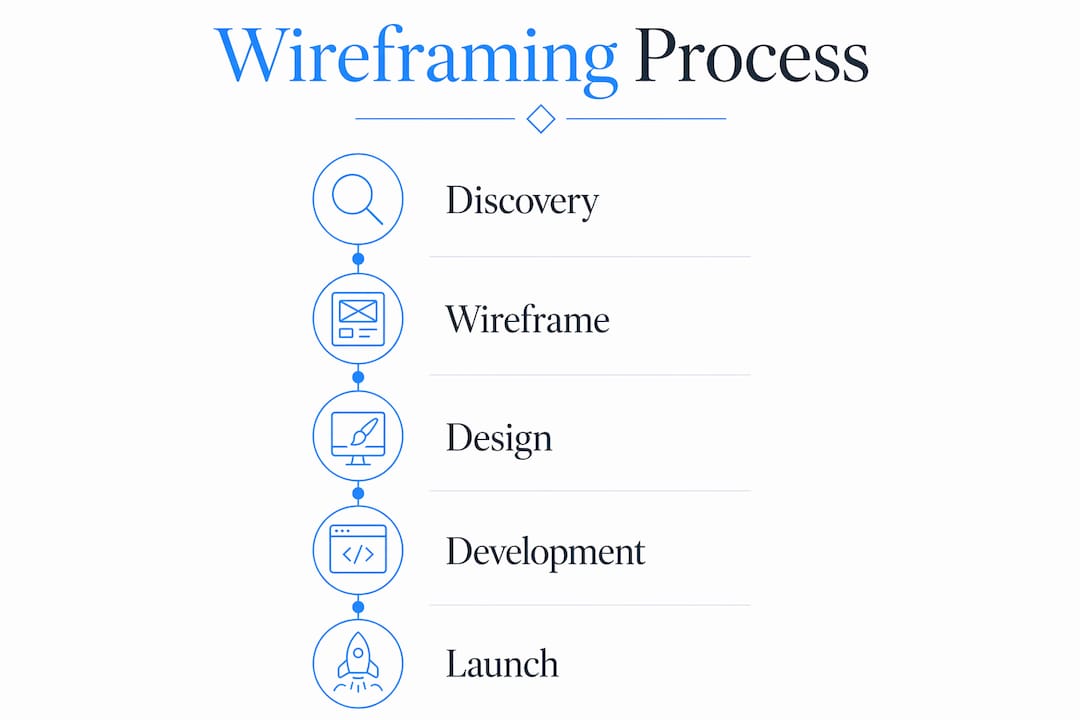
A typical law firm website project follows a defined sequence. Wireframing sits in the middle of the discovery phase and the visual design phase, making it the pivot point of the entire project.
- Discovery (weeks 1–2): The designer interviews you about your practice areas, target clients, competitors, and goals. This phase produces a content inventory and a site map.
- Wireframing (weeks 2–4): The designer builds low-fidelity wireframes for each major page type. You review and approve the structure before any visual work begins.
- Visual design (weeks 4–6): Colors, typography, photography, and branding are applied to the approved wireframe structure.
- Content integration (weeks 6–8): Your attorney bios, practice area descriptions, and blog posts are placed into the designed templates.
- Development and testing (weeks 8–12): The site is built, tested on multiple devices, and reviewed for accessibility and performance before launch.
The table below shows how each phase contributes to the overall project outcome.
| Phase | Primary output | Lawyer's role |
|---|---|---|
| Discovery | Site map and content list | Provide goals and client personas |
| Wireframing | Structural page layouts | Review and approve structure |
| Visual design | Branded page mockups | Approve colors and typography |
| Content integration | Populated page templates | Deliver final copy and photos |
| Development and testing | Live website | Final review and sign-off |
Lawyers respond well to visual wireframe demonstrations using tools like Balsamiq or Figma, which shift the conversation from aesthetic preferences to structural decisions. This "show, don't explain" approach keeps the project on schedule and reduces revision cycles. You can review a wireframe for law firm web design the same way you review a contract: look for gaps, ambiguities, and missing elements before signing off.
What practical benefits do lawyers gain from website wireframes?
The benefits of wireframing are concrete and measurable across the entire project lifecycle. Here is what lawyers consistently gain from a proper wireframing phase:
- Faster client conversions: Wireframing improves UX by clarifying layout, content priorities, and navigation before design begins, which reduces visitor confusion and increases the rate at which visitors submit intake forms.
- Clearer communication with designers: A wireframe gives you and your designer a shared reference point. Disagreements about "where the contact button should go" are resolved in the wireframe, not after the site launches.
- Early detection of user flow conflicts: A family law firm serving both divorce clients and estate planning clients has two very different user journeys. Wireframing reveals when those journeys conflict or create confusion, before the conflict is baked into the final site.
- Better content prioritization: The wireframe forces a decision about what appears above the fold on every page. That decision directly affects which services get visibility and which get buried.
- Reduced development costs: Structural changes made during wireframing cost a fraction of the same changes made after development. The cost ratio documented in legal technology projects reaches as high as 50:1.
- Smoother developer handoff: A complete wireframe gives developers a precise specification. They spend less time guessing and more time building.
The comparison below shows the difference between a wireframed and a non-wireframed law firm website project.
| Factor | With wireframing | Without wireframing |
|---|---|---|
| Structural revisions | Resolved before design | Discovered after launch |
| Designer-lawyer alignment | Established early | Negotiated during build |
| Client intake path | Mapped and tested | Assumed and guessed |
| Post-launch rework | Minimal | Frequent and costly |
Lawyers who invest in wireframing before visual design also report a clearer sense of ownership over their site. When you approve a structure before colors and fonts appear, you are making decisions based on function, not aesthetics. That clarity carries through the entire project. For a deeper look at how structure shapes client perception, the article on website prototypes for law firms covers the next step after wireframing in detail.
Key Takeaways
A website wireframe is the single most cost-effective investment a law firm can make before committing to visual design, development, or content creation.
| Point | Details |
|---|---|
| Wireframe definition | A grayscale structural blueprint mapping layout, navigation, and CTAs before design begins. |
| Cost savings | Fixing structural issues in wireframes costs up to 50 times less than post-development rework. |
| Trust and professionalism | Poor site structure damages a firm's perceived competence immediately, making wireframing a trust-building step. |
| Lawyer participation | Reviewing wireframes with tools like Balsamiq or Figma keeps projects on schedule and reduces revision cycles. |
| Project timeline | Wireframing occurs in weeks 2–4 of a typical 8–12 week law firm website project. |
Why I think most lawyers skip the most important step in web design
Lawyers are trained to focus on outcomes. When a client asks about a website, the first question is almost always about how it will look, not how it will work. I have seen this pattern repeat across dozens of professional service projects: the attorney approves a beautiful design, the site launches, and then the phone does not ring because the contact form is buried three clicks deep.
The wireframe phase is where that problem gets solved, but it is also the phase most lawyers want to skip. It looks unfinished. It lacks color. It does not feel like progress. That reaction is completely understandable, and it is also the reason so many law firm websites underperform.
What I have found is that lawyers who engage seriously with their wireframes, who push back on navigation choices and question why a practice area page is structured a certain way, end up with sites that actually generate consultations. The wireframe is not a formality. It is the moment where your knowledge of your clients gets translated into a structure that works for them.
The attorneys who treat wireframe review like a deposition prep session, methodical, skeptical, and focused on gaps, consistently end up with better sites. The ones who wave it through and wait for the "real" design consistently end up with expensive revisions six months after launch.
— Kate
How Epdwebsites approaches wireframing for law firm websites
Epdwebsites has worked with attorneys and professional service providers since 2009, and wireframing is a core part of every law firm web design project. The process starts with a discovery conversation about your practice areas, your clients, and the actions you want visitors to take. From there, a structured wireframe is built for every major page before any visual design work begins.

Every wireframe includes mapped CTAs, a clear navigation hierarchy, attorney bio layouts, and practice area page structures tailored to legal services. Lawyers review and approve the structure before the project moves forward, which keeps timelines tight and revisions minimal. If you are ready to build a site that works as well as it looks, explore the web design features Epdwebsites offers for legal professionals. The process is straightforward, the turnaround is fast, and the result is a site built on a structure that actually serves your clients.
FAQ
What is a website wireframe in simple terms?
A website wireframe is a grayscale layout that shows where each element on a page will appear before any design or coding begins. It focuses on structure, navigation, and content placement rather than colors or fonts.
How long does the wireframing phase take for a law firm website?
The wireframing phase typically takes two to three weeks within an overall 8–12 week law firm website project. The timeline depends on the number of pages and how quickly the attorney reviews and approves the layouts.
Can a lawyer review a wireframe without technical knowledge?
Yes. Wireframes are intentionally simple and require no technical background to evaluate. Tools like Balsamiq and Figma present wireframes as clickable visual layouts that any attorney can review and comment on directly.
Why does wireframing reduce costs for law firm websites?
Structural changes made during wireframing cost a fraction of the same changes made after development. Cost ratios as high as 50:1 have been documented in legal technology projects, making early wireframe review one of the highest-return steps in the process.
What pages should a law firm wireframe always include?
A complete law firm wireframe should cover the homepage, individual practice area pages, attorney bio pages, a contact and intake form page, and a blog or resources section. Each page needs a mapped call-to-action and a clear navigation path back to the homepage.