
A law firm website costs can range from about $15 a month for a DIY builder to over $20,000 for a custom agency build, with many small-to-mid-size firms generally investing in the mid-range for the initial build. What moves you between those bands is mostly page count, integrations, and design complexity. Whatever you spend upfront, ongoing hosting and maintenance costs often decide your real five-year price tag more than the build itself.
TL;DR:
- The total five-year cost for a law firm website varies widely, with DIY options being cheapest upfront but most labor-intensive.
- Managed subscription platforms offer predictable monthly fees but limit customization, making them ideal for firms with frequent content updates.
- Functional integrations with practice management systems and accessibility compliance significantly add to the initial build cost, especially for larger firms.
- Ongoing costs, including hosting, security, and content updates, often surpass initial build expenses over five years, especially with frequent modifications.
- Choosing a vendor based on total long-term cost and update frequency, not just initial price, helps firms avoid hidden expenses and legal risks.
Table of Contents
- How Much Does a Law Firm Website Cost by Approach?
- What Drives the Cost of an Attorney Website Up or Down?
- What Should You Budget for Ongoing Website Costs?
- How Do You Choose the Right Pricing Model?
- What Should Solo, Small, Mid-Size, and Multi-Office Firms Expect to Pay?
- Why a Legal-Focused Website Provider Changes the Math
- Why Most Attorneys Budget for the Wrong Number
- Get a Tailored Website Estimate From Epdwebsites
- Sources
How Much Does a Law Firm Website Cost by Approach?
The number you land on depends almost entirely on which of four paths you choose: DIY, freelancer, managed subscription, or agency/custom build. Each one trades cash cost against time cost, and attorneys routinely underestimate the second half of that equation.
DIY builders
Platforms like Wix, Squarespace, or WordPress.com charge $15 to $50 a month in cash. That sounds like the obvious winner until you count your own hours. Building a professional site from scratch typically eats 20 to 60 hours of your time, and that hidden labor cost often exceeds what a freelancer would have charged you outright once you value those hours at your billing rate. A DIY site also tends to look like a DIY site. For a solo practitioner competing against firms with polished branding, that is a real credibility gap.
Freelancers
A freelance designer or developer usually charges $1,500 to $8,000 upfront for a basic-to-mid-complexity attorney site, according to industry pricing surveys reflected in guides like Clio's attorney website breakdown. The catch is what happens after launch. Most freelancers bill hourly for changes, typically $75 to $200 an hour, and a simple bio update or new practice-area page can turn into a $300 invoice. If you plan to update your site often, that exposure adds up fast.
Managed subscription platforms
Flat-monthly, build-included platforms have become a serious middle path. Pricing commonly runs $89 to $449 a month with the site itself bundled into that fee, based on analysis from WorkspaceCMS's 2026 pricing review. You give up some customization compared to a fully custom build, and you're locked into whatever service-level agreement the vendor offers. But you also get predictable costs, someone else handling security patches, and no surprise hourly invoices when you need a new page added.
Agencies and custom builds
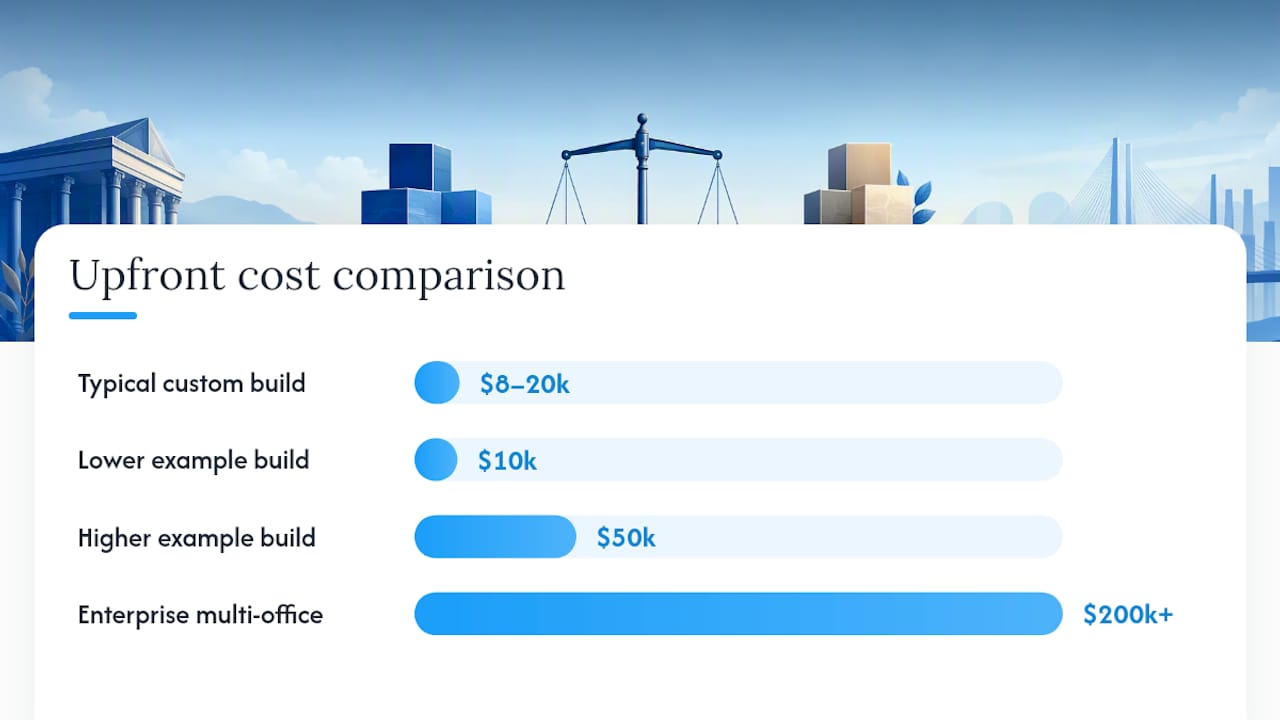
Full custom builds run $8,000 to $20,000 or more, and enterprise multi-office sites can clear $200,000. What justifies that spend? Strategy work, custom integrations with practice management software, bespoke design that doesn't look templated, and a build process that accounts for accessibility from day one rather than bolting it on later. A comparison of legal website design options is worth reviewing before you commit to this tier, since the gap between a $10,000 build and a $50,000 build often comes down to scope creep rather than quality.
Here's how the four approaches stack up on the factors that actually matter:
- DIY: Lowest cash cost, highest time cost, weakest brand impression.
- Freelancer: Moderate upfront cost, unpredictable long-term cost if you update often.
- Managed subscription: Predictable monthly cost, some ceiling on customization.
- Agency/custom: Highest upfront cost, strongest long-term control and differentiation.
Weigh those tradeoffs against a simple checklist before choosing:
- How often will you need content changes after launch?
- Do you need integrations with case management software?
- Is brand differentiation a priority in your market?
- Can you tolerate a monthly recurring fee versus a large one-time cost?
- Who owns the site files and domain if you switch vendors later?
What Drives the Cost of an Attorney Website Up or Down?
Once you've picked an approach, the line-item details determine where you land inside that price band. A handful of factors do most of the work.
Content and pages. Per-page copy, including practice-area pages, generally involves costs that increase with depth and SEO optimization efforts. A firm with five practice areas and a blog needs meaningfully more content investment than a solo generalist with three core pages.
Attorney bios and headshots. Professional headshots run $150 to $500 per attorney, and well-written bio copy adds another $100 to $300 each. A ten-attorney firm can expect $2,500 to $8,000 just for this line item.
Integrations. Connecting your site to practice management systems like Clio or PracticePanther, plus secure client intake forms or document upload portals, commonly adds $1,500 to $8,000 depending on how deep the integration goes. A simple contact form costs nothing extra; a conflict-check-aware intake flow tied to your case management system is custom development.
Accessibility compliance. This is the line item most firms skip and later regret.
WCAG audits and remediation typically cost $600 to $8,000, based on firm size and how many accessibility gaps exist, according to pricing data from a 2026 law firm cost guide. Skipping this isn't a cosmetic risk. Firms have faced ADA-related demand letters over inaccessible sites, and remediation after the fact costs more than building it in from the start.
Design complexity. Custom design elements such as animations and bespoke layouts increase costs compared to template-based builds, with premiums varying based on design ambition.
- Practice-area page: $200 to $1,200 each
- Attorney bio with headshot: $250 to $800 each
- Practice management integration: $1,500 to $8,000
- Accessibility audit and remediation: $600 to $8,000
- Custom design elements: $2,000 to $10,000+
What Should You Budget for Ongoing Website Costs?
The build price is only half the story. What you pay every month, year after year, often outweighs the upfront cost once you look at a five-year horizon.
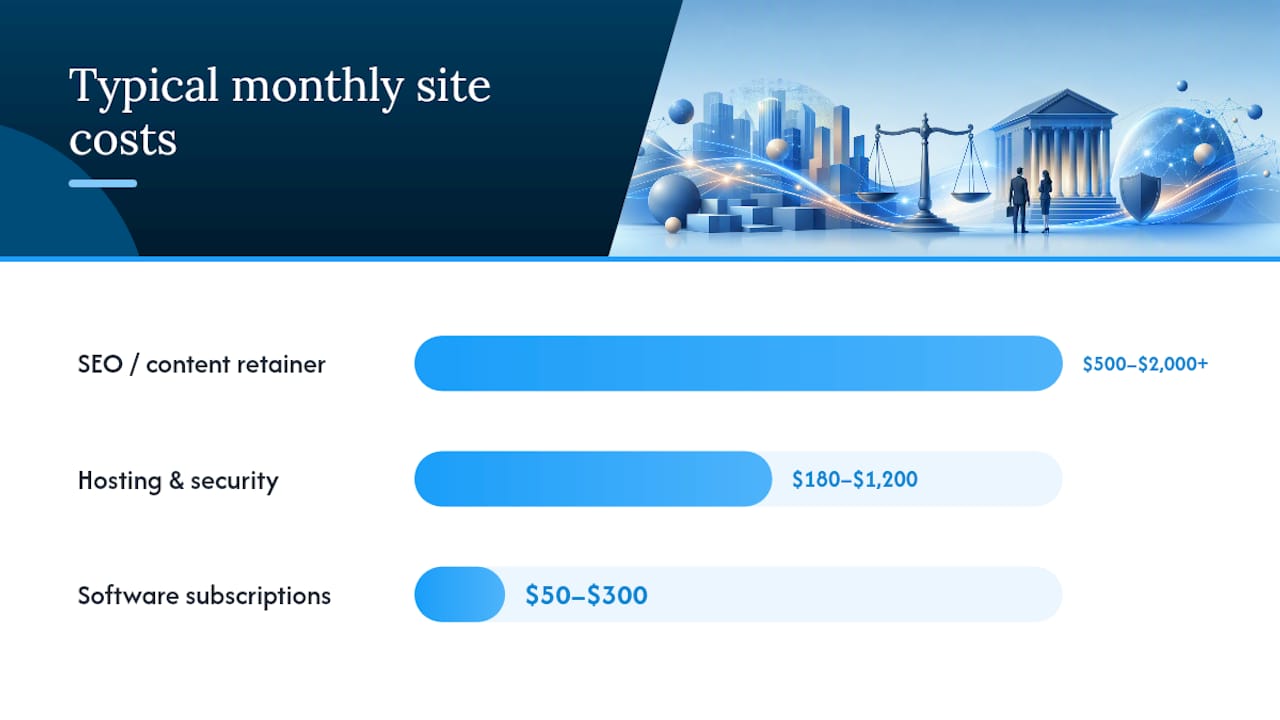
Hosting, security monitoring, and basic maintenance typically run $180 to $1,200 a month depending on firm size, with solo attorneys at the lower end and mid-size firms needing more support at the higher end, per firm-size cost breakdowns from a 2026 industry guide. SEO or content retainers add to monthly expenses, ranging from moderate to higher amounts depending on the level of service. Then layer on software subscriptions: online scheduling, live chat, form tools, and analytics dashboards, which together usually add $50 to $300 a month.
Here's how three common models compare over five years for a small-to-mid-size firm making moderate content updates:
| Cost model | Year 1 total | 5-year total | What drives the gap |
|---|---|---|---|
| Freelancer + hourly changes | $4,000 build + $1,500 changes | $20,000+ | Frequent small edits billed hourly compound fast |
| Managed subscription | $89 to $449/mo, no separate build fee | $5,000 to $20,000 | Predictable, but customization ceiling |
| Agency build + retainer | $15,000 build + $2,000 retainers | $20,000+ | Highest control, highest sustained cost |
That table illustrates a point WorkspaceCMS's cost analysis makes clearly: when you need frequent updates, hourly freelance models often lose to flat-monthly managed platforms on total cost, even though the freelancer's initial quote looked cheaper.
Calculations suggest that depending on case value and site costs, law firms need only a modest number of clients sourced via their website to justify investment. Firms that track how a stronger website affects client acquisition usually find that threshold clears easily within the first year.
- Hosting and security: $180 to $1,200/mo
- SEO/content retainer: $500 to $2,000+/mo
- Software subscriptions: $50 to $300/mo
- Reliable managed hosting reduces the odds of a costly security incident
How Do You Choose the Right Pricing Model?
Vendors price attorney websites four main ways, and each one favors a different kind of buyer.
Flat-fee pricing gives you one number for the whole build. It favors buyers who scoped their project tightly before asking for quotes. Hourly pricing favors the vendor unless you cap total hours in the contract. Per-page pricing works well when your scope is well-defined and you're mostly adding pages to an existing structure. Subscription pricing favors firms that want predictability over customization and plan to make regular content updates.
Before signing anything, ask every vendor these questions:
- What exactly is included in the quoted price, and what counts as a change order?
- Who owns the site files, code, and domain if we part ways?
- How are backups handled, and how often?
- Do you test for WCAG accessibility, and is remediation included?
- What's your typical response time for support requests or urgent fixes?
Pro Tip: Ask for the vendor's change-order pricing in writing before you sign anything. A vague "we'll figure it out" answer here is the single biggest predictor of budget overruns six months into a contract.
Watch for red flags: no written scope document, no accessibility plan at all, vague answers about who owns your content, or no mention of backups. Any one of these can turn a $6,000 build into an $18,000 headache once you factor in what it costs to fix or migrate later. A quick look at what a typical website prototype and review process should look like gives you a benchmark for what a well-run vendor relationship actually feels like.
What Should Solo, Small, Mid-Size, and Multi-Office Firms Expect to Pay?
Your realistic budget depends heavily on firm size, and the ranges below reflect what firms in each category typically pay for both the build and the first year of operating costs.
| Firm profile | Build cost | Monthly ongoing cost | Typical timeline |
|---|---|---|---|
| Solo attorney | $1,500 to $8,000 | $180 to $400 | 3 to 6 weeks |
| Small firm (2 to 5 attorneys) | $6,000 to $20,000 | $300 to $500 | 6 to 10 weeks |
| Mid-size firm (6 to 20 attorneys) | $8,000 to $20,000 | $500 to $1,200 | 10 weeks |
| Multi-office/enterprise | $8,000 to $200,000+ | $1,200+ | 4 to 8 months |
These ranges come from calibrated firm-size cost data across recent agency and platform pricing surveys.
A few notes on what actually stretches these timelines. Content prep, meaning gathering attorney bios, case results, and practice-area copy, is almost always the bottleneck, not the design or development work. Review cycles matter too: a solo attorney can approve a design in a day, but a mid-size firm with multiple partners weighing in on branding can add three or four weeks of back-and-forth. Staging environments, where you preview the site before it goes live, are worth insisting on regardless of firm size. They catch broken forms and accessibility gaps before clients ever see them.
- Solo firms: budget light, but don't skip a professional headshot and bio
- Small firms: this is where managed subscriptions often make the most financial sense
- Mid-size firms: integrations with case management software typically become necessary here
- Multi-office firms: expect a formal RFP process and a longer, more structured timeline
Why a Legal-Focused Website Provider Changes the Math
General web design shops can build you a nice-looking site. What they often miss is the compliance layer that matters specifically to law firms: bar advertising rules, accessibility exposure, and the security expectations clients have when submitting sensitive case details through an intake form.
Epdwebsites has built and hosted sites for attorneys, CPAs, and other professional service providers since 2009, which means the accessibility review, the intake security questions, and the branding expectations of a legal audience aren't new territory on every project.
A specialist provider tends to move faster through compliance review because they've already built the checklist: WCAG testing, secure form handling, and bar-compliant disclaimers baked in from the first draft rather than added after a client complaint.
- Custom design paired with managed hosting and maintenance under one relationship
- Accessibility support built into the process rather than sold as an afterthought
- Ongoing edits handled by a known point of contact instead of a support ticket queue
Choose a specialist when you want a distinct brand identity and expect to make frequent content updates. A managed flat-fee product can still make sense for a very small, low-update solo practice on a tight budget.
Why Most Attorneys Budget for the Wrong Number
The conventional advice on law firm website cost focuses almost entirely on the build price, and that's the number attorneys fixate on when comparing quotes. It's the wrong number to optimize. A $6,000 build with a $150-an-hour change fee can cost more over five years than a $15,000 build with a flat $400 monthly retainer, and most firms never run that math before signing a contract.
What the research actually supports is this: the update frequency you expect, not the initial quote, should drive which pricing model you choose. If you're going to touch your site once a year, hourly freelance work is fine. If you're adding content monthly, a subscription or retainer model almost always wins on total cost.
The other blind spot is accessibility. Firms treat WCAG compliance as optional polish when it's closer to insurance against a legal complaint that costs far more than the $600 to $8,000 remediation would have. Budget for it upfront, not as a fix-it-later line item.
— Kate
Get a Tailored Website Estimate From Epdwebsites
If the ranges above have you thinking less "DIY weekend project" and more "I need this done right," that's exactly the gap Epdwebsites fills. We build custom websites for attorneys, CPAs, and other professional service firms, bundling design, hosting, and ongoing maintenance into one relationship instead of juggling a freelancer, a hosting company, and a security vendor separately.

A typical estimate accounts for your practice areas, attorney headcount, and whether you need integrations with case management software or a secure intake form, and most firms get a clear quote within a few business days. You can review the full breakdown of what's included on our website features and services page, or browse completed projects on our portfolio of professional service websites to see how similar firms have positioned their brand. If you're ready to see what a compliant, professionally built site would cost for your firm specifically, request a quote and we'll walk you through the numbers.
Sources
The figures throughout this guide draw from a handful of current industry sources worth reviewing directly if you want to dig into methodology or see additional pricing examples.
- How Much Are Attorney Websites? A Guide to Budgeting and Value | Clio
- Law Firm Website Cost Guide 2026