
Medical staff pages on healthcare websites are the primary trust signal patients use to evaluate a provider before booking an appointment. The role of medical staff pages on websites goes far beyond listing names and credentials. These pages directly influence whether a visitor converts to a patient or leaves for a competitor. 67% of healthcare organizations growing their patient base prioritize patient journey-focused design using provider profile pages. That number tells you staff pages are not a design afterthought. They are a patient acquisition tool.
What key features make medical staff pages effective?
Effective medical staff profile pages share a consistent set of features that move patients from curiosity to confidence. Each element serves a specific function in reducing the perceived risk of choosing a new provider.
The non-negotiable components include:
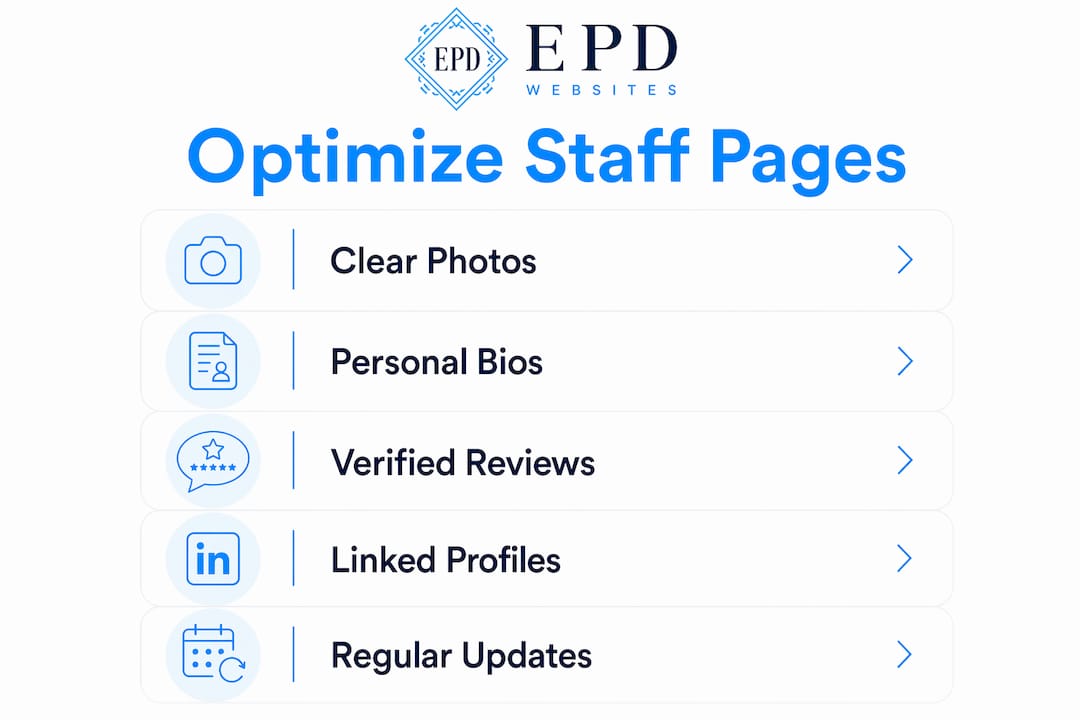
- Professional headshots. A clear, well-lit photo signals approachability. Patients form impressions in seconds, and a quality photo sets the tone before a single word is read. Investing in custom photography for your staff pages pays dividends in first impressions.
- Credential and experience details. Board certifications, medical school, residency, and years in practice answer the first question every patient has: "Is this person qualified?"
- Languages spoken. Bios listing languages spoken gain better patient reach and multicultural engagement. A Spanish-speaking patient who sees "Hablo español" in a bio is far more likely to book.
- Patient reviews linked to the profile. Profiles with 50 or more patient reviews receive ten times more bookings, and profiles with 100 or more reviews yield 27 times more bookings. Reviews are not social proof. They are a booking multiplier.
- Service descriptions and conditions treated. Patients want to know if this provider handles their specific problem before they call.
- Booking integration. A direct "Book an Appointment" button on each profile removes friction at the exact moment a patient is ready to act.
Pro Tip: Write bios in the first person or a warm third person. "Dr. Martinez has treated patients in Phoenix for 15 years" feels more human than a list of credentials formatted like a resume.
The combination of photos, reviews, and clear credentials is what reduces patients' perceived risk before appointments. Each feature reinforces the others.

How do different types of medical staff profile pages compare?
Not every practice needs the same format. The right type of staff page depends on your practice size, patient volume, and how patients typically search for providers.
| Page Type | Best For | Key Features | Limitation |
|---|---|---|---|
| Simple Team Page | Small practices, 1–5 providers | Group photo, short bios, contact info | Limited search and filter options |
| Detailed Provider Profiles | Mid-size practices | Full bio, credentials, reviews, booking link | Requires ongoing content updates |
| Find-a-Provider Tool | Large health systems | Search by specialty, location, insurance | Higher development cost |
| Meet the Team Page | Boutique clinics, concierge practices | Personal stories, photos, patient-friendly tone | Less structured for SEO |
A find-a-provider tool on a website helps patients select providers without leaving the site, which increases bookings. Large health systems with dozens of physicians benefit most from this format because patients can filter by specialty, insurance accepted, and location.
"Meet the Team" pages work best for smaller practices where the personal relationship between patient and provider is the core value proposition. These pages humanize care by showing providers as real people, not just credential holders.
Detailed provider profiles sit in the middle ground. They give each physician enough space to tell their story, list their expertise, and collect reviews. For most medical practices, this format delivers the best return on investment.
Why does medical staff digital presence matter beyond the website?
A well-designed staff page on your website is the foundation. But the digital identity of your providers extends further, and gaps in that identity create credibility problems you may not see until a patient chooses someone else.
Over 100 million LinkedIn members added account verification by late 2025. For physicians, this verification is now a baseline expectation for professional credibility. A provider without a verified LinkedIn profile looks less established than a wellness influencer with 50,000 followers and a blue checkmark.
LinkedIn profiles now function as landing pages, allowing appointment bookings and direct inquiries. That means a patient who finds your physician on LinkedIn can book without ever visiting your website. This is a patient acquisition channel most healthcare administrators are not yet using.
The stakes are higher than bookings alone. Healthcare professionals with trusted social presences contribute to public health literacy and earn both professional and patient trust. The alternative is a credibility vacuum that wellness influencers and misinformation fill.
"Maintaining a professional digital presence is a public health necessity to bridge the credibility gap often exploited by wellness influencers." — Heropost, 2026
Digital competency in translating clinical expertise to accessible content directly improves patient engagement and decreases online communication risks. Providers who explain conditions clearly online attract patients who arrive better informed and more prepared for their appointments.
The practical takeaway for administrators: your staff pages and your providers' LinkedIn profiles should tell the same story. Consistent photos, consistent credentials, and consistent messaging across both platforms reinforce each other and build a coherent digital identity that patients trust.
What steps optimize medical staff pages for patient engagement?
Building the pages is step one. Keeping them accurate, visible, and conversion-ready is the ongoing work that separates high-performing healthcare websites from static ones.
Follow these steps to maintain and improve your staff pages:
- Audit every profile twice a year. Credentials change, providers leave, and new physicians join. An outdated bio with a former hospital affiliation or an old photo erodes trust faster than having no bio at all.
- Actively collect patient reviews. Send a follow-up message after appointments asking patients to leave a review on the provider's profile. The booking impact of 50-plus reviews is documented. Build a system to get there.
- Add multilingual content where your patient population demands it. If 30% of your patients speak Spanish, your provider bios should reflect that. This is not just good marketing. It is a patient access issue.
- Integrate secure messaging and patient portal links. Patients who can message their provider directly from the profile page are more engaged and less likely to switch practices. This also reduces front desk call volume.
- Write for search engines as well as patients. Each provider profile is an individual page that can rank for searches like "cardiologist in Glendale AZ" or "Spanish-speaking pediatrician Phoenix." Use the provider's specialty and location naturally in the bio text.
- Review your healthcare website design practices regularly. Design trends and patient expectations shift. A page that looked current in 2022 may now feel dated and reduce confidence.
Pro Tip: Link each provider's profile to their Google Business Profile if your practice uses one. Consistent NAP (name, address, phone) data across your website and Google improves local search rankings and makes it easier for patients to find the right provider.
The importance of medical staff online is not just about aesthetics. A well-maintained profile page reduces the number of calls asking "Does Dr. Chen speak Mandarin?" or "What insurance does Dr. Patel accept?" Every answer you put on the page is a call your front desk does not have to take.
Key takeaways
Medical staff profile pages are the single most direct tool healthcare organizations have for converting website visitors into booked patients.
| Point | Details |
|---|---|
| Reviews drive bookings | Profiles with 100-plus reviews generate 27 times more bookings than profiles without reviews. |
| Page type should match practice size | Small practices benefit from team pages; large systems need find-a-provider tools with search filters. |
| LinkedIn extends your reach | Verified LinkedIn profiles act as secondary landing pages and capture patients who never visit your website. |
| Multilingual bios expand access | Listing languages spoken in provider bios directly increases reach among non-English-speaking patient populations. |
| Regular audits protect credibility | Outdated credentials or photos on staff pages actively reduce patient trust and should be reviewed twice yearly. |
What i've learned after years of watching staff pages win and lose patients
Most healthcare administrators treat staff pages as a one-time task. Build them at launch, move on, and revisit them when a provider leaves. That approach costs practices more patients than they realize.
The practices I have seen grow consistently are the ones that treat their provider profiles like living documents. They update photos when a physician changes their look. They add new certifications within weeks of completion. They respond to reviews on the profile page. These small actions compound into a digital presence that feels current, credible, and worth trusting.
The detail that surprises most administrators is how much the photo matters. A professional headshot taken in a clinical setting, with good lighting and a clean background, outperforms a cropped conference photo every time. Patients are making a judgment about whether they feel safe with this person. The photo is the first data point they use.
The other shift I recommend is moving away from credential-heavy bios written in the passive voice. "Dr. Johnson completed her fellowship at Mayo Clinic and is board-certified in internal medicine" is accurate. It is also forgettable. A bio that mentions she grew up in the same city as your patients, speaks two languages, and has a particular interest in managing chronic conditions in working adults is the same information told in a way that creates connection.
The practices that get this right do not just see more bookings. They see patients who arrive more prepared, stay longer, and refer more often. That is the real return on a well-built staff page.
— Kate
How Epdwebsites builds staff pages that convert
If your current staff pages are outdated, inconsistent, or missing the features that drive bookings, the design is the problem, not the content.
Epdwebsites has built professional websites for medical practices since 2009, with a focus on the features that matter most to patients: clear provider bios, professional photos, review integration, and booking tools. Every staff page is designed to reflect your practice's credibility and make it easy for patients to choose you. Explore the full range of web design features built specifically for professional service providers, including medical practices. Whether you need a complete site build or a targeted update to your provider profiles, Epdwebsites delivers quality that commands respect and keeps your patient pipeline moving.
FAQ
What is the primary role of medical staff pages?
Medical staff pages establish patient trust by presenting provider credentials, photos, and reviews before a patient books. They are the most direct conversion tool on a healthcare website.
How many reviews should a provider profile have?
Profiles with 50 or more patient reviews receive ten times more bookings than those without. Reaching 100 reviews increases that multiplier to 27 times more bookings.
What types of medical staff profile pages work best?
Small practices benefit from simple team pages or detailed individual bios. Large health systems get the best results from find-a-provider tools that let patients filter by specialty, location, and insurance.
Should providers have LinkedIn profiles in addition to website bios?
Yes. LinkedIn profiles now support direct appointment booking and function as secondary landing pages. Verified LinkedIn profiles also signal credibility that website-only profiles cannot replicate on their own.
How often should medical staff pages be updated?
Audit every provider profile at least twice a year. Update photos, credentials, and service descriptions whenever changes occur. Outdated information actively reduces patient trust and search visibility.