
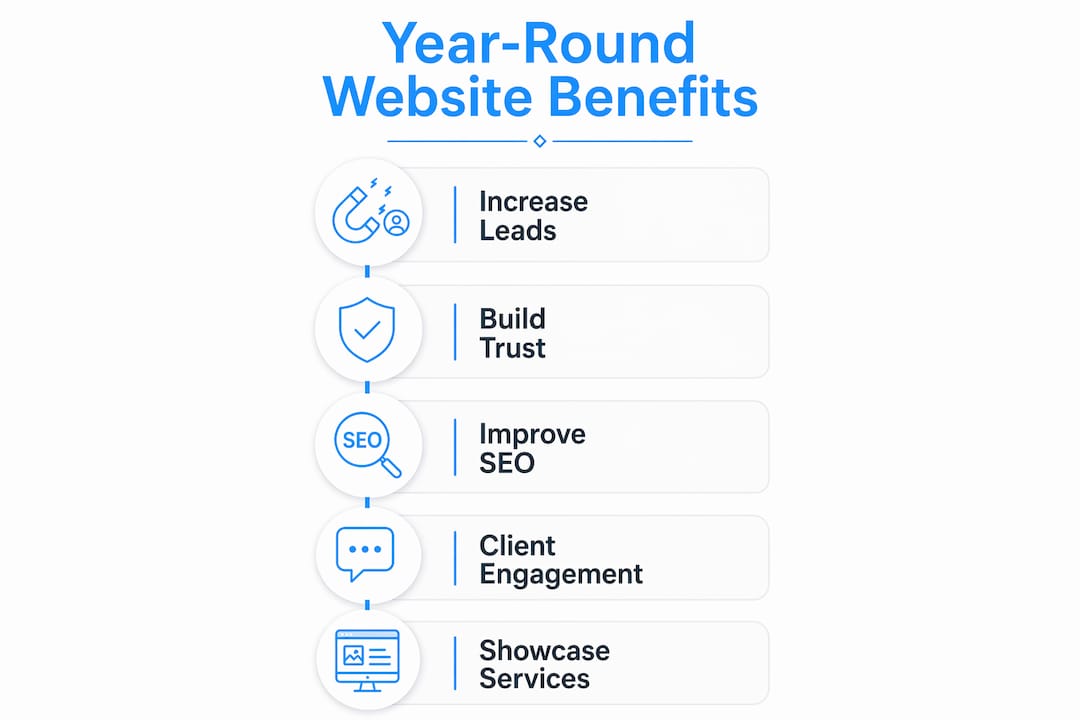
A year-round website is defined as an actively maintained digital presence that generates client inquiries, builds trust, and supports business growth every month of the year, not just during filing season. Tax professionals who understand why tax professionals need year-round websites gain a measurable edge over competitors whose sites go dark after april 15. A well-built site functions as a virtual storefront that differentiates your firm by showcasing expertise, credentials, and the full range of services you offer. CPAs, enrolled agents, and tax advisors who maintain active sites capture advisory, bookkeeping, and business formation leads throughout the year. The result is a practice that grows steadily rather than sprinting for three months and stalling for nine.
Why tax professionals need year-round websites to beat seasonality
Tax professionals face a demand curve unlike almost any other profession. Tax prep searches peak from january through april, then drop sharply by may, while searches for advisory and planning services continue year-round. That gap is not a reason to go quiet. It is the exact window where a maintained website captures clients your competitors are missing.
Seasonal firms make a predictable mistake. They build a site, push it hard before april, then let it sit untouched until the following january. Static websites lose search ranking over time because Google rewards fresh, relevant content. A site that has not been updated in eight months signals to search engines that the business is inactive or unreliable.

The contrast between a seasonal site and a year-round site is stark:
| Factor | Seasonal website | Year-round website |
|---|---|---|
| Search ranking | Drops off-season | Holds and builds continuously |
| Lead generation | January to April only | Every month |
| Client trust | Inconsistent | Reinforced by fresh content |
| Service visibility | Tax prep only | Full service range |
| Competitive position | Reactive | Proactive |
A year-round online presence for accountants means your site keeps working even when you are not actively marketing. Clients searching for quarterly tax planning in july or bookkeeping help in september find you instead of a competitor who stayed active.
- Update service pages at least once per quarter
- Publish blog posts or tax updates monthly during off-season
- Keep contact forms and scheduling tools functional year-round
- Refresh meta descriptions and page titles before each major tax deadline
What website features should tax professionals maintain year-round?
The benefits of websites for tax professionals depend entirely on what those sites contain. A homepage with a phone number and a vague tagline does not convert visitors. Specific, transparent, and current content does.
Service pages that cover your full practice
Your website should list every service you offer, not just tax preparation. Tax planning, advisory, bookkeeping, payroll, business formation, and IRS representation each attract different search queries at different times of year. Year-round content on bookkeeping and advisory generates leads during the off-season that a tax-prep-only site will never see. Each service deserves its own dedicated page with a clear description, who it is for, and how to get started.
Transparency elements that convert visitors
Clear information on pricing, whether you accept new clients, and whether you work remotely directly influences whether a visitor picks up the phone or clicks away. Visitors make that decision in seconds. Displaying your CPA or EA designation, your office location, and your availability removes friction and builds immediate confidence.
Key transparency elements every tax professional site needs:
- Credentials displayed prominently (CPA, EA, PTIN)
- Pricing ranges or starting rates for core services
- Remote and in-person availability stated clearly
- Whether you are currently accepting new clients
- Client testimonials with specific outcomes
Client engagement tools
A secure client portal reduces administrative workload, improves document security, and increases client satisfaction. High portal adoption rates cut down on email chains and phone tag. Pair that with an online scheduling tool and a contact form, and your website handles intake even when your office is closed.
Pro Tip: Schedule a content refresh every october. Content published by october ranks by january, giving you a three-month SEO lead over firms that update in december or later.
How does year-round SEO improve a tax firm's visibility?
Search engine optimization for tax professionals is not a one-time setup. It is a continuous publishing and updating process that builds authority over time. The importance of year-round websites is most visible in search rankings: firms that publish consistently outrank firms that publish seasonally, even when the seasonal firm has a larger budget.
- Start content 3–6 months before peak season. Content published by october ranks by january. Firms that wait until december lose traffic to competitors who planned ahead.
- Build keyword clusters beyond tax prep. Target searches for bookkeeping, business tax advisory, payroll services, and LLC formation. Each cluster attracts a different client segment at a different time of year.
- Publish on a consistent schedule. Google rewards sites that publish regularly. A monthly blog post or tax update signals that your site is active and authoritative.
- Keep your Google Business Profile current. Firms that dominate local search keep their profiles updated with hours, services, and posts aligned to seasonal search patterns.
- Refresh existing pages, not just new ones. Updating a page that already ranks is faster and more effective than building a new page from scratch. Review your top pages quarterly and add current information.
The firms that treat SEO as a year-round discipline build domain authority that compounds. A firm that has published 24 relevant articles over two years will outrank a firm that published six articles in march every single time. That authority does not disappear in the off-season. It keeps generating leads.
Pro Tip: Use Google Search Console to identify which pages drop in ranking between may and august. Those pages need fresh content or updated statistics before the next tax season begins.
Does website transparency actually build client trust?
Transparency on a tax professional's website is not a design preference. It is a conversion factor. Displaying CPA and EA designations alongside client testimonials significantly improves credibility and moves generic searchers toward becoming qualified leads.
Visitors arrive at your site with a specific problem and a high level of anxiety. Tax issues carry financial and legal weight. A site that answers their questions immediately, shows who you are, and explains exactly what you do removes that anxiety faster than any sales copy.
Mobile-friendly, fast-loading websites reduce visitor bounce and improve conversion, particularly on phones during stressful searches. A slow or cluttered site loses potential clients before they read a single sentence. Speed and clarity are not optional features. They are the baseline.
Common website pitfalls that destroy trust:
- Vague slogans like "We make taxes easy" with no specifics
- No mention of credentials or professional designations
- Outdated copyright dates or references to past tax years
- No client reviews or case examples
- Contact forms that do not confirm submission
Learning how to build trust through design is a skill that pays off directly in client conversion. A site that communicates competence and reliability before the first phone call sets the tone for the entire client relationship. For tax professionals, that first impression often determines whether a prospect becomes a long-term client or moves on to the next result in Google.
"A modern tax professional website is a virtual storefront that differentiates firms by showcasing expertise and trustworthiness." — Bloomdev
Knowing how to display credentials professionally online is one of the highest-return investments a tax professional can make in their digital presence. It costs nothing to add, and it converts.
Key Takeaways
A year-round, actively maintained website is the single most effective tool tax professionals have for generating consistent leads, building client trust, and growing beyond the constraints of filing season.
| Point | Details |
|---|---|
| Seasonality is a solvable problem | Active websites capture advisory and bookkeeping leads year-round, not just during tax season. |
| SEO requires a 3–6 month lead time | Content published by october ranks by january, giving early publishers a clear traffic advantage. |
| Transparency drives conversion | Displaying credentials, pricing, and availability directly increases the rate of visitors becoming clients. |
| Mobile speed is non-negotiable | Slow, heavy websites lose potential clients immediately, especially on phones during high-stress searches. |
| Consistent publishing builds authority | Firms that publish monthly outrank seasonal publishers over time, regardless of budget size. |
From seasonal to sustainable: what I've learned about tax firm websites
Tax professionals are among the most underserved clients in the web design world. Most of the sites I see fall into one of two categories: a bare-bones placeholder built years ago, or a polished site that gets updated once a year in january and then ignored. Neither approach works.
The firms that grow consistently treat their website as a business asset, not a business card. They update it. They add content. They check that their contact forms work and that their service pages reflect what they actually offer today, not what they offered in 2021. That discipline is rare, and it shows up directly in their client acquisition numbers.
The off-season is where the real opportunity lives. While competitors go quiet after april, a firm with an active site is capturing planning clients in june, bookkeeping clients in august, and business formation clients in october. Those clients often stay for years. The website did not just fill a slow month. It changed the trajectory of the practice.
The future belongs to tax professionals who think of digital presence as continuous, not cyclical. A professional CPA website is not a project you finish. It is a system you maintain. The firms that understand that distinction will be the ones still growing five years from now.
— Kate
How Epdwebsites helps tax professionals stay visible year-round
Tax professionals need websites that work every month, not just in april. Epdwebsites has built professional websites for CPAs, enrolled agents, and tax advisors since 2009, with a focus on clean design, fast load times, and content structures that support year-round SEO.

Every site Epdwebsites builds includes the features that matter most for tax professionals: clear service pages, credential displays, client testimonial sections, contact forms, and mobile-first design. The team handles hosting, updates, and technical maintenance so you can focus on clients. Browse the web design features built specifically for professional service firms, or view the completed portfolio to see the quality standard firsthand.
FAQ
Why do tax professionals need a website beyond tax season?
Advisory, bookkeeping, and business formation clients search year-round. A maintained website captures those leads during months when competitors are invisible.
How far in advance should tax professionals publish SEO content?
Content published 3–6 months before peak season ranks by january. Publishing by october gives your site the best chance of appearing at the top of search results during filing season.
What credentials should a tax professional display on their website?
CPA and EA designations should appear prominently, along with PTIN registration, client testimonials, and any relevant professional memberships. These elements directly improve visitor-to-client conversion rates.
Does mobile design really affect client conversion for tax firms?
Slow, heavy websites lose potential clients immediately, especially on phones. Mobile-friendly design is a baseline requirement, not a bonus feature, for any tax professional site.
How often should a tax professional update their website?
Service pages should be reviewed quarterly. Blog posts or tax updates should go out at least monthly during the off-season to maintain search rankings and demonstrate active expertise.