
Ongoing website support keeps a law firm site secure, fast, and reliably capturing leads. That means routine CMS and plugin updates, security monitoring, off-site backups, uptime checks, and someone answering the phone when a contact form breaks. Firms that need this most are ones with client intake forms, sensitive data, and a partner list that hates surprises. EPD Websites builds that kind of ongoing support around exactly those requirements.
TL;DR:
- Vendors should provide scheduled updates, security monitoring, off-site backups, and incident response, tested on staging environments before live deployment.
- Response times for emergencies should be within hours, with routine support handled within one business day, and support tickets tracked transparently.
- A regular maintenance cycle should include daily uptime checks, weekly speed tests, monthly backup restores, quarterly content audits, and annual legal and privacy reviews.
- Support providers must understand legal compliance, including advertising rules, privacy laws like CCPA and GDPR, and ADA accessibility standards, with ongoing audits.
- Backup and restore policies are the most critical aspects, providing a safeguard against crises, and should be tested regularly before selecting a support vendor.
Table of Contents
- What Law Firm Website Support Usually Includes
- What Good Support Looks Like In Practice
- Maintenance Schedule: What Should Happen and When
- How to Choose a Law Firm Website Support Provider
- Why Firms Choose EPD Websites for Ongoing Support
- Compliance With Legal Advertising and Privacy Rules
- Accessibility Compliance and ADA Standards
- Client Data Protection on Legal Websites
- Keeping Intake Systems and CRM Tools Running
- Analytics and Reporting for Law Firm Marketing
- The Real Gap in Most Law Firm Support Contracts
- Get Ongoing Support Built for Law Firms
- Sources
What Law Firm Website Support Usually Includes
Ask ten vendors what "support" means and you'll get ten different answers, which is exactly the problem. A real support contract for a law office covers specific, recurring technical work, not a vague promise to "help when needed."
Here's what a serious plan actually contains:
- CMS, plugin, and theme updates applied on a schedule, tested in staging before they touch your live site. Skipping this step is how a routine WordPress update takes down an intake form the night before a filing deadline.
- Security monitoring and malware scanning, including a web application firewall (WAF) and active SSL management. HTTPS is a confirmed ranking and trust signal, and most hosts bundle free SSL through Let's Encrypt, so there's no excuse for a firm site running on unencrypted HTTP in 2026.
- Backups, both incremental (nightly) and full, stored off-site rather than on the same server as the live site. A backup nobody has tried to restore isn't a backup. It's a guess.
- Uptime monitoring and incident response, with someone actually watching for downtime rather than waiting on a client to notice the site is dark.
- Performance work: caching, a content delivery network (CDN), image compression, and attention to Core Web Vitals, the metrics Google uses to judge load speed and stability.
- Forms and intake testing, plus routine content edits for attorney bios, practice-area pages, and blog posts.
Complete support packages built for law firms typically bundle all of the above rather than pricing each piece separately, which matters more than it sounds. A firm that buys "hosting" from one vendor, security from another, and backups from a third ends up with nobody accountable when something breaks at 2 a.m. before a hearing.
What Good Support Looks Like In Practice
Specifications on a sales page mean nothing until you see how a vendor behaves under pressure. Here's a rough breakdown of what solid service levels look like when something actually goes wrong or a partner needs a bio updated by Friday.
- Emergency response: site down, malware detected, or a form silently failing should get acknowledgment within hours, not days. Some vendors advertise 24/7 monitoring with same-day emergency fixes; routine requests get handled within one business day.
- Small content edits: many flat-fee plans include unlimited minor edits (text changes, new headshots, updated hours) rather than billing them hourly, with larger projects drawing from a monthly allotment of maintenance hours.
- Staging before go-live: any update, plugin, theme, or core CMS, gets tested on a staging copy of the site first. If it breaks something, it breaks the staging copy, not the site your referral sources are viewing right now.
- Reporting: a monthly summary showing what was updated, what was patched, and how the site performed, closes the loop so you're not wondering what you're actually paying for.
Pro Tip: Ask any prospective vendor how many support tickets they closed last month and their average resolution time. A vendor who can't answer that question in under thirty seconds probably doesn't track it, which tells you plenty about what happens when your site goes down.
Maintenance Schedule: What Should Happen and When
A maintenance calendar isn't paperwork. It's how a firm knows whether the person or company charging them monthly is actually doing the work.
A structured cadence running daily through annual checks is what reduces incidents and protects a firm's reputation when something does go sideways. Here's how that breaks down:
- Daily: uptime checks, backup verification, a quick pass on contact forms to confirm leads are actually reaching the intake team.
- Weekly: review of plugin and patch status, a speed check against Core Web Vitals benchmarks.
- Monthly: backup restore tests (not just backup creation) and a Core Web Vitals performance report.
- Quarterly: content audits, accessibility spot checks, and a vulnerability scan across the full site.
- Annual: privacy policy and legal disclosure review, a full disaster-recovery drill, and a hard look at the vendor contract itself.
The target numbers worth holding a vendor to: Largest Contentful Paint under 2.5 seconds, Interaction to Next Paint under 200 milliseconds, and Cumulative Layout Shift under 0.1, the three Core Web Vitals thresholds Google uses to judge whether a page feels fast and stable to a real visitor. A site that misses those numbers loses potential clients before they ever read a word of your bio.
How to Choose a Law Firm Website Support Provider
Most law firms don't shop for website support often, which is exactly why vendors get away with vague terms. Evaluate on substance, not a features list.
Look for these criteria before you sign anything:
- Actual law-firm experience, not just general small-business web work. Legal sites carry ethics-rule considerations, client confidentiality concerns, and intake workflows that generic support plans don't anticipate.
- Security expertise you can name specifically, not "we take security seriously." Ask what firewall, what scanning tool, what SSL provider.
- SLA clarity: a written response-time commitment for both emergencies and routine requests, not "we'll get to it quickly."
- Backup policy that specifies frequency, storage location, and how often restores are actually tested.
- Transparent pricing: one flat monthly number, not a base fee plus a la carte charges that show up on the invoice later.
Ask direct questions in the sales call: Who owns the backups if we switch providers? How are updates tested before deployment? What's the actual escalation path for a middle-of-the-night outage? Can you sign an NDA given the confidentiality obligations we carry? Will you work alongside our existing CRM or intake vendor, or does everything have to run through you?
Red flags worth walking away from: vague response-time language, hourly billing with no cap, no staging environment for testing updates, and a vendor who can't produce a single reference from another law firm.
Why Firms Choose EPD Websites for Ongoing Support
Some vendors have built websites for attorneys, CPAs, and other professional service firms since 2009, which suggests the support side of the business is integrated with design services. The portfolio reflects that specialization directly, rather than a general web agency that happens to take legal clients.
What a firm can generally expect from an EPD Websites hosting and maintenance engagement:
- A single point of contact for updates, edits, and technical issues, instead of juggling a hosting company, a developer, and a security vendor separately.
- Ongoing resources on accessibility and legal-site best practices published through the EPD Websites blog, covering the kind of detail most firms only think about after a complaint.
- Support built around the reality that a law firm's site is a client-facing intake channel first, and a brochure second.
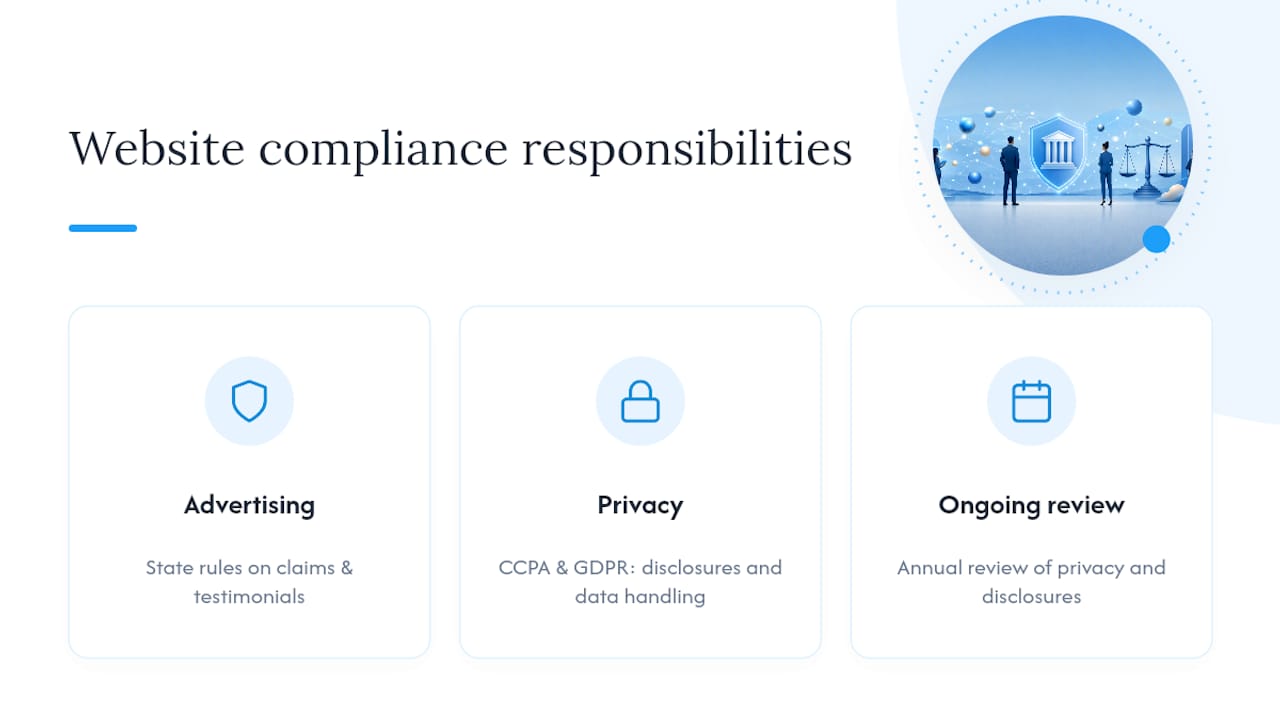
Compliance With Legal Advertising and Privacy Rules
A law firm website isn't just a marketing asset. It's regulated speech in most states, and the support team maintaining it needs to understand that.
State bar advertising rules govern how attorneys describe results, use testimonials, and claim specializations online, and those rules vary by jurisdiction. A support provider who edits your homepage copy without knowing your state's advertising rules can create liability nobody catches until a bar complaint lands. That's a reason to keep content edits routed through people familiar with legal marketing, not a generic freelancer working from a template.
Privacy compliance adds another layer. If your firm collects visitor data through analytics, cookies, or intake forms, the California Consumer Privacy Act (CCPA) and, for firms with any EU-connected clients, the General Data Protection Regulation (GDPR) both impose disclosure and data-handling obligations. That typically means a clear, current privacy policy, a cookie consent mechanism where required, and a documented process for what happens to submitted client data.
None of this is a one-time setup. Advertising rules get updated, privacy law keeps expanding at the state level, and a site that was compliant two years ago may not be today. Ongoing support should include periodic review of the privacy policy and any client-facing disclosures, flagged as part of the annual maintenance cycle rather than left until something forces the issue.
Accessibility Compliance and ADA Standards
Roughly a quarter of American adults live with a disability, and a law firm's website is often the first point of contact for exactly those potential clients. An inaccessible site doesn't just risk legal exposure. It turns away people who need representation.
The Americans with Disabilities Act (ADA) doesn't spell out a specific technical standard for websites, but courts and settlements have consistently pointed to the Web Content Accessibility Guidelines (WCAG) as the practical benchmark. That means alt text on images, sufficient color contrast, keyboard navigability for people who can't use a mouse, and properly labeled form fields so screen readers can walk a visually impaired user through an intake form.

Law firms face outsized exposure here because ADA website lawsuits target public-facing businesses broadly, and a firm getting sued over its own site's accessibility is an uncomfortable irony that shows up in local news. Ongoing support should include periodic accessibility audits, not a one-time fix at launch, since content edits and plugin updates can quietly break accessibility features that worked fine on day one. EPD Websites addresses this directly through its accessibility services, building compliance checks into the maintenance cycle rather than treating it as a separate project.
Client Data Protection on Legal Websites
A law firm's website often handles more sensitive information than the average business site: case details typed into a contact form, uploaded documents, retainer inquiries that reference ongoing disputes. That data needs handling that respects both technical security and the duty of confidentiality attorneys already owe their clients.
On the technical side, that means encrypted form submissions, restricted access to who on the support team can view stored data, and a clear data retention policy so old intake submissions don't sit indefinitely on a server nobody's monitoring. Malware scanning and a web application firewall matter here specifically because a breached law firm site doesn't just leak a name and email. It can expose details tied to active legal matters.
Confidentiality also means being deliberate about which third-party tools touch your site. A chat widget, a form plugin, or an analytics tool that routes data through an external server is a vendor relationship your support provider should vet, not add without asking. Firms handling especially sensitive practice areas, family law, criminal defense, immigration, should ask their support vendor directly what data-handling agreements are in place and whether an NDA covering site access is available.
Keeping Intake Systems and CRM Tools Running
The contact form on a law firm's homepage is often the least glamorous part of the site and the most important for revenue. If it silently stops sending submissions, and it happens more often than firms realize after a plugin update, leads vanish without anyone noticing until a partner asks why the phone's been quiet.
Most firms now connect their website forms to a customer relationship management (CRM) tool or legal intake platform, which routes new inquiries to an intake coordinator or directly into a case management system. That integration is a piece of infrastructure that needs the same maintenance attention as the site itself. An API connection can break silently when either the CRM or the website platform pushes an update, and nobody finds out until the lead count drops.
Ongoing support should include regular testing of every form-to-CRM connection, not just a visual check that the form loads. That means submitting a test lead periodically and confirming it lands where it's supposed to, checking that automated confirmation emails still fire, and verifying that any lead-scoring or routing rules still function after platform updates on either end. This is exactly the kind of quiet, unglamorous maintenance task that gets skipped when support is treated as a checklist instead of a habit.
Analytics and Reporting for Law Firm Marketing
A support plan that doesn't include reporting is a support plan you're taking on faith. Firms investing in a website and its ongoing maintenance need to see what's actually happening: traffic sources, which practice-area pages convert, and where visitors drop off before submitting an intake form.
Useful reporting for a law firm goes beyond a raw traffic number. It should show which pages are driving actual consultation requests, how mobile visitors behave compared to desktop, and whether local search traffic (someone searching "divorce attorney" plus a city name) is finding the right landing page. Technical SEO and site maintenance work together here. Fixing a slow-loading page or a broken sitemap directly amplifies whatever a firm is already spending on local SEO and content, rather than working against it.
A monthly report tying Core Web Vitals performance to conversion data gives decision-makers something concrete to act on, rather than a vanity metric like total page views. Sitemap health and crawlability, covered in more depth in EPD's guide on website sitemaps for law firms, directly affects whether new content even gets indexed and found. Ask any support vendor what's included in their standard report before signing, because "we'll send you something monthly" isn't a reporting commitment.
The Real Gap in Most Law Firm Support Contracts
Most law firms don't get burned by bad web design. They get burned by good design with no maintenance plan behind it, and the gap between those two things is where this whole conversation should start.
The conventional advice treats website support as an insurance policy, something you buy so nothing bad happens. That framing undersells it. A properly maintained site with fast Core Web Vitals scores and clean technical SEO doesn't just avoid disaster. It actively converts more of the traffic a firm is already paying to attract, which makes support a revenue function, not a cost center.
If I had to pick one priority for a firm evaluating vendors right now, it wouldn't be price. It would be the backup and restore policy. Everything else, security, speed, uptime, is preventive. Backups are the only thing standing between a bad afternoon and a genuine crisis. Ask to see a restore test, not just a backup schedule, before you ask about monthly cost.
— Kate
Get Ongoing Support Built for Law Firms
Most support contracts force a choice between cheap and reachable. Some vendors offer flat monthly hosting and maintenance plans built for professional service firms, providing security monitoring, backups, and direct support without surprise hourly invoices.

Some vendors focus on attorneys, CPAs, and other professional practices and understand why a broken intake form on a Friday afternoon is a bigger deal for a law office than for a retail site. Plans often cover fundamentals such as staged testing before updates go live, monitored backups, and timely handling of edits without long ticket queues. If you want to see what's included and request a proposal for your firm's site, explore the hosting and support features EPD Websites offers, or check current pricing details to see how a flat monthly plan compares to what you're paying now.
Sources
- Law Firm Website Support & WordPress Maintenance
- Law Firm Website Optimization | Inoriseo
- The role of ongoing website maintenance in protecting your law firm's online reputation