
A website legal disclaimer is a concise statement that limits your liability, sets user expectations, and legally protects your business from claims of misrepresentation or negligence. Every professional website, from law firms to medical practices to financial consultants, needs one. This legal disclaimer website setup guide walks you through the exact components, jurisdictional requirements, placement strategies, and drafting steps you need to build a disclaimer that actually holds up. The Federal Trade Commission (FTC), state bar rules, and regulations like GDPR and CCPA all shape what your disclaimer must say.
What are the essential components of an effective website disclaimer?
A website disclaimer is not a single document. It is a set of coordinated statements that address specific risks your site creates. Most businesses are not legally required to have a disclaimer, except affiliate marketers and professionals providing medical, legal, or financial advice. That exception covers most professional service providers reading this.
Every effective disclaimer includes six core elements:
- Business identity and site scope. Name your company, describe what the site covers, and state what it does not cover. Vague scope statements are the first thing courts scrutinize.
- Purpose statement. Clarify whether your content is informational, educational, or commercial. A CPA's site that publishes tax tips needs to state clearly that those tips are not personalized tax advice.
- Limitation of liability clause. State that your business is not responsible for losses arising from reliance on site content. Keep this clause direct and specific to your industry.
- Accuracy warranty. Acknowledge that information may change and that you do not guarantee its completeness or currency. This is especially critical for medical and financial sites.
- Third-party link disclosures. If you link to external sites, state that you do not control or endorse their content. Courts have found site owners partially liable for damages caused by linked third-party content.
- Affiliate and compensation disclosures. FTC rules require you to disclose any material connection to products or services you recommend. This applies to referral fees, sponsored content, and product partnerships.
Disclaimers written in plain English are more enforceable than those filled with legal jargon. A disclaimer no one can read is a disclaimer no court will enforce.
Pro Tip: Draft your disclaimer in the same reading level as your site's main content. If your homepage speaks to a general audience, your disclaimer should too.

YMYL sites, meaning "Your Money or Your Life" sites covering legal, medical, or financial topics, need sector-specific modules. A law firm's disclaimer must explicitly deny an attorney-client relationship. A medical practice's disclaimer must state that site content does not replace professional diagnosis or treatment. These are not optional additions. They are required by state bar rules and medical licensing boards.
How do you tailor disclaimers for jurisdictional and regulatory compliance?
Jurisdiction is where most professional websites get their disclaimers wrong. A disclaimer valid in California may not satisfy New York's bar rules or the EU's GDPR requirements. Experts recommend a 3–5 jurisdiction strategy that covers the US at the federal level, the EU and UK, and key US states where your clients are located.
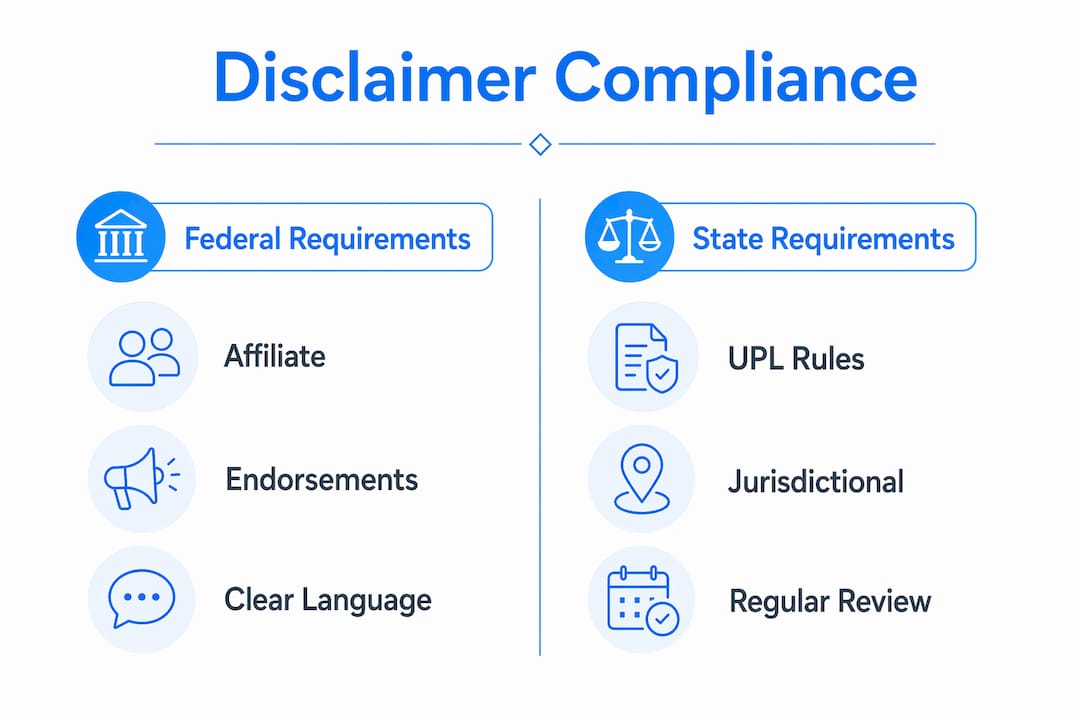
The table below shows the primary compliance layer each jurisdiction adds:
| Jurisdiction | Key Requirement |
|---|---|
| Federal (US/FTC) | Affiliate and endorsement disclosures; clear and conspicuous placement |
| California (CCPA) | Privacy rights notice; opt-out language for data sale |
| New York / Florida / Texas | UPL (Unauthorized Practice of Law) language for legal sites |
| EU / UK (GDPR) | Data processing disclosure; cookie consent integration |
Legal and financial YMYL sites must include state-specific Unauthorized Practice of Law (UPL) language for states like California, New York, Florida, and Texas. Each state bar has its own required phrasing. Using a generic UPL statement across all four states creates a compliance gap that a plaintiff's attorney will find quickly.
Pro Tip: Use a legal-tech platform or attorney-reviewed template library to generate jurisdiction-specific language. Manual drafting across five jurisdictions takes hours and introduces errors.
Affiliate and professional services disclosures also carry FTC obligations. If you earn a referral fee for recommending a product, that connection must appear near the recommendation, not buried in a footer disclaimer. The FTC's "clear and conspicuous" standard means the disclosure must be visible before the reader acts on the recommendation. GDPR and CCPA add data-processing layers that interact with your disclaimer language, so your privacy policy, terms of service, and disclaimer must use consistent definitions and terminology.
Where should you place disclaimers on your website?
Placement determines whether your disclaimer is legally effective. A disclaimer buried in a footer link does not meet the FTC's "clear and conspicuous" standard for high-risk content. Disclaimers must appear near relevant content for high-risk topics, not only in a footer. That distinction matters enormously in court.
The most effective placement strategy uses three layers:
- Dedicated disclaimer page. Create a full disclaimer page and link it in your site footer. This page holds your complete legal notice for websites, including all jurisdiction-specific modules and affiliate disclosures.
- In-content disclosures. Place short-form disclaimers directly adjacent to the content they govern. An affiliate link needs a disclosure in the same paragraph, not three scrolls away. A medical article needs a disclaimer at the top of the page, not only at the bottom.
- Pre-content banners. For high-risk topics, use a banner or modal that appears before the reader accesses the content. Legal sites discussing specific case outcomes and financial sites projecting returns are the clearest examples.
Footer-only placement is insufficient for any site that publishes advice, endorsements, or regulated content. Courts have consistently found that users cannot be expected to scroll to a footer before reading content that influences their decisions.
Website accessibility compliance also affects disclaimer placement. Disclaimers must be readable by screen readers, display correctly on mobile devices, and meet WCAG contrast standards. A disclaimer that fails accessibility requirements may be deemed non-conspicuous in a legal dispute.
Pro Tip: Test your disclaimer placement on a mobile device. If a user must scroll past three screens of content before seeing a disclosure, a court may rule it was not conspicuous.
Step-by-step process to draft, publish, and maintain your disclaimer
A clear workflow prevents the most common mistake: publishing a disclaimer once and never updating it. Quarterly reviews are necessary to keep disclaimers aligned with FTC, SEC, and state regulatory changes. Here is the process that works for professional service websites:
- Audit your site's content and risk types. List every content category on your site: blog posts, service pages, testimonials, affiliate links, and downloadable resources. Each category carries a different liability risk and needs a corresponding disclaimer type.
- Select your disclaimer types and jurisdictions. Based on your audit, identify which disclaimers apply: general liability, affiliate disclosure, professional advice, third-party links, and earnings disclaimers. Map each to the jurisdictions where your clients are located.
- Draft or generate your disclaimer language. Use attorney-reviewed templates or a legal-tech platform to produce jurisdiction-specific language. For legal content writing, plain English drafting is not optional. It is the standard that courts apply.
- Publish your master disclaimer page and implement in-content disclosures. Link the master page in your footer. Add short-form disclosures to every page or section that carries specific risk.
- Assign an owner and set a review calendar. One person in your organization must own disclaimer compliance. Set quarterly calendar reminders to review regulatory updates from the FTC, your state bar, and any industry body that governs your practice.
- Maintain version records. Save each version of your disclaimer with a date stamp. If a dispute arises over what your site said at a specific time, version records are your evidence.
Integrated legal documentation across your disclaimer, terms of service, and privacy policy reduces conflicts and improves user trust. Inconsistent language between these documents creates ambiguity that works against you in a dispute.
Key Takeaways
A website disclaimer protects your business only when it is specific, correctly placed, and kept current with FTC, GDPR, and state regulatory requirements.
| Point | Details |
|---|---|
| Core components matter | Include business identity, liability limits, accuracy warranty, and affiliate disclosures in every disclaimer. |
| Jurisdiction strategy | Cover federal US, EU/UK, and 3–5 key US states to address all relevant legal requirements. |
| Placement is legal evidence | Place disclaimers near relevant content, not only in footers, to meet FTC "clear and conspicuous" standards. |
| Plain English wins | Disclaimers written in clear, simple language are more enforceable than those filled with legal jargon. |
| Quarterly reviews required | Assign an owner and review your disclaimer every quarter to stay current with regulatory changes. |
Why most website disclaimers fail before they are ever tested
I have reviewed dozens of professional service websites over the years, and the pattern is consistent. The disclaimer is a block of copied legalese dropped into a footer page, never touched again after launch. It contradicts the service promises on the homepage. It uses terms the privacy policy defines differently. And it covers jurisdictions the business has never served.
Boilerplate disclaimers that contradict actual service promises can be invalidated in court. That is not a theoretical risk. It is the most common way a disclaimer fails when it is actually needed. A disclaimer that says "we provide no professional advice" on a site where the homepage says "get expert legal guidance from our team" is not a disclaimer. It is a contradiction.
The fix is not complicated, but it requires honesty about what your site actually does. If your site generates leads by positioning you as an expert, your disclaimer needs to acknowledge that expertise while drawing a clear line between general information and a formal professional engagement. That line is what protects you.
Plain language also matters more than most professionals realize. A disclaimer written for a judge is not written for your client. Your client reads it first. If they cannot understand it, they cannot be held to have received adequate notice. Writing disclaimers in plain English is not dumbing it down. It is making it legally effective.
The professionals who get this right treat their disclaimer as a living document, not a one-time checkbox. They review it when they add a new service, when a regulation changes, and when their contracts are updated. That discipline is what separates a disclaimer that protects from one that only looks like it does.
— Kate
Professional web design that supports your legal compliance
Building a compliant professional website means more than choosing the right colors and fonts. Legal notices, accessibility standards, and disclaimer placement all depend on how your site is structured and maintained.

Epdwebsites has built professional websites for attorneys, CPAs, real estate agents, and medical practices since 2009. Every site includes the structural foundation that makes proper disclaimer placement possible, from dedicated legal pages to mobile-compliant layouts that meet WCAG standards. If you are ready to build or update a site that reflects your professional standards and supports your legal obligations, explore the professional website features Epdwebsites offers for service providers. You can also review website accessibility services to confirm your site meets the visibility standards that make disclaimers legally effective.
FAQ
What is a website legal disclaimer?
A website legal disclaimer is a statement that limits your liability, sets user expectations, and discloses material information such as affiliate relationships or the non-professional nature of site content. It is a core part of any professional site's legal framework.
Is a disclaimer legally required for my website?
Most businesses are not legally required to have a disclaimer, but affiliate marketers and professionals providing medical, legal, or financial advice face specific legal obligations that make one necessary.
Where should I place my website disclaimer?
Place a full disclaimer on a dedicated page linked in your footer, and add short-form disclosures near any high-risk content such as affiliate links, medical information, or legal guidance. Footer-only placement does not meet FTC "clear and conspicuous" standards for high-risk content.
How often should I update my website disclaimer?
Quarterly reviews are the standard for keeping disclaimers current with FTC, SEC, and state regulatory changes. Update immediately whenever you add a new service, change your affiliate relationships, or when a governing regulation is amended.
What makes a disclaimer unenforceable?
A disclaimer becomes unenforceable when it contradicts your actual service promises, uses vague or inconsistent language, or fails to appear conspicuously near the content it governs. Aligning your disclaimer with your contracts and service agreements is the most direct way to protect its enforceability.